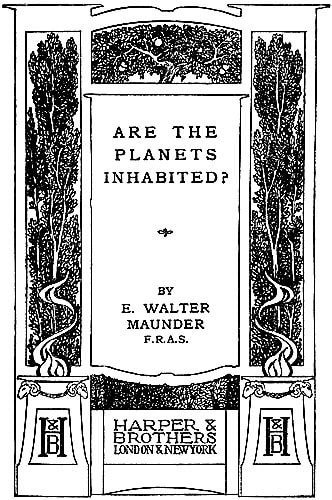
Are the Planets Inhabited?
1913
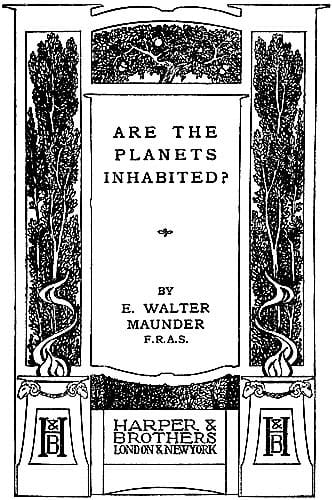
Published in 1913, this fascinating work captures a pivotal moment in humanity's contemplation of cosmic neighbors. E. Walter Maunder, a respected astronomer best known for his study of the sun's sparse activity period, turns his rigorous scientific mind to one of humanity's oldest questions: are we alone in the universe? Maunder systematically examines the physical conditions on Mars, Venus, and other solar system bodies, asking what would actually be required for worlds to support intelligent life. He argues that a planet can only truly be considered "inhabited" if it hosts conscious, intelligent beings, not merely vegetation or microorganisms. The book stands as a remarkable time capsule, revealing both the sophisticated reasoning of early 20th-century astronomy and the limits imposed by pre-telescopic technology. Reading it now, after a century of space exploration, offers the peculiar pleasure of watching a careful scientist reason through questions we now have answers to. For anyone interested in the history of science, the evolution of astronomical thought, or the human need to find company in the cosmos.
Editions
Link to this book
Add a free, dofollow link to Lex on your blog, forum, syllabus, or reading list.

<a href="https://lex-books.com/book/are-the-planets-inhabited-2fbb2c1f-5c5b-4be5-a216-a10c3c40b22e"><img src="https://lex-books.com/badges/read-on-lex.svg" alt="Read Are the Planets Inhabited? by E. Walter Maunder free on Lex" width="160" height="40"></a>[](https://lex-books.com/book/are-the-planets-inhabited-2fbb2c1f-5c5b-4be5-a216-a10c3c40b22e)[url=https://lex-books.com/book/are-the-planets-inhabited-2fbb2c1f-5c5b-4be5-a216-a10c3c40b22e][img]https://lex-books.com/badges/read-on-lex.svg[/img][/url]Read Are the Planets Inhabited? by E. Walter Maunder free on Lex: https://lex-books.com/book/are-the-planets-inhabited-2fbb2c1f-5c5b-4be5-a216-a10c3c40b22eCite this book
Reading this edition for a paper or guide? Copy a citation.
Maunder, E. Walter. Are the Planets Inhabited?. Lex, lex-books.com/book/are-the-planets-inhabited-2fbb2c1f-5c5b-4be5-a216-a10c3c40b22e.Maunder, E. W. (1913). Are the Planets Inhabited?. Lex. https://lex-books.com/book/are-the-planets-inhabited-2fbb2c1f-5c5b-4be5-a216-a10c3c40b22eMaunder, E. Walter. Are the Planets Inhabited?. Lex. https://lex-books.com/book/are-the-planets-inhabited-2fbb2c1f-5c5b-4be5-a216-a10c3c40b22e.