Alraune
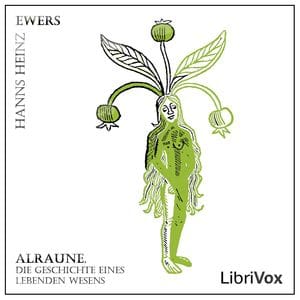
The forbidden fruit of German Expressionism. Hanns Heinz Ewers posed a question that still unsettles: what happens when science creates life without the act of love? The answer is Alraune, a woman grown from a mandrake root and the blood of a hanged man in a professor's private laboratory. She is beautiful, magnetic, and utterly dangerous. Every man who encounters her finds himself drawn into her orbit, only to discover that her proximity brings ruin, madness, and death. The creature becomes a mirror for the darkest impulses of those around her, revealing what lies beneath the surface of respectability. The novel pulses with scientific hubris, forbidden desire, and mounting dread. Ewers wrote this in 1911, but it reads like a precursor to every body horror and sci-fi cautionary tale that followed. It is decadent, dark, and deliberately transgressive: a story about the price of playing God and the monsters we create when we refuse to let nature take its course.
Editions

Link to this book
Add a free, dofollow link to Lex on your blog, forum, syllabus, or reading list.

<a href="https://lex-books.com/book/alraune-0f9cbc6e-fdd0-47e4-bd5b-b9abdb7f3ae7"><img src="https://lex-books.com/badges/read-on-lex.svg" alt="Read Alraune by Hanns Heinz Ewers free on Lex" width="160" height="40"></a>[](https://lex-books.com/book/alraune-0f9cbc6e-fdd0-47e4-bd5b-b9abdb7f3ae7)[url=https://lex-books.com/book/alraune-0f9cbc6e-fdd0-47e4-bd5b-b9abdb7f3ae7][img]https://lex-books.com/badges/read-on-lex.svg[/img][/url]Read Alraune by Hanns Heinz Ewers free on Lex: https://lex-books.com/book/alraune-0f9cbc6e-fdd0-47e4-bd5b-b9abdb7f3ae7Cite this book
Reading this edition for a paper or guide? Copy a citation.
Ewers, Hanns Heinz. Alraune. Lex, lex-books.com/book/alraune-0f9cbc6e-fdd0-47e4-bd5b-b9abdb7f3ae7.Ewers, H. H. (n.d.). Alraune. Lex. https://lex-books.com/book/alraune-0f9cbc6e-fdd0-47e4-bd5b-b9abdb7f3ae7Ewers, Hanns Heinz. Alraune. Lex. https://lex-books.com/book/alraune-0f9cbc6e-fdd0-47e4-bd5b-b9abdb7f3ae7.