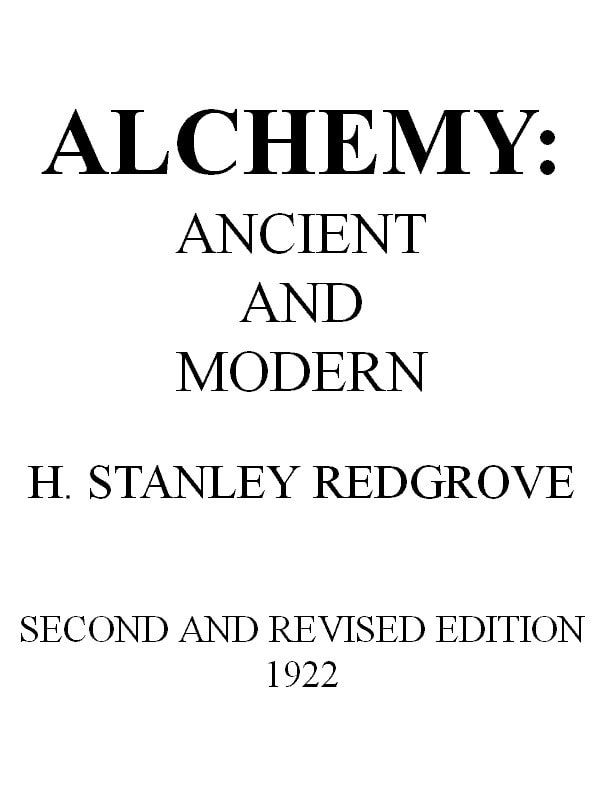
Alchemy: Ancient and Modern: Being a Brief Account of the Alchemistic Doctrines, and Their Relations, to Mysticism on the One Hand, and to Recent Discoveries in Physical Science on the Other Hand; Together with Some Particulars Regarding the Lives and Teachings of the Most Noted Alchemists
1922
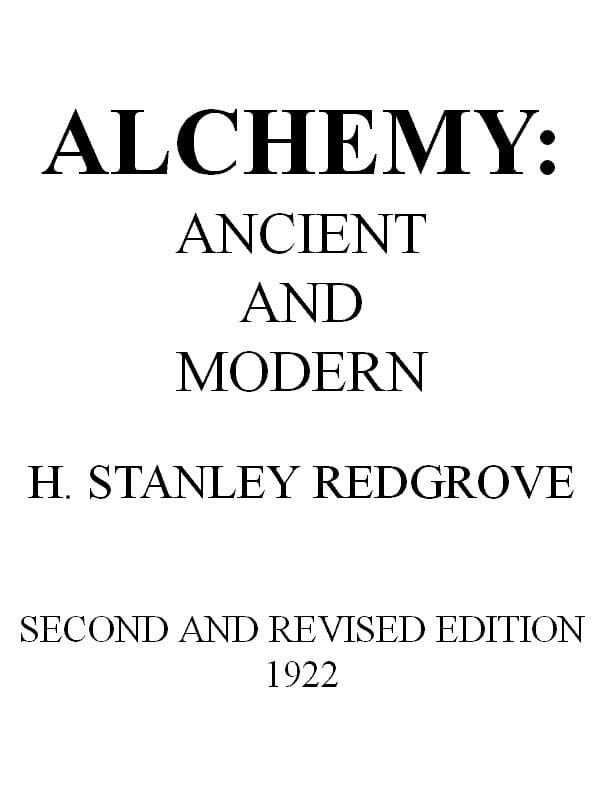
Alchemy: Ancient and Modern: Being a Brief Account of the Alchemistic Doctrines, and Their Relations, to Mysticism on the One Hand, and to Recent Discoveries in Physical Science on the Other Hand; Together with Some Particulars Regarding the Lives and Teachings of the Most Noted Alchemists
1922
Before chemistry existed, there was alchemy: a discipline that combined laboratory experimentation with metaphysical speculation about the nature of reality itself. H. Stanley Redgrove's 1922 study undertakes the ambitious task of reclaiming alchemy from the dustbin of superstition, demonstrating how these medieval and Renaissance practitioners laid the groundwork for modern science while pursuing goals that sound almost mythological: the transmutation of base metals into gold, the creation of the Philosopher's Stone, the elixir of life. Yet Redgrove reveals alchemy as far stranger and more sophisticated than popular imagination allows. It was simultaneously a physical practice and a spiritual philosophy, an attempt to understand cosmic unity through both retort and ritual. The book traces this dual heritage through the lives of celebrated alchemists like Paracelsus, Roger Bacon, and Hermes Trismegistus, showing how their mystical doctrines interwove with empirical observation in ways that would eventually birth chemistry as a separate discipline. Redgrove illuminates how the alchemists' obsession with transformation, both material and spiritual, anticipated discoveries in atomic theory and the transmutation of elements that his own era was beginning to witness. This is a book for anyone curious about how we got from alchemy to science, and whether something vital was lost in that journey.
Editions
X-Ray
“every substance contains undeveloped resources and potentialities, and can be brought outward and forward into perfection.””
— H. Stanley Redgrove
“A jet of water moving with a sufficient velocity behaves like a rigid and impenetrable solid, whilst a revolving disc of paper exhibits elasticity and can act as a circular saw.[97] It appears, therefore, that the ancient doctrine of the alchemistic essence is fundamentally true after all, that out of the “One Thing” all material things have been produced by adaptation or modification; and, as we have already noticed (§ 60), there also appears to be some resemblance between the concept of the electron and that of the seed of gold, which seed, it should be borne in mind, was regarded by the alchemists as the common seed of all metals.””
— H. Stanley Redgrove
“By a skilful method, based on the fact discovered by Mr. C. T. R. Wilson, that charged particles can serve as nuclei for the condensation of water-vapour, he was further able to determine the value of the electrical charge carried by these particles, which was found to be constant also, and equal to the charge carried by univalent ions, e.g., hydrogen, in electrolysis. Hence, it follows that the mass of these kathode particles must be much smaller than the hydrogen ion, the actual ratio being about 1 : 1700. The first theory put forward by Sir J. J. Thomson in explanation of these facts, was that these kathode particles (“corpuscles” as he termed them) were electrically charged portions of matter, much smaller than the smallest atom; and since the same sort of corpuscle is obtained whatever gas is contained in the vacuum tube, it is reasonable to conclude that the corpuscle is the common unit of all matter.””
— H. Stanley Redgrove
“Robert Boyle (1626-1691) had defined an element as a substance which could not be decomposed, but which could enter into combination with other elements giving compounds capable of decomposition into these original elements.””
— H. Stanley Redgrove
“Paracelsus, in his work on The Tincture of the Philosophers, tells us that all that is necessary for us to do is to mix and coagulate the “rose-coloured blood from the Lion” and “the gluten from the Eagle,” by which he probably meant that we must combine “philosophical sulphur” with “philosophical mercury.” This opinion, that the Philosopher’s Stone consists of “philosophical sulphur and mercury” combined so as to constitute a perfect unity, was commonly held by the alchemists, and they frequently likened this union to the conjunction of the sexes in marriage.””
— H. Stanley Redgrove
“Coming to the alchemists, we find the view that the metals are all composed of two elementary principles”
— H. Stanley Redgrove
“We have said that “Alchemy was the attempt to demonstrate experimentally on the material plane the validity of a certain philosophical view of the Cosmos”; now, this “philosophical view of the Cosmos” was Mysticism. Alchemy had its origin in the attempt to apply, in a certain manner, the principles of Mysticism to the things of the physical plane, and was, therefore, of a dual nature, on the one hand spiritual and religious, on the other, physical and material.””
— H. Stanley Redgrove
Link to this book
Add a free, dofollow link to Lex on your blog, forum, syllabus, or reading list.

<a href="https://lex-books.com/book/alchemy-ancient-and-modern-being-a-brief-account-of-the-alchemistic-doctrines-an-ffabecec-1e92-46d3-805d-6214ef597ce7"><img src="https://lex-books.com/badges/read-on-lex.svg" alt="Read Alchemy: Ancient and Modern: Being a Brief Account of the Alchemistic Doctrines, and Their Relations, to Mysticism on the One Hand, and to Recent Discoveries in Physical Science on the Other Hand; Together with Some Particulars Regarding the Lives and Teachings of the Most Noted Alchemists by H. Stanley Redgrove free on Lex" width="160" height="40"></a>[](https://lex-books.com/book/alchemy-ancient-and-modern-being-a-brief-account-of-the-alchemistic-doctrines-an-ffabecec-1e92-46d3-805d-6214ef597ce7)[url=https://lex-books.com/book/alchemy-ancient-and-modern-being-a-brief-account-of-the-alchemistic-doctrines-an-ffabecec-1e92-46d3-805d-6214ef597ce7][img]https://lex-books.com/badges/read-on-lex.svg[/img][/url]Read Alchemy: Ancient and Modern: Being a Brief Account of the Alchemistic Doctrines, and Their Relations, to Mysticism on the One Hand, and to Recent Discoveries in Physical Science on the Other Hand; Together with Some Particulars Regarding the Lives and Teachings of the Most Noted Alchemists by H. Stanley Redgrove free on Lex: https://lex-books.com/book/alchemy-ancient-and-modern-being-a-brief-account-of-the-alchemistic-doctrines-an-ffabecec-1e92-46d3-805d-6214ef597ce7Cite this book
Reading this edition for a paper or guide? Copy a citation.
Redgrove, H. Stanley. Alchemy: Ancient and Modern: Being a Brief Account of the Alchemistic Doctrines, and Their Relations, to Mysticism on the One Hand, and to Recent Discoveries in Physical Science on the Other Hand; Together with Some Particulars Regarding the Lives and Teachings of the Most Noted Alchemists. Lex, lex-books.com/book/alchemy-ancient-and-modern-being-a-brief-account-of-the-alchemistic-doctrines-an-ffabecec-1e92-46d3-805d-6214ef597ce7.Redgrove, H. S. (1922). Alchemy: Ancient and Modern: Being a Brief Account of the Alchemistic Doctrines, and Their Relations, to Mysticism on the One Hand, and to Recent Discoveries in Physical Science on the Other Hand; Together with Some Particulars Regarding the Lives and Teachings of the Most Noted Alchemists. Lex. https://lex-books.com/book/alchemy-ancient-and-modern-being-a-brief-account-of-the-alchemistic-doctrines-an-ffabecec-1e92-46d3-805d-6214ef597ce7Redgrove, H. Stanley. Alchemy: Ancient and Modern: Being a Brief Account of the Alchemistic Doctrines, and Their Relations, to Mysticism on the One Hand, and to Recent Discoveries in Physical Science on the Other Hand; Together with Some Particulars Regarding the Lives and Teachings of the Most Noted Alchemists. Lex. https://lex-books.com/book/alchemy-ancient-and-modern-being-a-brief-account-of-the-alchemistic-doctrines-an-ffabecec-1e92-46d3-805d-6214ef597ce7.