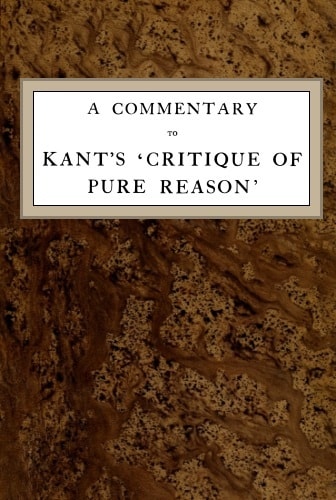
A Commentary to Kant's 'Critique of Pure Reason
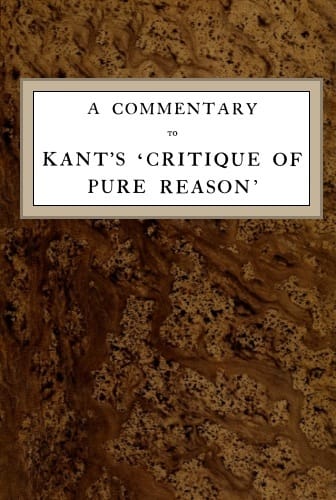
Kant's Critique of Pure Reason remains the most formidable gateway into modern philosophy: a text that reshaped how we think about knowledge, perception, and the limits of human reason, yet whose prose remains stubbornly resistant to casual reading. Norman Kemp Smith's commentary, first published in the 1920s, has endured as the essential English-language companion to this labyrinthine work. But this is no mere gloss or footnote aggregation. Kemp Smith argues that Kant's internal contradictions are not failures but the very heart of his philosophical enterprise, the tension between Kant's rationalist and empiricist impulses generates the productive instability that makes the Critique so endlessly debatable. The commentary thus serves double duty: it illuminates the text section by section while mounting a sustained argument about what Kant was really trying to do and why he never quite succeeded in doing it entirely. This is a book for readers ready to stop treating Kant as a monument and start taking him seriously as a thinker still working through problems that remain unsolved.
Editions
Link to this book
Add a free, dofollow link to Lex on your blog, forum, syllabus, or reading list.

<a href="https://lex-books.com/book/a-commentary-to-kant-s-critique-of-pure-reason-68252f57-d04b-4f9f-90ba-28bf17310116"><img src="https://lex-books.com/badges/read-on-lex.svg" alt="Read A Commentary to Kant's 'Critique of Pure Reason by Norman Kemp Smith free on Lex" width="160" height="40"></a>[](https://lex-books.com/book/a-commentary-to-kant-s-critique-of-pure-reason-68252f57-d04b-4f9f-90ba-28bf17310116)[url=https://lex-books.com/book/a-commentary-to-kant-s-critique-of-pure-reason-68252f57-d04b-4f9f-90ba-28bf17310116][img]https://lex-books.com/badges/read-on-lex.svg[/img][/url]Read A Commentary to Kant's 'Critique of Pure Reason by Norman Kemp Smith free on Lex: https://lex-books.com/book/a-commentary-to-kant-s-critique-of-pure-reason-68252f57-d04b-4f9f-90ba-28bf17310116Cite this book
Reading this edition for a paper or guide? Copy a citation.
Smith, Norman Kemp. A Commentary to Kant's 'Critique of Pure Reason. Lex, lex-books.com/book/a-commentary-to-kant-s-critique-of-pure-reason-68252f57-d04b-4f9f-90ba-28bf17310116.Smith, N. K. (n.d.). A Commentary to Kant's 'Critique of Pure Reason. Lex. https://lex-books.com/book/a-commentary-to-kant-s-critique-of-pure-reason-68252f57-d04b-4f9f-90ba-28bf17310116Smith, Norman Kemp. A Commentary to Kant's 'Critique of Pure Reason. Lex. https://lex-books.com/book/a-commentary-to-kant-s-critique-of-pure-reason-68252f57-d04b-4f9f-90ba-28bf17310116.