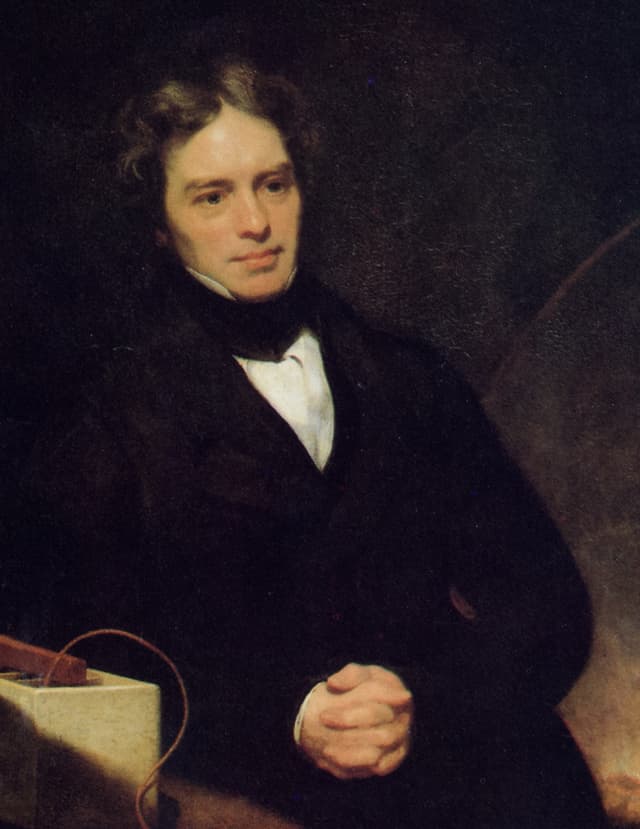
Michael Faraday
Michael Faraday was an English chemist and physicist whose groundbreaking contributions to electrochemistry and electromagnetism laid the foundation for modern physics. Despite having little formal education, Faraday became one of history's most influential scientists, known for his discoveries in electromagnetic induction, diamagnetism, and electrolysis. His pioneering work on the magnetic field around a conductor carrying a direct current established the concept of the electromagnetic field, fundamentally changing the understanding of electricity and magnetism. Faraday's inventions, including electromagnetic rotary devices, were crucial in the development of electric motor technology, making electricity practical for widespread use. In addition to his work in physics, Faraday made significant contributions to chemistry, discovering compounds such as benzene and carbon tetrachloride, and introducing important terminology like 'anode,' 'cathode,' 'electrode,' and 'ion.' He served as the Fullerian Professor of Chemistry at the Royal Institution for life, where he was known for his ability to communicate complex ideas in accessible language. Faraday's legacy is further cemented by the SI unit of capacitance, the farad, named in his honor. His experimental approach and insights influenced later scientists, including James Clerk Maxwell, who recognized Faraday's profound impact on the mathematical understanding of electromagnetic phenomena.
Famous Quotes
View all 3 quotes“Nothing is too wonderful to be true if it be consistent with the laws of nature.”
“There’s nothing quite as frightening as someone who knows they are right.”
“A man who is certain he is right is almost sure to be wrong.”
Books from the author




Link to this page
Add a free, dofollow link to Lex on your blog, forum, syllabus, or reading list.

<a href="https://lex-books.com/author/michael-faraday"><img src="https://lex-books.com/badges/read-on-lex.svg" alt="Michael Faraday on Lex" width="160" height="40"></a>[](https://lex-books.com/author/michael-faraday)[url=https://lex-books.com/author/michael-faraday][img]https://lex-books.com/badges/read-on-lex.svg[/img][/url]Michael Faraday on Lex: https://lex-books.com/author/michael-faraday