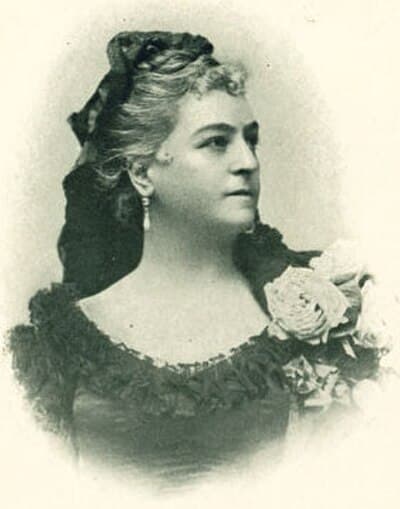
Lilli Lehmann
Lilli Lehmann, originally named Elisabeth Maria Lehmann, was a prominent German soprano whose illustrious career spanned from the mid-19th century into the 1920s. Renowned for her remarkable vocal flexibility and dramatic prowess, she began her journey as a prima donna at the Berlin Hofoper, where she captivated audiences with her lyric coloratura soprano roles. Her breakthrough into the dramatic soprano repertoire came in 1884 at the Royal Opera House in London, where she portrayed Isolde in Richard Wagner's 'Tristan und Isolde.' This performance marked the beginning of her influential association with Wagner's operas, which she helped popularize in America during her tenure at the Metropolitan Opera from 1885 to 1892. Throughout her career, Lehmann mastered over 170 opera roles, showcasing her versatility across various soprano fachs. She played a pivotal role in the first American performances of several of Wagner's operas, including 'Siegfried' and 'Götterdämmerung,' and was instrumental in the first complete staging of Wagner's 'Ring Cycle' at the Met in 1889. Beyond her operatic achievements, Lehmann was also a dedicated voice teacher at the Mozarteum in Salzburg and an advocate for animal welfare. She continued to perform well into her later years, leaving a lasting legacy in the world of opera as one of the great sopranos of her time, celebrated for her artistry and contributions to the operatic canon.
Famous Quotes
View all 3 quotes“It will be much more correct to call every tone of every voice by the name of a new additional register, for in the end, every tone will and must be taken in a different relation, with a different position of the organs, although the difference may be imperceptible, if it is to have its proper place in the whole.”
“Students of singing should use the early morning hours, and fill their days with the various branches of their study.”
“One who has sung for a short time, and then has lost his voice, and for this reason becomes a singing teacher, has never sung consciously; it has simply been an accident, and this accident will be repeated, for good or for ill, in his pupils.”
Books from the author





Link to this page
Add a free, dofollow link to Lex on your blog, forum, syllabus, or reading list.

<a href="https://lex-books.com/author/lilli-lehmann"><img src="https://lex-books.com/badges/read-on-lex.svg" alt="Lilli Lehmann on Lex" width="160" height="40"></a>[](https://lex-books.com/author/lilli-lehmann)[url=https://lex-books.com/author/lilli-lehmann][img]https://lex-books.com/badges/read-on-lex.svg[/img][/url]Lilli Lehmann on Lex: https://lex-books.com/author/lilli-lehmann