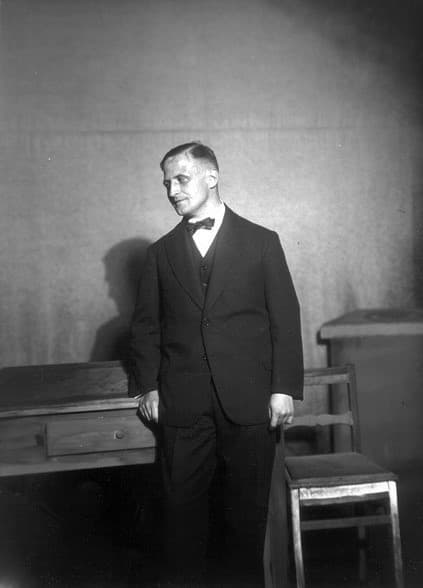
Franz Jung
Franz Jung was a multifaceted German writer, economist, and political activist known for his contributions to literature and thought during a tumultuous period in Germany. Born in Neisse, he cultivated a diverse intellectual background, studying music, law, and economics across several prominent universities, including Leipzig and Munich. His early friendship with poet Max Herrmann-Neisse influenced his literary pursuits, leading him to explore themes of individuality and societal critique in his work. Jung's writings often reflected his political convictions and his engagement with contemporary issues, making him a significant figure in the literary landscape of his time. Jung's notable works include 'The Last of the Great Ones' and 'The New Man,' where he delved into the complexities of human existence and the socio-political landscape of early 20th-century Germany. Writing under various pseudonyms, including Franz Larsz and Frank Ryberg, he was able to navigate the literary and political spheres with a unique voice. His work is characterized by a blend of philosophical inquiry and social commentary, positioning him as a precursor to later existentialist thought. Jung's legacy endures through his innovative approach to literature and his unwavering commitment to addressing the pressing issues of his time.
Famous Quotes
View all 20 quotes“Jung said that to be in a situation where there is no way out or to be in a conflict where there is no solution is the classical beginning of the process of individuation. It is meant to be a situation without solution; the unconscious wants the hopeless conflict in order to put ego consciousness up against the wall, so that the man has to realize that whatever he does is wrong, whichever way he decides will be wrong. This is meant to knock out the superiority of the ego, which always acts from the illusion that it has the responsibility of decision. . . If he is ethical enough to suffer to the core of his personality, then generally, because of the insolubility of the conscious situation, the Self manifests. In religious language you could say that the situation without issue is meant to force the man to rely on an act of God.””
“Many people discover relatively soon in life that the realm of their inferior function is where they are emotional, touchy and unadapted, and they therefore acquire the habit of covering up this part of their personality with a surrogate pseudo-reaction. For instance, a thinking type often cannot express his feelings normally and in the appropriate manner at the right time. It can happen that when he hears that the husband of a friend has died he cries, but when he meets the widow not a word of pity will come out. They not only look very cold, but they really do not feel anything! They had all the feeling before, when at home, but now in the appropriate situation they cannot pull it out. Thinking types are very often looked on by other people as having no feeling; this is absolutely not true. It is not that they have no feeling, but that they cannot express it at the appropriate moment. They have the feeling somehow and somewhere, but not just when they ought to produce it.””
“Jung has said that to be in a situation where there is no way out, or to be in a conflict where there is no solution, is the classical beginning of the process of individuation. It is meant to be a situation without solution: the unconscious wants the hopeless conflict in order to put ego-consciousness up against the wall, so that the man has to realise that whatever he does is wrong, whichever way he decides will be wrong. This is meant to knock out the superiority of the ego, which always acts from the illusion that it has the responsibility of decision. Naturally, if a man says, "Oh well, then I shall just let everything go and make no decision, but just protract and wriggle out of [it]," the whole thing is equally wrong, for then naturally nothing happens. But if he is ethical enough to suffer to the core of his personality, then generally because of the insolubility of the conscious situation, the Self manifests. In religious language you could say that the situation without issue is meant to force the man to rely on an act of God. In psychological language the situation without issue, which the anima arranges with great skill in a man's life, is meant to drive him into a condition in which he is capable of experiencing the Self. When thinking of the anima as the soul guide, we are apt to think of Beatrice leading Dante up to Paradise, but we should not forget that he experienced that only after he had gone through Hell. Normally, the anima does not take a man by the hand and lead him right up to Paradise; she puts him first into a hot cauldron where he is nicely roasted for a while.””
Books from the author


Link to this page
Add a free, dofollow link to Lex on your blog, forum, syllabus, or reading list.

<a href="https://lex-books.com/author/franz-jung"><img src="https://lex-books.com/badges/read-on-lex.svg" alt="Franz Jung on Lex" width="160" height="40"></a>[](https://lex-books.com/author/franz-jung)[url=https://lex-books.com/author/franz-jung][img]https://lex-books.com/badges/read-on-lex.svg[/img][/url]Franz Jung on Lex: https://lex-books.com/author/franz-jung