What Every Mother Should Know; Or, How Six Little Children Were Taught the Truth
1914
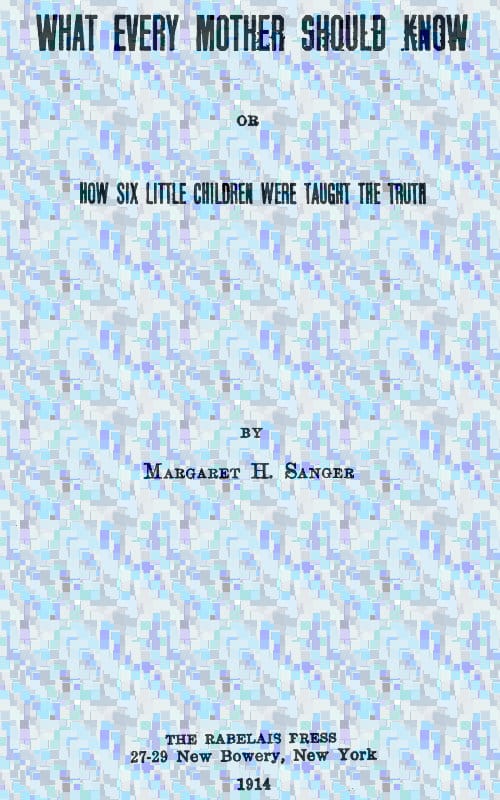
What Every Mother Should Know; Or, How Six Little Children Were Taught the Truth
1914
In 1914, when speaking of reproduction to children was unspeakable, Margaret Sanger wrote this quiet revolutionary manual for mothers desperate to do better by their children. Using the natural world as her classroom, Sanger guides readers through a remarkable pedagogical sequence: flowers and pollination give way to toads and frogs, then birds, then mammals, until finally arriving at human reproduction. Each chapter was originally published as an newspaper article and tested on Sanger's own son and neighborhood children. The genius lies in Sanger's insistence that children absorb these truths "without realizing they have received any 'sex' instruction", that knowledge should arrive wrapped in wonder, not shame. The book doubls as a manifesto for mothers themselves, arguing that protecting children from harmful ignorance is an act of love. Nearly a century before comprehensive sex education became a political battlefield, Sanger offered a radical proposition: told honestly, these facts need not corrupt childhood but rather fortify it. For readers interested in the history of sexuality, education, or one of birth control's most complicated pioneers, this remains a fascinating artifact, dated in tone, undeniable in intent.
Editions
Link to this book
Add a free, dofollow link to Lex on your blog, forum, syllabus, or reading list.

<a href="https://lex-books.com/book/what-every-mother-should-know-or-how-six-little-children-were-taught-the-truth-459063d4-8523-4ecf-83bf-6e621845b080"><img src="https://lex-books.com/badges/read-on-lex.svg" alt="Read What Every Mother Should Know; Or, How Six Little Children Were Taught the Truth by Margaret Sanger free on Lex" width="160" height="40"></a>[](https://lex-books.com/book/what-every-mother-should-know-or-how-six-little-children-were-taught-the-truth-459063d4-8523-4ecf-83bf-6e621845b080)[url=https://lex-books.com/book/what-every-mother-should-know-or-how-six-little-children-were-taught-the-truth-459063d4-8523-4ecf-83bf-6e621845b080][img]https://lex-books.com/badges/read-on-lex.svg[/img][/url]Read What Every Mother Should Know; Or, How Six Little Children Were Taught the Truth by Margaret Sanger free on Lex: https://lex-books.com/book/what-every-mother-should-know-or-how-six-little-children-were-taught-the-truth-459063d4-8523-4ecf-83bf-6e621845b080Cite this book
Reading this edition for a paper or guide? Copy a citation.
Sanger, Margaret. What Every Mother Should Know; Or, How Six Little Children Were Taught the Truth. Lex, lex-books.com/book/what-every-mother-should-know-or-how-six-little-children-were-taught-the-truth-459063d4-8523-4ecf-83bf-6e621845b080.Sanger, M. (1914). What Every Mother Should Know; Or, How Six Little Children Were Taught the Truth. Lex. https://lex-books.com/book/what-every-mother-should-know-or-how-six-little-children-were-taught-the-truth-459063d4-8523-4ecf-83bf-6e621845b080Sanger, Margaret. What Every Mother Should Know; Or, How Six Little Children Were Taught the Truth. Lex. https://lex-books.com/book/what-every-mother-should-know-or-how-six-little-children-were-taught-the-truth-459063d4-8523-4ecf-83bf-6e621845b080.