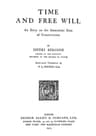
Time and Free Will: An Essay on the Immediate Data of Consciousness
1889
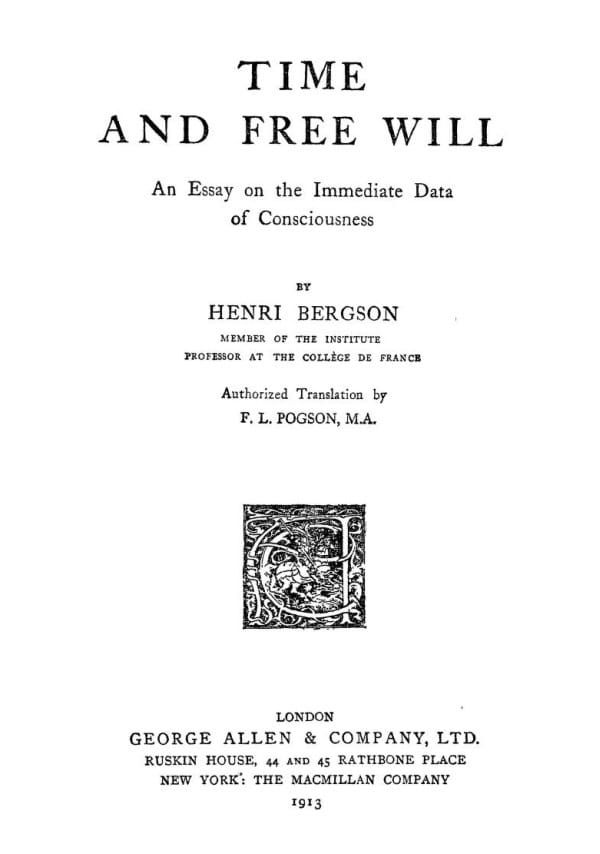
Time and Free Will: An Essay on the Immediate Data of Consciousness
1889
Translated by Frank Lubecki Pogson
Bergson's 1889 debut is a frontal assault on the scientific orthodoxy of his age. He argues that consciousness cannot be measured like distance or weight, that our inner life flows in a way fundamentally different from clock time. The feelings we have, the moments we experience, their "intensity" as he calls it, resists quantification. When we say a grief or a joy is "intense," we cannot point to some quantity that increases, the way temperature rises. This is the kernel of his attack on determinism: if consciousness cannot be reduced to mechanical terms, then we are not machines, and the question of free will opens anew. Bergson wrote with such literary grace that he became the only philosopher to win the Nobel Prize in Literature. His ideas went on to influence Proust, James, Whitehead, and even Einstein. For any reader who has felt that something essential about being human escapes the measuring rod, this is the philosophy that names that intuition.
Editions
X-Ray
“The idea of the future, pregnant with an infinity of possibilities, is thus more fruitful than the future itself, and this is why we find more charm in hope than in possession, in dreams than in reality.””
— Henri Bergson
“What makes hope such an intense pleasure is the fact that the future, which we dispose of to our liking, appears to us at the same time under a multitude of forms, equally attractive and equally possible. Even if the most coveted of these becomes realized, it will be necessary to give up the others, and we shall have lost a great deal.The idea of the future, pregnant with an infinity of possibilities, is thus more fruitful than the future itself, and this is why we find more charm in hope than in possession, in dreams than in reality.””
— Henri Bergson
“[Duration is] the form which the succession of our conscious states assumes when our ego lets itself live, when it refrains from separating its present state from its former state.””
— Henri Bergson
“[W]ithin our ego, there is succession without mutual externality; outside the ego, in pure space, mutual externality without succession.””
— Henri Bergson
Link to this book
Add a free, dofollow link to Lex on your blog, forum, syllabus, or reading list.

<a href="https://lex-books.com/book/time-and-free-will-an-essay-on-the-immediate-data-of-consciousness-3885ae36-f8ba-45be-8813-bb70d48acca7"><img src="https://lex-books.com/badges/read-on-lex.svg" alt="Read Time and Free Will: An Essay on the Immediate Data of Consciousness by Henri Bergson free on Lex" width="160" height="40"></a>[](https://lex-books.com/book/time-and-free-will-an-essay-on-the-immediate-data-of-consciousness-3885ae36-f8ba-45be-8813-bb70d48acca7)[url=https://lex-books.com/book/time-and-free-will-an-essay-on-the-immediate-data-of-consciousness-3885ae36-f8ba-45be-8813-bb70d48acca7][img]https://lex-books.com/badges/read-on-lex.svg[/img][/url]Read Time and Free Will: An Essay on the Immediate Data of Consciousness by Henri Bergson free on Lex: https://lex-books.com/book/time-and-free-will-an-essay-on-the-immediate-data-of-consciousness-3885ae36-f8ba-45be-8813-bb70d48acca7Cite this book
Reading this edition for a paper or guide? Copy a citation.
Bergson, Henri. Time and Free Will: An Essay on the Immediate Data of Consciousness. Lex, lex-books.com/book/time-and-free-will-an-essay-on-the-immediate-data-of-consciousness-3885ae36-f8ba-45be-8813-bb70d48acca7.Bergson, H. (1889). Time and Free Will: An Essay on the Immediate Data of Consciousness. Lex. https://lex-books.com/book/time-and-free-will-an-essay-on-the-immediate-data-of-consciousness-3885ae36-f8ba-45be-8813-bb70d48acca7Bergson, Henri. Time and Free Will: An Essay on the Immediate Data of Consciousness. Lex. https://lex-books.com/book/time-and-free-will-an-essay-on-the-immediate-data-of-consciousness-3885ae36-f8ba-45be-8813-bb70d48acca7.