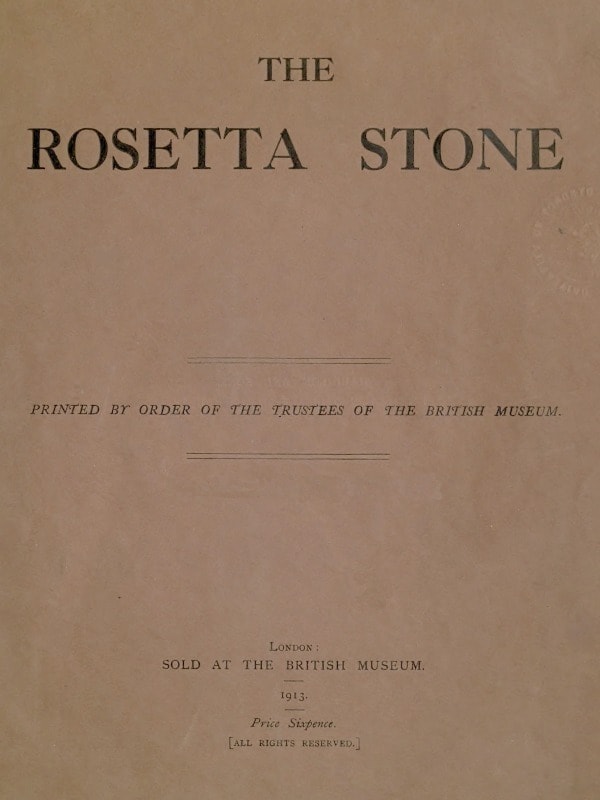
The Rosetta Stone
1929
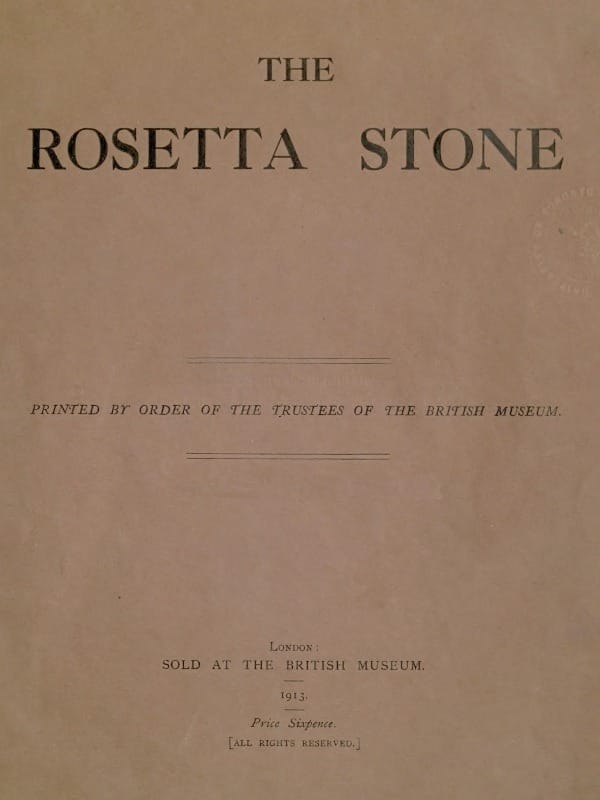
In 1799, French soldiers dismantling a fort near Rosetta uncovered a slab of black basalt that would change history. Carved into it was a decree from 196 BCE, repeated in Greek, Demotic, and hieroglyphics, the three scripts of ancient Egypt. For fourteen centuries, the hieroglyphs had been silent. Then this stone gave scholars their foothold. E.A. Wallis Budge, one of the twentieth century's most formidable Egyptologists, tells the full story: the stone's discovery amid Napoleon's Egyptian campaign, its capture by British forces, and the brilliant, bitter race between Thomas Young and Jean-François Champollion to crack the code. Budge doesn't merely recount dates and acquisitions, he captures the sheer audacity of the decipherment, the moment when a dead language suddenly breathed again. The book includes full original texts and translations, but its heart lies in showing how a handful of scholars rebuilt an entire civilization's voice from three parallel inscriptions. This is intellectual adventure at its most visceral.
Editions
X-Ray
French Officer of Engineers who discovered the Rosetta Stone in August 1799. Later rose to the rank of General and was alive in 1814.
French general who took possession of the Rosetta Stone and regarded it as his private property for about two years. Ordered the stone brought to his house in Alexandria.
French Emperor who ordered the Rosetta Stone to be taken to Cairo and placed in the Institut National. Exhibited great curiosity about the inscriptions and ordered copies made for European scholars.
British military leader whose successful operations in Egypt in 1801 led to the Treaty of Capitulation that secured the Rosetta Stone for Britain.
About The Rosetta Stone
Chapter Summaries
- 1
- French Officer Boussard discovers the Rosetta Stone near Rosetta, Egypt in August 1799 while working on fortifications. General Menou claims it as private property before Napoleon orders it to Cairo's Institut National for scholarly study.
- 2
- After British military success in Egypt, the Treaty of Capitulation transfers the stone to British possession. Major-General Turner transports it to England in 1802, where it's studied by the Society of Antiquaries before reaching the British Museum.
- 3
- The stone is described as an irregularly-shaped black basalt slab measuring about 3 feet 9 inches long. It contains inscriptions in three scripts: hieroglyphic, demotic, and Greek, representing two languages - Egyptian and Greek.
Key Themes
- Scientific Discovery and Method
- The systematic approach to deciphering hieroglyphs demonstrates the power of methodical scholarship. The comparison of cartouches, use of bilingual texts, and application of Coptic knowledge exemplify rigorous academic methodology.
- Cultural Preservation and Loss
- The text highlights how ancient knowledge can be lost and recovered. The Rosetta Stone represents both the fragility of cultural transmission and the possibility of resurrection through archaeological discovery.
- International Scholarship
- The collaborative nature of decipherment involved scholars from multiple nations - French, British, and others - working together despite political conflicts. Knowledge transcends national boundaries.
Characters
- Boussard/Bouchard(minor)
- French Officer of Engineers who discovered the Rosetta Stone in August 1799. Later rose to the rank of General and was alive in 1814.
- General Menou(minor)
- French general who took possession of the Rosetta Stone and regarded it as his private property for about two years. Ordered the stone brought to his house in Alexandria.
- Napoleon Bonaparte(minor)
- French Emperor who ordered the Rosetta Stone to be taken to Cairo and placed in the Institut National. Exhibited great curiosity about the inscriptions and ordered copies made for European scholars.
- Sir Ralph Abercromby(minor)
- British military leader whose successful operations in Egypt in 1801 led to the Treaty of Capitulation that secured the Rosetta Stone for Britain.
- General Hutchinson(minor)
- British general who received the Rosetta Stone and other Egyptian antiquities under Article XVI of the Treaty of Capitulation in August 1801.
- Major-General Turner(minor)
- British officer who claimed and obtained possession of the Rosetta Stone in 1801, transporting it to England aboard H.M.S. L'Égyptienne.
Link to this book
Add a free, dofollow link to Lex on your blog, forum, syllabus, or reading list.

<a href="https://lex-books.com/book/the-rosetta-stone-5a47cc22-e183-444b-9596-52ec34e0105a"><img src="https://lex-books.com/badges/read-on-lex.svg" alt="Read The Rosetta Stone by E. A. Wallis , Sir Budge free on Lex" width="160" height="40"></a>[](https://lex-books.com/book/the-rosetta-stone-5a47cc22-e183-444b-9596-52ec34e0105a)[url=https://lex-books.com/book/the-rosetta-stone-5a47cc22-e183-444b-9596-52ec34e0105a][img]https://lex-books.com/badges/read-on-lex.svg[/img][/url]Read The Rosetta Stone by E. A. Wallis , Sir Budge free on Lex: https://lex-books.com/book/the-rosetta-stone-5a47cc22-e183-444b-9596-52ec34e0105aCite this book
Reading this edition for a paper or guide? Copy a citation.
E. A. Wallis , Sir Budge. The Rosetta Stone. Lex, lex-books.com/book/the-rosetta-stone-5a47cc22-e183-444b-9596-52ec34e0105a.E. A. Wallis, S. B. (1929). The Rosetta Stone. Lex. https://lex-books.com/book/the-rosetta-stone-5a47cc22-e183-444b-9596-52ec34e0105aE. A. Wallis , Sir Budge. The Rosetta Stone. Lex. https://lex-books.com/book/the-rosetta-stone-5a47cc22-e183-444b-9596-52ec34e0105a.