The Rights of War and Peace
1625
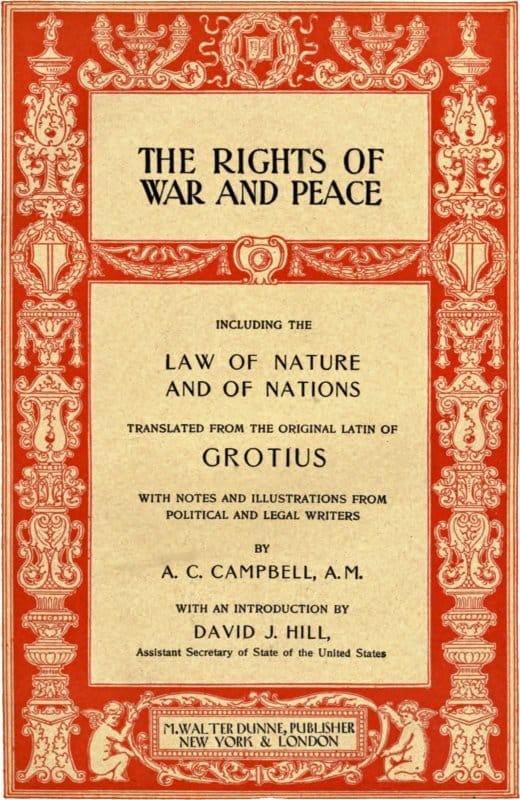
The Rights of War and Peace
1625
Translated by A. C. (Archibald Colin) Campbell
In 1625, as Europe tore itself apart in the Thirty Years' War, a imprisoned Dutch lawyer made an audacious claim: even war has laws. Hugo Grotius argued that natural rights exist above kings and nations, that sovereigns can commit injustices, and that conflict itself can be judged by a universal standard of justice. This became the foundation of modern international law. The Rights of War and Peace systematically examines whether any war can be just, who may lawfully wage it, and what conduct is permissible once it begins. Grotius distinguishes between just and unjust wars, analyzes the binding force of treaties and oaths, and establishes principles for the treatment of prisoners and the conduct of peace negotiations. His argument rests on natural law - rights inherent to humanity itself, not granted by any ruler. The book's influence extends far beyond legal theory. It shaped the moral and political philosophy of Hobbes, Pufendorf, Locke, Rousseau, and Kant. The American Founders drew upon its ideas when constructing international legal frameworks. Nearly four centuries later, the principles Grotius articulated - that nations are bound by rules, that rights exist independently of power - remain the foundation of how the international system operates.
Editions
Link to this book
Add a free, dofollow link to Lex on your blog, forum, syllabus, or reading list.

<a href="https://lex-books.com/book/the-rights-of-war-and-peace-5339b2a1-b264-4616-ac5f-bef11d88ff22"><img src="https://lex-books.com/badges/read-on-lex.svg" alt="Read The Rights of War and Peace by Hugo Grotius free on Lex" width="160" height="40"></a>[](https://lex-books.com/book/the-rights-of-war-and-peace-5339b2a1-b264-4616-ac5f-bef11d88ff22)[url=https://lex-books.com/book/the-rights-of-war-and-peace-5339b2a1-b264-4616-ac5f-bef11d88ff22][img]https://lex-books.com/badges/read-on-lex.svg[/img][/url]Read The Rights of War and Peace by Hugo Grotius free on Lex: https://lex-books.com/book/the-rights-of-war-and-peace-5339b2a1-b264-4616-ac5f-bef11d88ff22Cite this book
Reading this edition for a paper or guide? Copy a citation.
Grotius, Hugo. The Rights of War and Peace. Lex, lex-books.com/book/the-rights-of-war-and-peace-5339b2a1-b264-4616-ac5f-bef11d88ff22.Grotius, H. (1625). The Rights of War and Peace. Lex. https://lex-books.com/book/the-rights-of-war-and-peace-5339b2a1-b264-4616-ac5f-bef11d88ff22Grotius, Hugo. The Rights of War and Peace. Lex. https://lex-books.com/book/the-rights-of-war-and-peace-5339b2a1-b264-4616-ac5f-bef11d88ff22.