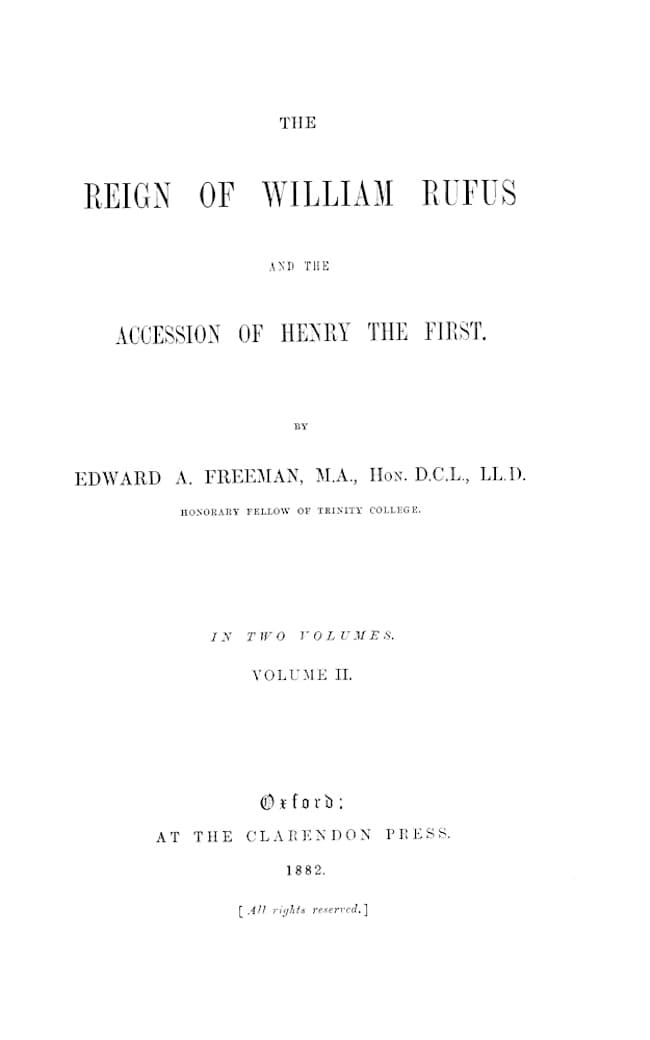
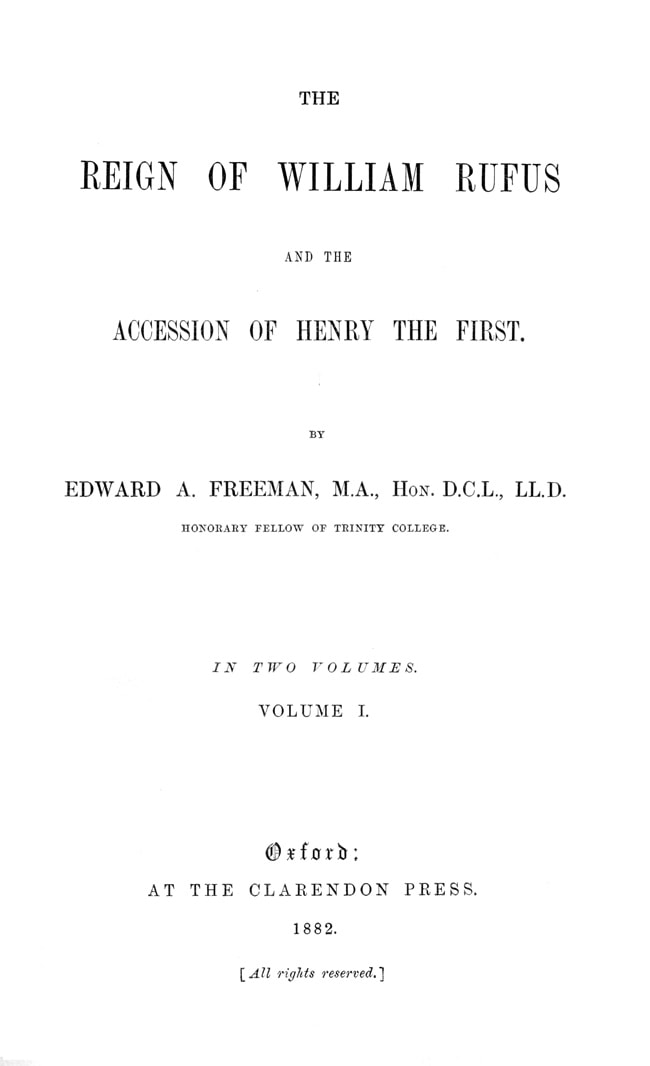
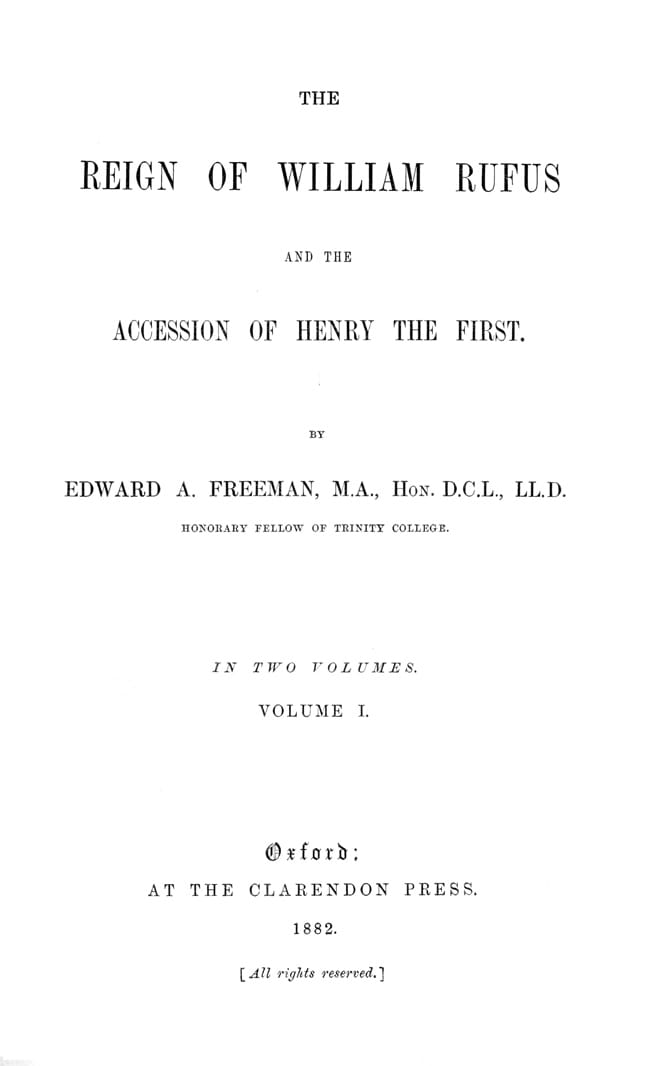
The Reign of William Rufus and the Accession of Henry the First, Volume 1 (of 2)
1882
The Reign of William Rufus and the Accession of Henry the First, Volume 1 (of 2)
1882
William Rufus ruled England for thirteen years and died in a New Forest hunting accident that has sparked conspiracy theories for nine centuries. Was it assassination, divine judgment, or simple tragedy? Freeman, the Victorian era's most scrupulous medievalist, doesn't answer that question lightly. He walks the ground where events happened, reads the chronicles in their original Latin, and builds a portrait of a king who held England together through sheer political brutality, exploiting Norman barons, crushing ecclesiastical independence, and expanding the royal forest until a third of England belonged to the crown. This is history written the old way: patient, evidence-obsessed, unafraid to sit with uncertainty. Freeman gives you the documents, the geography, and the competing chronicles, then lets you judge. Volume One stops at Rufus's death; the stage is set for his brother Henry to seize what William left behind. For readers who find modern history too smooth, too certain, Freeman offers the messy, fascinating process of actually figuring out what happened.
Editions
X-Ray
Second Norman king of England, son of William the Conqueror. Known for his red hair and fierce temperament, he becomes king through his father's nomination and Lanfranc's support.
Bishop of Bayeux and Earl of Kent, half-brother to William the Conqueror. The primary leader of the 1088 rebellion against William Rufus, seeking to place Robert Curthose on the throne.
Archbishop of Canterbury and chief advisor to both William the Conqueror and William Rufus. The key figure in securing the throne for Rufus through his ecclesiastical authority.
Duke of Normandy and eldest son of William the Conqueror. The rival claimant to the English throne, supported by rebellious Norman nobles but ultimately unsuccessful.
About The Reign of William Rufus and the Accession of Henry the First, Volume 1 (of 2)
Chapter Summaries
- 1
- Freeman outlines the significance of William Rufus's reign as both the completion and transformation of the Norman Conquest. He establishes the key themes of feudal development, anti-feudal tendencies, and England's changing European position.
- 2
- Chronicles William Rufus's accession through Lanfranc's support, the 1088 rebellion led by Odo of Bayeux, and the crucial English support that secured his throne. Includes detailed accounts of the sieges of Rochester and Pevensey, and the trial of William of Saint-Calais.
Key Themes
- The Completion and Transformation of the Norman Conquest
- The 1088 rebellion marks both the final stage of the Norman Conquest and its fundamental transformation. When Englishmen fight for a Norman king against rebellious Normans, the Conquest is both completed and undone, as Norman rule becomes English rule.
- Royal Authority versus Feudal Independence
- The central political theme explores the tension between centralized royal power and feudal autonomy. William Rufus's victory establishes the principle that no individual noble, however powerful, can successfully challenge the crown when it has popular support.
- Church-State Relations and Ecclesiastical Reform
- The conflicts with William of Saint-Calais and later Anselm represent the emerging struggle between secular and ecclesiastical authority, particularly regarding appeals to Rome and clerical privileges versus royal supremacy.
Characters
- William Rufus (William II)(protagonist)
- Second Norman king of England, son of William the Conqueror. Known for his red hair and fierce temperament, he becomes king through his father's nomination and Lanfranc's support.
- Odo of Bayeux(antagonist)
- Bishop of Bayeux and Earl of Kent, half-brother to William the Conqueror. The primary leader of the 1088 rebellion against William Rufus, seeking to place Robert Curthose on the throne.
- Lanfranc(major)
- Archbishop of Canterbury and chief advisor to both William the Conqueror and William Rufus. The key figure in securing the throne for Rufus through his ecclesiastical authority.
- Robert Curthose(major)
- Duke of Normandy and eldest son of William the Conqueror. The rival claimant to the English throne, supported by rebellious Norman nobles but ultimately unsuccessful.
- William of Saint-Calais(major)
- Bishop of Durham who initially serves as William Rufus's chief counselor but later joins the rebellion. First to appeal from an English court to Rome, establishing important precedent.
- Anselm(major)
- Abbot of Bec and later Archbishop of Canterbury, representing the spiritual opposition to William Rufus's policies. A saint-like figure who embodies ecclesiastical reform.
Link to this book
Add a free, dofollow link to Lex on your blog, forum, syllabus, or reading list.

<a href="https://lex-books.com/book/the-reign-of-william-rufus-and-the-accession-of-henry-the-first-volume-1-of-2-ecbab6d6-e320-4c0b-9a64-e9bf295b2221"><img src="https://lex-books.com/badges/read-on-lex.svg" alt="Read The Reign of William Rufus and the Accession of Henry the First, Volume 1 (of 2) by Edward A. Freeman free on Lex" width="160" height="40"></a>[](https://lex-books.com/book/the-reign-of-william-rufus-and-the-accession-of-henry-the-first-volume-1-of-2-ecbab6d6-e320-4c0b-9a64-e9bf295b2221)[url=https://lex-books.com/book/the-reign-of-william-rufus-and-the-accession-of-henry-the-first-volume-1-of-2-ecbab6d6-e320-4c0b-9a64-e9bf295b2221][img]https://lex-books.com/badges/read-on-lex.svg[/img][/url]Read The Reign of William Rufus and the Accession of Henry the First, Volume 1 (of 2) by Edward A. Freeman free on Lex: https://lex-books.com/book/the-reign-of-william-rufus-and-the-accession-of-henry-the-first-volume-1-of-2-ecbab6d6-e320-4c0b-9a64-e9bf295b2221Cite this book
Reading this edition for a paper or guide? Copy a citation.
Freeman, Edward A.. The Reign of William Rufus and the Accession of Henry the First, Volume 1 (of 2). Lex, lex-books.com/book/the-reign-of-william-rufus-and-the-accession-of-henry-the-first-volume-1-of-2-ecbab6d6-e320-4c0b-9a64-e9bf295b2221.Freeman, E. A. (1882). The Reign of William Rufus and the Accession of Henry the First, Volume 1 (of 2). Lex. https://lex-books.com/book/the-reign-of-william-rufus-and-the-accession-of-henry-the-first-volume-1-of-2-ecbab6d6-e320-4c0b-9a64-e9bf295b2221Freeman, Edward A.. The Reign of William Rufus and the Accession of Henry the First, Volume 1 (of 2). Lex. https://lex-books.com/book/the-reign-of-william-rufus-and-the-accession-of-henry-the-first-volume-1-of-2-ecbab6d6-e320-4c0b-9a64-e9bf295b2221.