The Privilege of Pain
1920
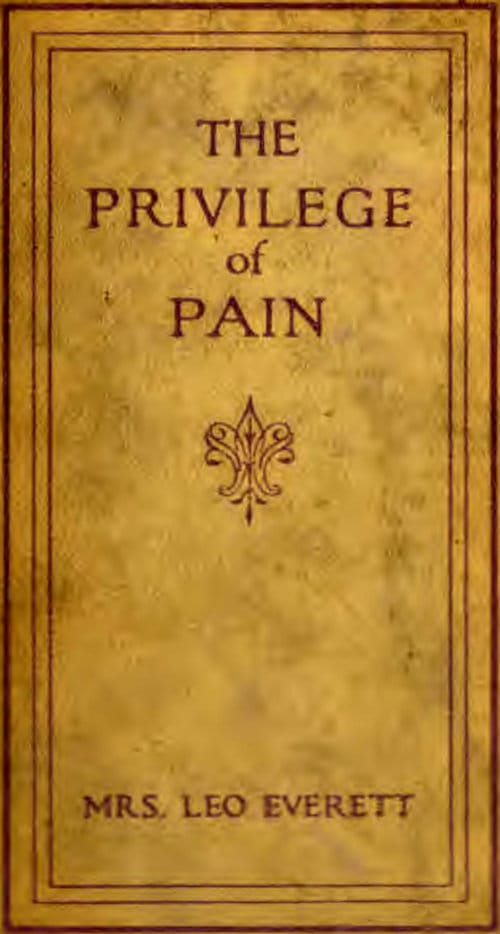
The Privilege of Pain
1920
In an age when suffering was whispered about or hidden, Mrs. Everett made a radical proposition: that pain might be a doorway rather than a wall. Written in 1920, this earnest exploration gathers the stories of poets who wrote through tuberculosis, blind women who transformed education, and philosophers who turned physical anguish into intellectual fire. The author argues that what we call weakness can become strength, that limitation can birth vision, and that the crucible of pain forges some of humanity's greatest contributions. With the spiritual earnestness characteristic of its era, the book insists that those who endure chronic suffering possess not merely a burden but a strange and difficult privilege. For readers today, it remains a fascinating time capsule of early twentieth-century optimism about the human spirit, and a provocative question: what might we achieve if we stopped fleeing discomfort and began studying it?
Editions

Link to this book
Add a free, dofollow link to Lex on your blog, forum, syllabus, or reading list.

<a href="https://lex-books.com/book/the-privilege-of-pain-07846428-ff9a-46ee-aecb-310f87a96da4"><img src="https://lex-books.com/badges/read-on-lex.svg" alt="Read The Privilege of Pain by Leo, Mrs.,Everett free on Lex" width="160" height="40"></a>[](https://lex-books.com/book/the-privilege-of-pain-07846428-ff9a-46ee-aecb-310f87a96da4)[url=https://lex-books.com/book/the-privilege-of-pain-07846428-ff9a-46ee-aecb-310f87a96da4][img]https://lex-books.com/badges/read-on-lex.svg[/img][/url]Read The Privilege of Pain by Leo, Mrs.,Everett free on Lex: https://lex-books.com/book/the-privilege-of-pain-07846428-ff9a-46ee-aecb-310f87a96da4Cite this book
Reading this edition for a paper or guide? Copy a citation.
Leo, Mrs.,Everett. The Privilege of Pain. Lex, lex-books.com/book/the-privilege-of-pain-07846428-ff9a-46ee-aecb-310f87a96da4.Leo, M. (1920). The Privilege of Pain. Lex. https://lex-books.com/book/the-privilege-of-pain-07846428-ff9a-46ee-aecb-310f87a96da4Leo, Mrs.,Everett. The Privilege of Pain. Lex. https://lex-books.com/book/the-privilege-of-pain-07846428-ff9a-46ee-aecb-310f87a96da4.