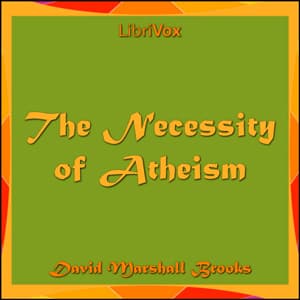
The Necessity of Atheism
1933
The Necessity of Atheism
1933
In 1811, a nineteen-year-old student at Oxford committed an act of extraordinary intellectual courage: he wrote a pamphlet arguing that belief in God was not merely unjustified, but unnecessary. He sent copies to every head of the university's colleges, refused to deny authorship when summoned before authorities, and was expelled for his trouble. That young man was Percy Bysshe Shelley, and the result is "The Necessity of Atheism," a compact philosophical detonation that still resonates more than two centuries later. Rather than attacking religion with mockery, Shelley approaches the question as a logician: he examines why humans invented gods, tracing the evolution from primitive animism through organized monotheism, and finds the foundations crumbling under scrutiny. He argues that fear and hope, those ancient engines of human psychology, gave birth to the divine, and that sustained belief in the supernatural has actively hindered human progress. The work was considered blasphemous, legally dangerous, and politically volatile. Shelley was rusticated from Oxford, his friend Thomas Jefferson Hogg punished alongside him. Yet the essay persisted, expanded in 1813 as notes to his poem Queen Mab, and became a foundational text in the tradition of freethought. It remains essential reading for anyone interested in the history of ideas, the courage of young dissenters, or the eternal question of what we owe to evidence versus tradition.
Editions
X-Ray
“IF [GOD] HAS SPOKEN, WHY IS THE UNIVERSE NOT CONVINCED?””
— David Marshall Brooks
“Plain speaking is necessary in any discussion of religion, for if the freethinker attacks the religious dogmas with hesitation, the orthodox believer assumes that it is with regret that the freethinker would remove the crutch that supports the orthodox. And all religious beliefs are 'crutches' hindering the free locomotive efforts of an advancing humanity. There are no problems related to human progress and happiness in this age which any theology can solve, and which the teachings of freethought cannot do better and without the aid of encumbrances.””
— David Marshall Brooks
“What did the Church do when we sought a living wage, shorter hours of work, safer working conditions, abolition of Sunday work, abolition of child labor?' The answer is an almost entirely negative one.””
— David Marshall Brooks
“Atheism is an emancipating system of thought that frees the mind from myths, fables, and childish fancies. There can be no inquisition, no witchcraft delusion, no religious wars, no persecutions of one sect by another, no impediment to science and progress, no stultification of the mind, as a result of its teachings.The philosophy of atheism teaches man to stand on his own feet, instills confidence in his reasoning powers, and forces him to conquer his environment. It teaches him not to subject himself and debase himself before mythical superhuman powers, for his reason is his power. The march from faith to reason is the march on which dwells the future hope of a really civilized mankind.Atheism teaches man to endeavor constantly to better his own condition and that of all of his fellowmen, to make his children wiser and happier; it supplies the powerful urge to add something new to the knowledge of mankind. And all this, not in the vain hope of being rewarded in another world, but from a pure sense of duty as a citizen of nature, as a patriot of the planet on which he dwells. This is no cold and cheerless philosophy; it is an elevating and ennobling ideal which may console him in his afflictions and teach him how to live and how to die. It is a self-reliant philosophy that makes a man intellectually free, and this mental emancipation allows him to face the world without fear of ghosts and gods.””
— David Marshall Brooks
“Religion arose as a means of explanation of natural phenomena at a time when no other explanation of the origin of natural phenomena had been ascertained. God is always what Spinoza called it, "the asylum of ignorance." When causes are unknown, God is brought forward; when causes are known, God retires into the background. In an age of ignorance, God is active; in an age of science, he is impotent.””
— David Marshall Brooks
“The idea of a supernatural being creating and governing this earth is a phantom born in the mind of the savage. If it had not been born in the early stages of man's mental development, it surely would not come into existence now. History proves that as the mind of man expands, it does not discover new gods, but that it discards them. It is not strange, therefore, that there has not been advanced a new major religious belief in the last 1300 years. All modern religious conceptions, no matter how disguised, find their origin in the fear-stricken ignorance of the primitive savage.””
— David Marshall Brooks
“The righting of the wrongs imposed on womankind therefore had been started not only without the aid of the churches but in face of their determined opposition.””
— David Marshall Brooks
“A secular morality teaches that what man thinks, says, and does lives after him and influences for good or ill future generations. This is a higher, nobler, and greater, incentive to righteousness than any life of personal reward or fear of punishment in a future life.””
— David Marshall Brooks
“The sentence 'thou shalt not suffer a witch to live' has caused more suffering, torture, and death than probably any other sentence ever framed.””
— David Marshall Brooks
Link to this book
Add a free, dofollow link to Lex on your blog, forum, syllabus, or reading list.

<a href="https://lex-books.com/book/the-necessity-of-atheism-278cc7aa-ab32-4a1f-a000-ff3ae72fabe6"><img src="https://lex-books.com/badges/read-on-lex.svg" alt="Read The Necessity of Atheism by David Marshall Brooks free on Lex" width="160" height="40"></a>[](https://lex-books.com/book/the-necessity-of-atheism-278cc7aa-ab32-4a1f-a000-ff3ae72fabe6)[url=https://lex-books.com/book/the-necessity-of-atheism-278cc7aa-ab32-4a1f-a000-ff3ae72fabe6][img]https://lex-books.com/badges/read-on-lex.svg[/img][/url]Read The Necessity of Atheism by David Marshall Brooks free on Lex: https://lex-books.com/book/the-necessity-of-atheism-278cc7aa-ab32-4a1f-a000-ff3ae72fabe6Cite this book
Reading this edition for a paper or guide? Copy a citation.
Brooks, David Marshall. The Necessity of Atheism. Lex, lex-books.com/book/the-necessity-of-atheism-278cc7aa-ab32-4a1f-a000-ff3ae72fabe6.Brooks, D. M. (1933). The Necessity of Atheism. Lex. https://lex-books.com/book/the-necessity-of-atheism-278cc7aa-ab32-4a1f-a000-ff3ae72fabe6Brooks, David Marshall. The Necessity of Atheism. Lex. https://lex-books.com/book/the-necessity-of-atheism-278cc7aa-ab32-4a1f-a000-ff3ae72fabe6.