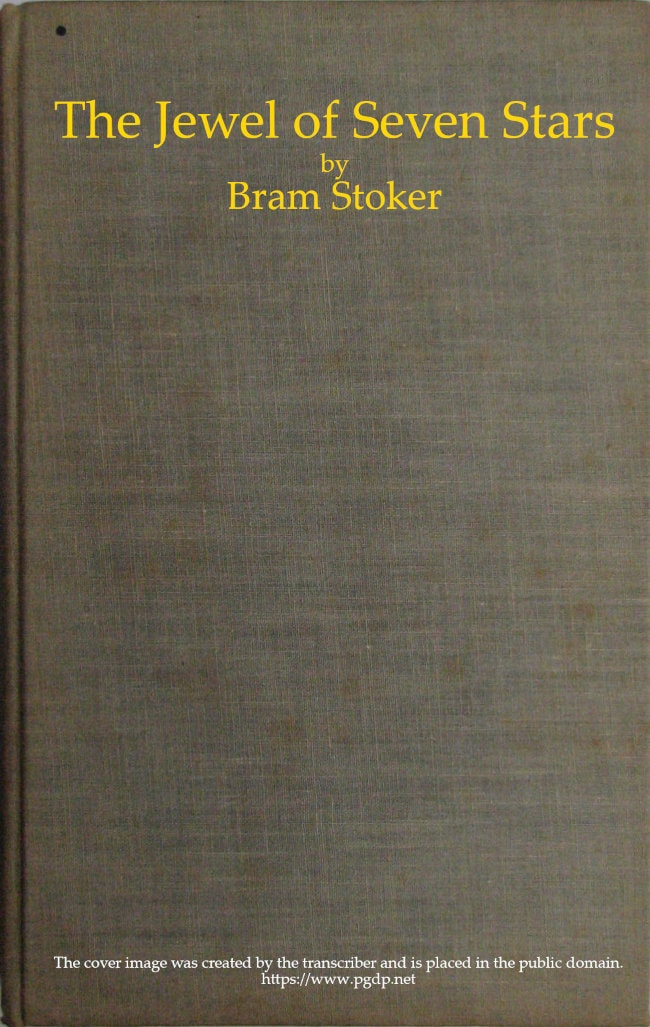
The Jewel of Seven Stars

Bram Stoker's "The Jewel of Seven Stars" is a gothic horror that digs up something far more disturbing than ancient artifacts. When archaeologist Abel Trelawny attempts to resurrect Queen Tera, an Egyptian ruler from millennia past, he unleashes forces that shatter the boundary between the living and the dead. His daughter Margaret becomes a vessel for Tera's returning soul, her body and mind slowly claimed by a queen who died hungry for immortality. Malcolm Ross, a young barrister drawn into the Trelawny's encrypted world, must decode ancient secrets while watching Margaret transform into something no longer fully human. The jewel of the title, a relic of immense occult power, serves as the key to Tera's resurrection but demands an unbearable price. Written at the fin de siècle, the novel pulses with Victorian anxieties about empire, progress, and the rise of a new kind of feminine power that both compels and terrifies its male protagonists. Stoker crafted something unique here: a horror novel where the real monster may be the act of resurrection itself, and where ancient Egyptian mysticism becomes a vehicle for exploring what we wake when we try to bring the dead back to life.
Editions
X-Ray
“We learn of great things by little experiences.””
— Bram Stoker
“Love is, after all, a selfish thing; and it throws a black shadow on anything between which and the light it stands.””
— Bram Stoker
“As yet we know nothing of what goes to create or evoke the active spark of life.””
— Bram Stoker
“For it is in the arcana of dreams that existences merge and renew themselves, change and yet keep the same.””
— Bram Stoker
“It seems that there is never to be any perfect rest. Even in Eden the snake rears its head among the laden boughs of the Tree of Knowledge. The silence of the dreamless night is broken by the roar of the avalanche; the hissing of sudden floods; the clanging of the engine bell marking its sweep through a sleeping American town; the clanking of distant paddles over the sea....””
— Bram Stoker
“We learn of great things by little experiences. The history of ages is but an indefinite repetition of the history of hours. The record of a soul is but a multiple of the story of a moment.””
— Bram Stoker
“Love and patience are all that make for happiness in this world; or in the world of the past or of the future; of the living or the dead. She dreamed her dream; and that is all that any of us can ask!””
— Bram Stoker
“They are done with now. Whatever comes - life or death - there will be no purpose in their using now.””
— Bram Stoker
“His will and his determination were as strong as ever; but the purely physical side of him had been weakened somewhat.””
— Bram Stoker
Link to this book
Add a free, dofollow link to Lex on your blog, forum, syllabus, or reading list.

<a href="https://lex-books.com/book/the-jewel-of-seven-stars-9ae8d82d-fb0e-40e2-919b-30532d971949"><img src="https://lex-books.com/badges/read-on-lex.svg" alt="Read The Jewel of Seven Stars by Bram Stoker free on Lex" width="160" height="40"></a>[](https://lex-books.com/book/the-jewel-of-seven-stars-9ae8d82d-fb0e-40e2-919b-30532d971949)[url=https://lex-books.com/book/the-jewel-of-seven-stars-9ae8d82d-fb0e-40e2-919b-30532d971949][img]https://lex-books.com/badges/read-on-lex.svg[/img][/url]Read The Jewel of Seven Stars by Bram Stoker free on Lex: https://lex-books.com/book/the-jewel-of-seven-stars-9ae8d82d-fb0e-40e2-919b-30532d971949Cite this book
Reading this edition for a paper or guide? Copy a citation.
Stoker, Bram. The Jewel of Seven Stars. Lex, lex-books.com/book/the-jewel-of-seven-stars-9ae8d82d-fb0e-40e2-919b-30532d971949.Stoker, B. (n.d.). The Jewel of Seven Stars. Lex. https://lex-books.com/book/the-jewel-of-seven-stars-9ae8d82d-fb0e-40e2-919b-30532d971949Stoker, Bram. The Jewel of Seven Stars. Lex. https://lex-books.com/book/the-jewel-of-seven-stars-9ae8d82d-fb0e-40e2-919b-30532d971949.