The Great Illusion: A Study of the Relation of Military Power to National Advantage
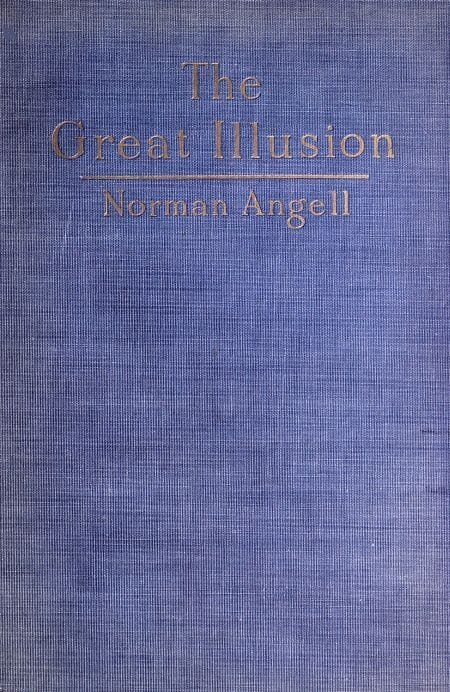
The Great Illusion: A Study of the Relation of Military Power to National Advantage
Published in 1909, The Great Illusion posed a question that would prove devastatingly prescient: why do modern nations persist in waging war when military conquest no longer yields economic advantage? Norman Angell dismantled the foundational assumption of European militarism, that political power and national wealth flow from the barrel of a gun, with meticulous economic analysis and historical evidence. He argued that in an industrialized world built on trade, finance, and complex interdependence, conquest doesn't capture wealth; it destroys the very infrastructure that creates it. The victor's army marches into rubble. Angell's thesis wasn't pacifist idealism, it was cold economic calculation, rooted in his observation that the real sources of national prosperity (commerce, credit, markets) cannot be seized by force; they can only be ruined by it. The book landed like a bomb in Edwardian Europe, dismissed by military establishments and embraced by peace activists. A decade later, the trenches of the Somme proved part of his terrible point. This is essential reading for anyone seeking to understand not just the First World War's catastrophe, but the persistent illusion of military power that continues to shape global politics.
Editions

X-Ray
“War has no longer the justification that it makes for the survival of the fittest; it involves the survival of the less fit. The idea that the struggle between nations is a part of the evolutionary law of man's advance involves a profound misreading of the biological analogy.The warlike nations do not inherit the earth; they represent the decaying human element.””
— Norman Angell
“The idea that the struggle between nations is a part of the evolutionary law of man's advance involves a profound misreading of the biological analogy. The warlike nations do not inherit the earth; they represent the decaying human element.””
— Norman Angell
“If the common man is prepared, as we know he is, to risk his life in a dozen dangerous trades and professions for no object higher than that of improving his position or increasing his income, why should the statesman shrink from such sacrifices as the average war demands if thereby the great interests which have been confided to him can be advanced? If it be true, as even the pacifist admits that it may be true, that the tangible material interests of a nation may be advanced by warfare; if, in other words, warfare can play some large part in the protection of the interests of humanity, the rulers of a courageous people are justified in disregarding the suffering and the sacrifice that it may involve.””
— Norman Angell
“They are based on the universal assumption that a nation, in order to find outlets for expanding population and increasing industry, or simply to ensure the best conditions possible for its people, is necessarily pushed to territorial expansion and the exercise of political force against others (German naval competition is assumed to be the expression of the growing need of an expanding population for a larger place in the world, a need which will find a realization in the conquest of English Colonies or trade, unless these were defended); it is assumed, therefore, that a nation’s relative prosperity is broadly determined by its political power; that nations being competing units, advantage, in the last resort, goes to the possessor of preponderant military force, the weaker going to the wall, as in the other forms of the struggle for life.””
— Norman Angell
“The idea that the struggle between nations is part of an evolutionary law of man's advance involves a profound misreading of the biological analogy. The warlike nations do not inherit the earth; the represent the decaying human element.””
— Norman Angell
Link to this book
Add a free, dofollow link to Lex on your blog, forum, syllabus, or reading list.

<a href="https://lex-books.com/book/the-great-illusion-a-study-of-the-relation-of-military-power-to-national-advanta-8c5e8509-cd6b-443e-aeb1-1dedf43f167f"><img src="https://lex-books.com/badges/read-on-lex.svg" alt="Read The Great Illusion: A Study of the Relation of Military Power to National Advantage by Norman Angell free on Lex" width="160" height="40"></a>[](https://lex-books.com/book/the-great-illusion-a-study-of-the-relation-of-military-power-to-national-advanta-8c5e8509-cd6b-443e-aeb1-1dedf43f167f)[url=https://lex-books.com/book/the-great-illusion-a-study-of-the-relation-of-military-power-to-national-advanta-8c5e8509-cd6b-443e-aeb1-1dedf43f167f][img]https://lex-books.com/badges/read-on-lex.svg[/img][/url]Read The Great Illusion: A Study of the Relation of Military Power to National Advantage by Norman Angell free on Lex: https://lex-books.com/book/the-great-illusion-a-study-of-the-relation-of-military-power-to-national-advanta-8c5e8509-cd6b-443e-aeb1-1dedf43f167fCite this book
Reading this edition for a paper or guide? Copy a citation.
Angell, Norman. The Great Illusion: A Study of the Relation of Military Power to National Advantage. Lex, lex-books.com/book/the-great-illusion-a-study-of-the-relation-of-military-power-to-national-advanta-8c5e8509-cd6b-443e-aeb1-1dedf43f167f.Angell, N. (n.d.). The Great Illusion: A Study of the Relation of Military Power to National Advantage. Lex. https://lex-books.com/book/the-great-illusion-a-study-of-the-relation-of-military-power-to-national-advanta-8c5e8509-cd6b-443e-aeb1-1dedf43f167fAngell, Norman. The Great Illusion: A Study of the Relation of Military Power to National Advantage. Lex. https://lex-books.com/book/the-great-illusion-a-study-of-the-relation-of-military-power-to-national-advanta-8c5e8509-cd6b-443e-aeb1-1dedf43f167f.