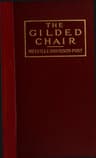
The Gilded Chair: A Novel
1910

A woman of mysterious origins arrives in Scotland with one goal: to find the new Duke of Dorset. Marchesa Soderrelli, whose name carries an exotic weight and whose past remains carefully obscured, journeys from London to Stirling with the precision of someone who knows exactly what she wants and precisely how to take it. The innkeepers recognize her immediately as someone of consequence, a foreign visitor whose questions about the Duke reveal an intelligence as sharp as her ambition. What unfolds is a tale of social maneuvering in the twilight of the Edwardian age, where a woman alone in the world must navigate the treacherous waters of British class and inherited power. Melville Davisson Post crafts this novel with the attentive detail of someone who understood exactly how wealth and title functioned in 1910 Britain. The Gilded Chair of the title suggests both the literal trappings of power and the gilded cage of social aspiration. Marchesa is no passive heroine awaiting rescue; she is the architect of her own fate, moving through Scottish Highlands and aristocratic drawing rooms with equal confidence. The novel operates on multiple registers: as a romance of reawakening, as a study of social mobility, and as an exploration of what women could accomplish when denied direct power but armed with wit and will.
Editions
Link to this book
Add a free, dofollow link to Lex on your blog, forum, syllabus, or reading list.

<a href="https://lex-books.com/book/the-gilded-chair-a-novel-4ab32d3e-922f-4cfb-8c94-129ef28db277"><img src="https://lex-books.com/badges/read-on-lex.svg" alt="Read The Gilded Chair: A Novel by Melville Davisson Post free on Lex" width="160" height="40"></a>[](https://lex-books.com/book/the-gilded-chair-a-novel-4ab32d3e-922f-4cfb-8c94-129ef28db277)[url=https://lex-books.com/book/the-gilded-chair-a-novel-4ab32d3e-922f-4cfb-8c94-129ef28db277][img]https://lex-books.com/badges/read-on-lex.svg[/img][/url]Read The Gilded Chair: A Novel by Melville Davisson Post free on Lex: https://lex-books.com/book/the-gilded-chair-a-novel-4ab32d3e-922f-4cfb-8c94-129ef28db277Cite this book
Reading this edition for a paper or guide? Copy a citation.
Post, Melville Davisson. The Gilded Chair: A Novel. Lex, lex-books.com/book/the-gilded-chair-a-novel-4ab32d3e-922f-4cfb-8c94-129ef28db277.Post, M. D. (1910). The Gilded Chair: A Novel. Lex. https://lex-books.com/book/the-gilded-chair-a-novel-4ab32d3e-922f-4cfb-8c94-129ef28db277Post, Melville Davisson. The Gilded Chair: A Novel. Lex. https://lex-books.com/book/the-gilded-chair-a-novel-4ab32d3e-922f-4cfb-8c94-129ef28db277.