The City
1925
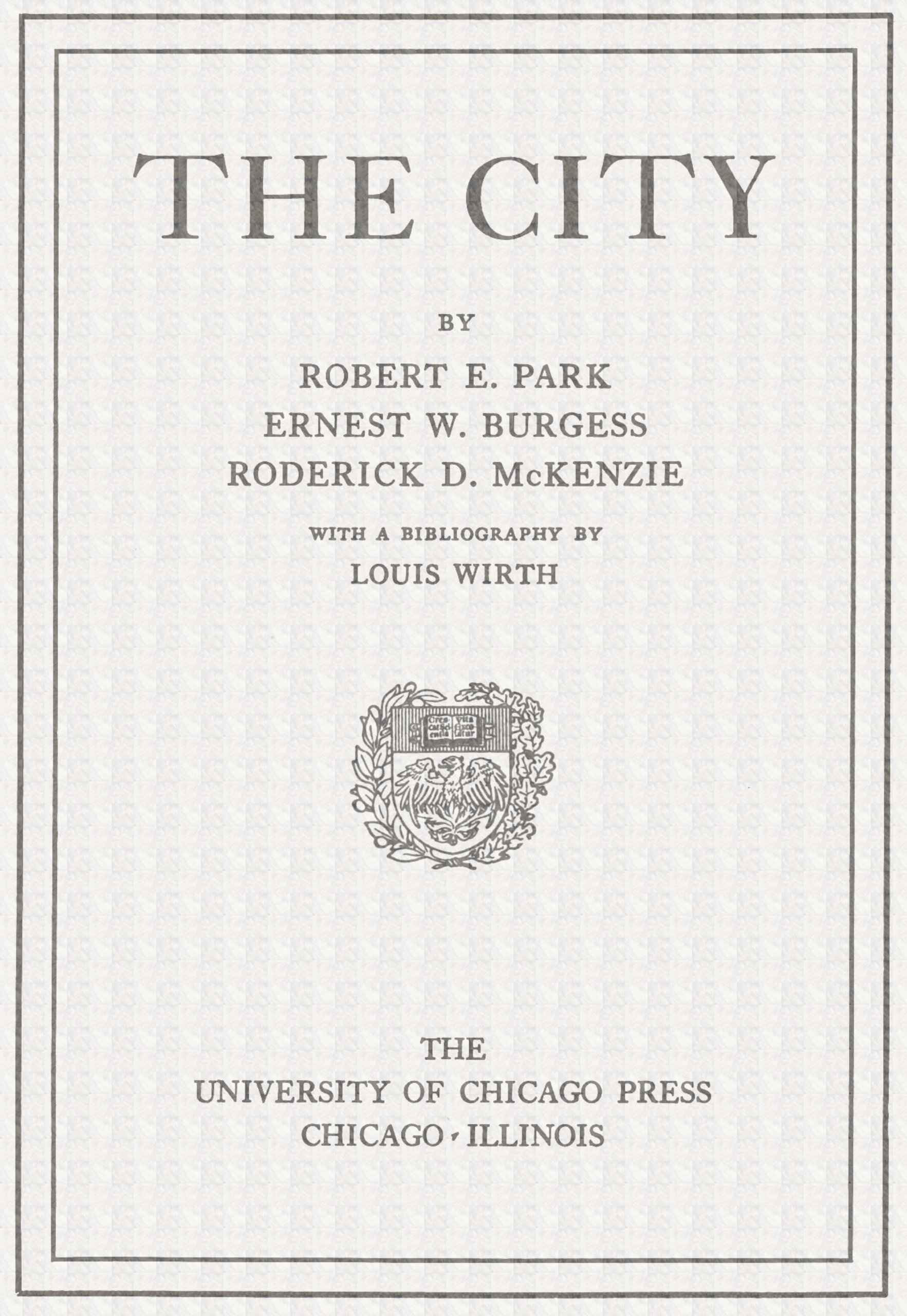
In 1925, a sociologist named Robert Ezra Park looked at Chicago and saw something no one had seen before: a living ecosystem, not of plants and animals, but of humans. The City is the book where modern urban studies was born. Park and his colleagues at the University of Chicago didn't just observe cities from the outside. They dove into the chaotic, electric mess of urban life and asked: How do millions of strangers learn to coexist? What happens to community when distance replaces kinship? How do economic forces and cultural traditions collide to create new forms of social order? The book reads part manifesto, part fieldwork report, part philosophical inquiry. Park believed cities were more than physical spaces. They were states of mind, ecosystems that shaped not just what people did but who they became. Reading it now feels like discovering the original source code for every conversation we've ever had about gentrification, segregation, alienation, and urban belonging. The questions remain unresolved because they're still the most important ones we have.
Editions
X-Ray
“If the plants have minds, as some people assume they do, they must be of that brooding, vegetative sort characteristic of those mystics who, quite forgetful of the active world, are absorbed in the contemplation of their own inner processes.””
— Robert Ezra Park
“[Our] restlessness and thirst for adventure is, for the most part, barren and illusory... We are seeking to escape from a dull world instead of turning back upon it to transform it.””
— Robert Ezra Park
“Boys' gangs are neighborhood institutions.””
— Robert Ezra Park
“The first newspapers were simply devices for organizing gossip, and that, to a greater or less extent, they have remained.””
— Robert Ezra Park
“In the urban environment literacy is almost as much a necessity as speech itself.””
— Robert Ezra Park
“The hobo is... merely a belated frontiersman, a frontiersman at a time and in a place when the frontier is passing or no longer exists.””
— Robert Ezra Park
“It is not because men are alike that they are social, but because they are different.””
— Robert Ezra Park
“Mind is an incident of locomotion.””
— Robert Ezra Park
“Our secret ambitions are seldom realized in our actual occupations.””
— Robert Ezra Park
Link to this book
Add a free, dofollow link to Lex on your blog, forum, syllabus, or reading list.

<a href="https://lex-books.com/book/the-city-e333585e-520f-4ecd-853a-67e1fff81732"><img src="https://lex-books.com/badges/read-on-lex.svg" alt="Read The City by Robert Ezra Park free on Lex" width="160" height="40"></a>[](https://lex-books.com/book/the-city-e333585e-520f-4ecd-853a-67e1fff81732)[url=https://lex-books.com/book/the-city-e333585e-520f-4ecd-853a-67e1fff81732][img]https://lex-books.com/badges/read-on-lex.svg[/img][/url]Read The City by Robert Ezra Park free on Lex: https://lex-books.com/book/the-city-e333585e-520f-4ecd-853a-67e1fff81732Cite this book
Reading this edition for a paper or guide? Copy a citation.
Park, Robert Ezra. The City. Lex, lex-books.com/book/the-city-e333585e-520f-4ecd-853a-67e1fff81732.Park, R. E. (1925). The City. Lex. https://lex-books.com/book/the-city-e333585e-520f-4ecd-853a-67e1fff81732Park, Robert Ezra. The City. Lex. https://lex-books.com/book/the-city-e333585e-520f-4ecd-853a-67e1fff81732.