A History of Matrimonial Institutions, Vol. 1 of 3
1904
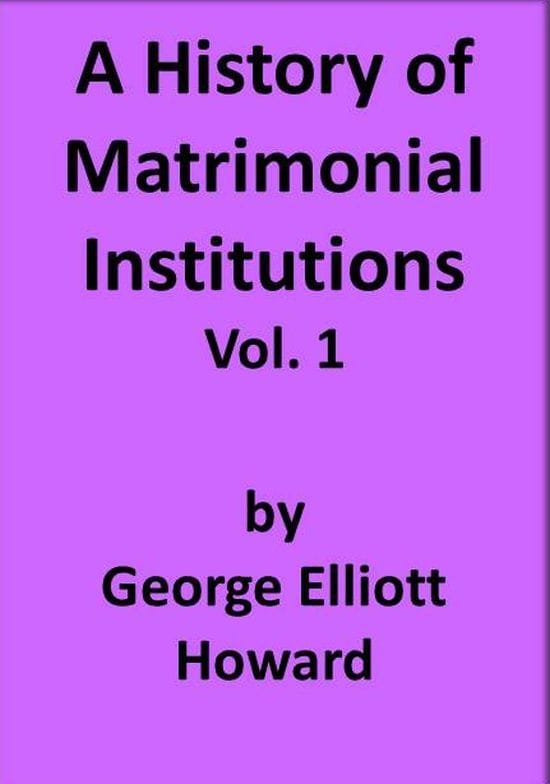
A History of Matrimonial Institutions, Vol. 1 of 3
1904
Published in 1904, this ambitious three-volume study traces the history of marriage from so-called primitive forms through the complexities of modern Anglo-American society. George Elliott Howard, writing at the dawn of sociology as a discipline, marshals an extraordinary range of anthropological evidence, legal codes, and ecclesiastical records to understand how humans have organized partnership, procreation, and household formation across centuries. What makes Howard's work especially compelling is not merely its scope but its moment: he composes this history in an era when marriage was undergoing seismic transformations, when women's suffrage movements were gaining momentum, and when the very definition of the family was being questioned. His analysis captures both the weight of tradition and the currents of change that would reshape matrimonial institutions in the twentieth century. For readers interested in the foundations of family law, the anthropology of kinship, or the evolution of Western marriage customs, this volume remains a valuable and surprisingly readable primary document. Howard writes with clarity and intellectual passion, making dense historical material accessible while never losing sight of the human stakes embedded in how societies regulate intimate life.
Editions
Link to this book
Add a free, dofollow link to Lex on your blog, forum, syllabus, or reading list.

<a href="https://lex-books.com/book/a-history-of-matrimonial-institutions-vol-1-of-3-01da7abb-79fd-41fe-a77d-54505b07c9bf"><img src="https://lex-books.com/badges/read-on-lex.svg" alt="Read A History of Matrimonial Institutions, Vol. 1 of 3 by George Elliott Howard free on Lex" width="160" height="40"></a>[](https://lex-books.com/book/a-history-of-matrimonial-institutions-vol-1-of-3-01da7abb-79fd-41fe-a77d-54505b07c9bf)[url=https://lex-books.com/book/a-history-of-matrimonial-institutions-vol-1-of-3-01da7abb-79fd-41fe-a77d-54505b07c9bf][img]https://lex-books.com/badges/read-on-lex.svg[/img][/url]Read A History of Matrimonial Institutions, Vol. 1 of 3 by George Elliott Howard free on Lex: https://lex-books.com/book/a-history-of-matrimonial-institutions-vol-1-of-3-01da7abb-79fd-41fe-a77d-54505b07c9bfCite this book
Reading this edition for a paper or guide? Copy a citation.
Howard, George Elliott. A History of Matrimonial Institutions, Vol. 1 of 3. Lex, lex-books.com/book/a-history-of-matrimonial-institutions-vol-1-of-3-01da7abb-79fd-41fe-a77d-54505b07c9bf.Howard, G. E. (1904). A History of Matrimonial Institutions, Vol. 1 of 3. Lex. https://lex-books.com/book/a-history-of-matrimonial-institutions-vol-1-of-3-01da7abb-79fd-41fe-a77d-54505b07c9bfHoward, George Elliott. A History of Matrimonial Institutions, Vol. 1 of 3. Lex. https://lex-books.com/book/a-history-of-matrimonial-institutions-vol-1-of-3-01da7abb-79fd-41fe-a77d-54505b07c9bf.