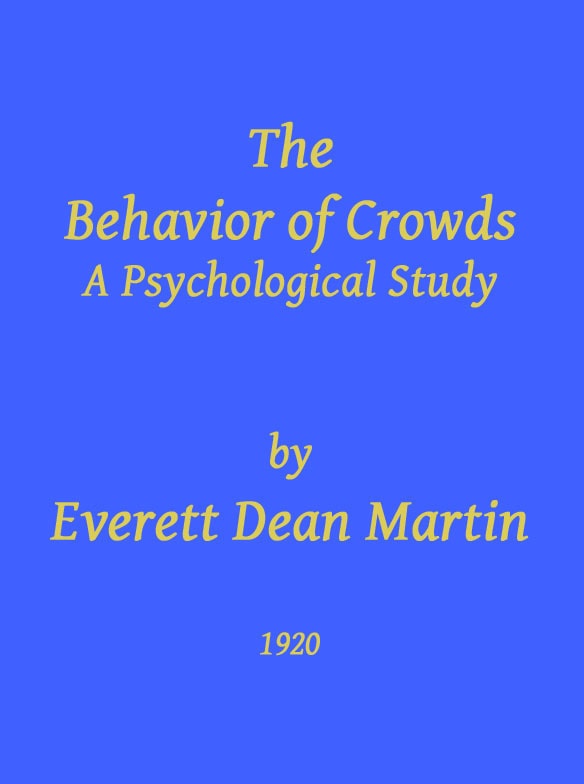
The Behavior of Crowds: A Psychological Study
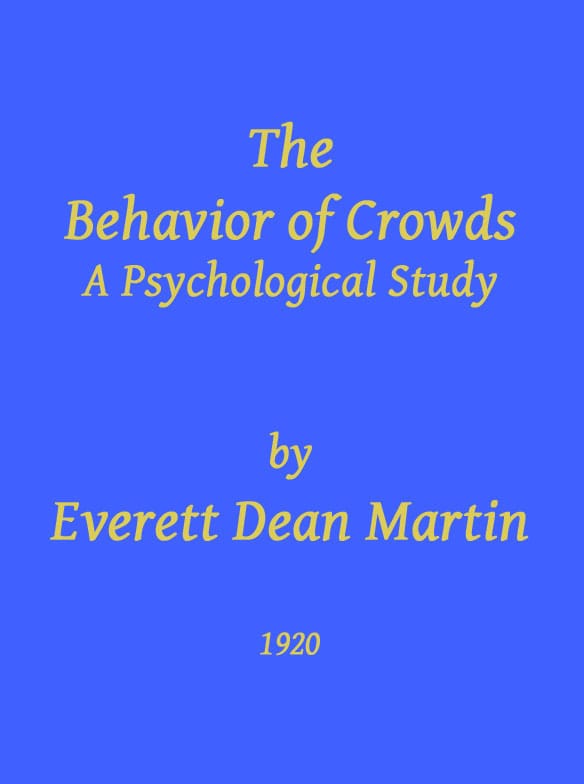
Written in the anxious aftermath of the Great War, when democracy seemed fragile and mass movements loomed large, this landmark text asks a question that still haunts us: what happens to the human mind when it joins a crowd? Everett Dean Martin, a psychologist who watched empires crumble to mob fury, argues that something profound and terrifying occurs when individuals merge into collectives. Reason surrenders to emotion, conscience dissolves into conformity, and the crowd becomes a creature of impulse and contagion. Yet Martin refuses to simple vilify the masses. He sees crowds not as aberrations but as natural expressions of social life, only dangerous when weaponized by those who understand the mechanics of collective unconsciousness. This is neither a populist celebration nor an elitist screed, but a careful anatomical study of how humans think together and lose themselves in the process. A century later, as algorithms engineer virality and polarization, Martin's analysis reads less like historical curiosity and more like warning.
Editions
X-Ray
“Probably the most telling point of likeness between the crowd-mind and the psychoneurosis”
— Everett Dean Martin
“By declaring that everyone is equally an end, Kant ignores all personal differences, and therefore the fact of individuality as such. We are each an end in respect to those qualities only in which we are identical”
— Everett Dean Martin
Link to this book
Add a free, dofollow link to Lex on your blog, forum, syllabus, or reading list.

<a href="https://lex-books.com/book/the-behavior-of-crowds-a-psychological-study-89cb60f8-ecf5-495f-a7ce-c943a6db7284"><img src="https://lex-books.com/badges/read-on-lex.svg" alt="Read The Behavior of Crowds: A Psychological Study by Everett Dean Martin free on Lex" width="160" height="40"></a>[](https://lex-books.com/book/the-behavior-of-crowds-a-psychological-study-89cb60f8-ecf5-495f-a7ce-c943a6db7284)[url=https://lex-books.com/book/the-behavior-of-crowds-a-psychological-study-89cb60f8-ecf5-495f-a7ce-c943a6db7284][img]https://lex-books.com/badges/read-on-lex.svg[/img][/url]Read The Behavior of Crowds: A Psychological Study by Everett Dean Martin free on Lex: https://lex-books.com/book/the-behavior-of-crowds-a-psychological-study-89cb60f8-ecf5-495f-a7ce-c943a6db7284Cite this book
Reading this edition for a paper or guide? Copy a citation.
Martin, Everett Dean. The Behavior of Crowds: A Psychological Study. Lex, lex-books.com/book/the-behavior-of-crowds-a-psychological-study-89cb60f8-ecf5-495f-a7ce-c943a6db7284.Martin, E. D. (n.d.). The Behavior of Crowds: A Psychological Study. Lex. https://lex-books.com/book/the-behavior-of-crowds-a-psychological-study-89cb60f8-ecf5-495f-a7ce-c943a6db7284Martin, Everett Dean. The Behavior of Crowds: A Psychological Study. Lex. https://lex-books.com/book/the-behavior-of-crowds-a-psychological-study-89cb60f8-ecf5-495f-a7ce-c943a6db7284.