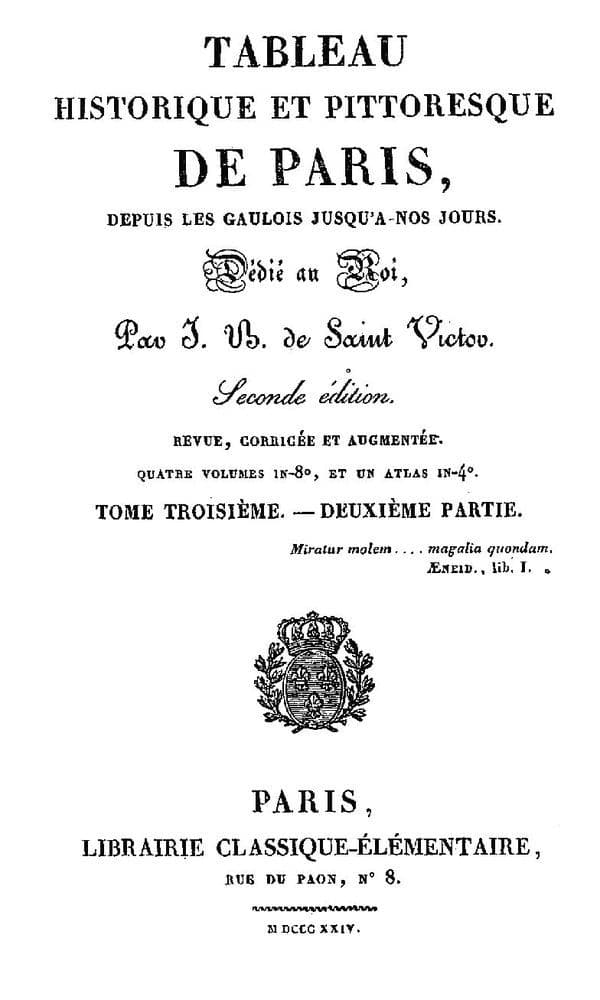
Tableau Historique Et Pittoresque De Paris Depuis Les Gaulois Jusqu'à Nos Jours (volume 1/8)
Tableau Historique Et Pittoresque De Paris Depuis Les Gaulois Jusqu'à Nos Jours (volume 1/8)
A historical account written in the early 19th century. This work provides a comprehensive exploration of Paris, detailing its development from ancient times through significant historical events, cultural institutions, and the evolution of its architecture. The opening of the book sets the stage for a thorough examination of Parisian history, addressing the considerable body of literature that has previously been written about the city and identifying gaps in these accounts. The author outlines a grand vision for documenting Paris’s evolution, emphasizing the need for a cohesive narrative that links historical events, monuments, and the cultural milieu of the city's inhabitants. He introduces the organizational structure of the work, which plans to divide the city into 20 quarters and recounts the history and significant transformations of these areas from prehistoric times to the brink of the French Revolution, providing insights into the urban, cultural, and political landscape of Paris across the centuries.
Editions
X-Ray
The author and historian who wrote this comprehensive historical and picturesque tableau of Paris. He presents himself as a dedicated scholar correcting previous historical errors and providing a more accurate account of Paris's development.
The first Frankish king to establish Paris as his capital and the true founder of the French monarchy. He converted to Christianity and made Paris the center of his empire.
The great Carolingian emperor who temporarily restored order to the French empire but whose successors' weakness led to further troubles. He rarely resided in Paris.
Count of Paris who became king and founder of the third dynasty. He established Paris as the permanent royal residence and founded the monastery of Saint-Barthélemi.
About Tableau Historique Et Pittoresque De Paris Depuis Les Gaulois Jusqu'à Nos Jours (volume 1/8)
Chapter Summaries
- Avertissement
- Saint-Victor explains his methodology and criticizes previous historians of Paris for their errors and inadequacies. He outlines his comprehensive approach to the city's history.
- Discours Préliminaire
- An overview of how great cities develop, comparing Paris to Rome and other capitals. The author traces the general pattern of urban growth from humble origins to greatness.
- Paris sous les deux premières races
- A detailed analysis of the feudal system's origins and development, defending it against Enlightenment criticisms. The author explains how feudalism saved civilization from chaos.
Key Themes
- Divine Providence in History
- Saint-Victor presents Paris's development as guided by Divine Providence, with Christianity serving as the civilizing force that saved France from barbarism and chaos.
- The Feudal System as Natural Order
- The author defends feudalism as a necessary and beneficial system that provided stability and protection during turbulent times, contrary to Enlightenment criticisms.
- Royal Authority and Legitimacy
- The work emphasizes the importance of legitimate royal authority, tracing how Paris became the seat of true monarchy under the Capetian dynasty.
Characters
- J. B. de Saint-Victor(protagonist)
- The author and historian who wrote this comprehensive historical and picturesque tableau of Paris. He presents himself as a dedicated scholar correcting previous historical errors and providing a more accurate account of Paris's development.
- Clovis(major)
- The first Frankish king to establish Paris as his capital and the true founder of the French monarchy. He converted to Christianity and made Paris the center of his empire.
- Charlemagne(major)
- The great Carolingian emperor who temporarily restored order to the French empire but whose successors' weakness led to further troubles. He rarely resided in Paris.
- Hugues Capet(major)
- Count of Paris who became king and founder of the third dynasty. He established Paris as the permanent royal residence and founded the monastery of Saint-Barthélemi.
- Philippe-Auguste(major)
- The king who created the first true walls around Paris beyond the Cité, greatly expanding the city and establishing the University's importance.
- Saint Louis(major)
- The saintly king who built the Sainte-Chapelle to house the Crown of Thorns and other precious relics. He embodied the ideal of Christian kingship.
Link to this book
Add a free, dofollow link to Lex on your blog, forum, syllabus, or reading list.

<a href="https://lex-books.com/book/tableau-historique-et-pittoresque-de-paris-depuis-les-gaulois-jusqu-nos-jours-vo-9fb1c3af-03e0-4c92-853f-935f98d3c973"><img src="https://lex-books.com/badges/read-on-lex.svg" alt="Read Tableau Historique Et Pittoresque De Paris Depuis Les Gaulois Jusqu'à Nos Jours (volume 1/8) by J. B. de Saint-Victor free on Lex" width="160" height="40"></a>[](https://lex-books.com/book/tableau-historique-et-pittoresque-de-paris-depuis-les-gaulois-jusqu-nos-jours-vo-9fb1c3af-03e0-4c92-853f-935f98d3c973)[url=https://lex-books.com/book/tableau-historique-et-pittoresque-de-paris-depuis-les-gaulois-jusqu-nos-jours-vo-9fb1c3af-03e0-4c92-853f-935f98d3c973][img]https://lex-books.com/badges/read-on-lex.svg[/img][/url]Read Tableau Historique Et Pittoresque De Paris Depuis Les Gaulois Jusqu'à Nos Jours (volume 1/8) by J. B. de Saint-Victor free on Lex: https://lex-books.com/book/tableau-historique-et-pittoresque-de-paris-depuis-les-gaulois-jusqu-nos-jours-vo-9fb1c3af-03e0-4c92-853f-935f98d3c973Cite this book
Reading this edition for a paper or guide? Copy a citation.
Saint-Victor, J. B. de. Tableau Historique Et Pittoresque De Paris Depuis Les Gaulois Jusqu'à Nos Jours (volume 1/8). Lex, lex-books.com/book/tableau-historique-et-pittoresque-de-paris-depuis-les-gaulois-jusqu-nos-jours-vo-9fb1c3af-03e0-4c92-853f-935f98d3c973.Saint-Victor, J. B. D. (n.d.). Tableau Historique Et Pittoresque De Paris Depuis Les Gaulois Jusqu'à Nos Jours (volume 1/8). Lex. https://lex-books.com/book/tableau-historique-et-pittoresque-de-paris-depuis-les-gaulois-jusqu-nos-jours-vo-9fb1c3af-03e0-4c92-853f-935f98d3c973Saint-Victor, J. B. de. Tableau Historique Et Pittoresque De Paris Depuis Les Gaulois Jusqu'à Nos Jours (volume 1/8). Lex. https://lex-books.com/book/tableau-historique-et-pittoresque-de-paris-depuis-les-gaulois-jusqu-nos-jours-vo-9fb1c3af-03e0-4c92-853f-935f98d3c973.