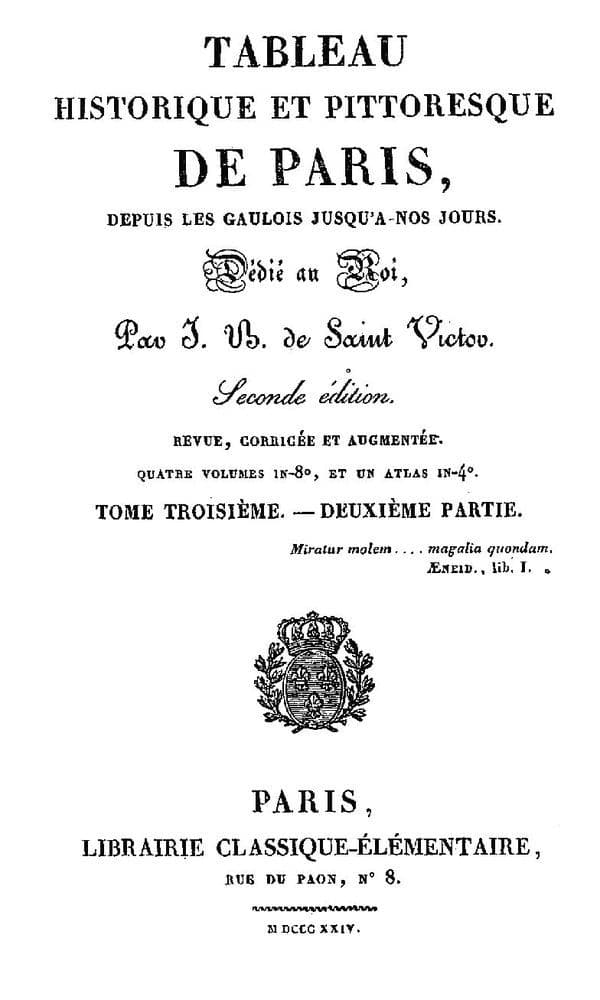
Tableau Historique Et Pittoresque De Paris Depuis Les Gaulois Jusqu'à Nos Jours (volume 5/8)
1822
Tableau Historique Et Pittoresque De Paris Depuis Les Gaulois Jusqu'à Nos Jours (volume 5/8)
1822
A historical account likely written in the early 19th century. The book provides a comprehensive examination of the history of Paris, detailing its development from the time of the Gauls through various significant historical periods. It paints a vivid portrait of the city through its streets, neighborhoods, and significant events, likely intertwining political, social, and cultural aspects. The opening of the work sets the stage for a detailed exploration of the quarter around Place Maubert, outlining its geographical boundaries and its historical significance up to 1789. It begins to delve into the tumultuous events during the reigns of Kings Henri II, François II, Charles IX, Henri III, and Henri IV, highlighting the conflicts between faiths and the resulting sociopolitical turmoil. The author emphasizes the role of Paris as a center of revolutionary movements and religious strife, introducing characters and occurrences that foreshadow major developments in both the city's fate and France's history at large.
Editions
X-Ray
King of France who died in 1559. Showed strong opposition to Protestant heresy and maintained royal authority against parliamentary resistance.
Queen mother who dominated French politics during her sons' reigns. Pursued a policy of balancing Catholic and Protestant factions for political advantage.
Powerful Catholic leader and military commander. Father of the later Duke of Guise, he was a staunch defender of Catholicism and royal authority.
Protestant leader and military commander. Gained influence over Charles IX but was assassinated in the St. Bartholomew's Day Massacre.
About Tableau Historique Et Pittoresque De Paris Depuis Les Gaulois Jusqu'à Nos Jours (volume 5/8)
Chapter Summaries
- 1
- Describes the geographical boundaries and institutional composition of this Parisian quarter in 1789, setting the historical context.
- 2
- Chronicles the reign of Henri II and the rise of Protestant influence, leading to the religious wars that would dominate French politics.
- 3
- Details the emergence of the Guise family as champions of Catholicism and their conflicts with Protestant leaders like Coligny.
Key Themes
- Religious Authority vs Political Power
- The text explores the tension between papal authority and royal sovereignty, arguing that separating political power from religious guidance leads to chaos and moral corruption.
- The Consequences of Weak Leadership
- Demonstrates how indecisive rulers like Henri III create power vacuums that allow factions to flourish and civil war to erupt.
- Fanaticism and Violence
- Examines how religious zeal, when divorced from proper authority, can lead to extremism and atrocities on both sides of the conflict.
Characters
- Henri II(major)
- King of France who died in 1559. Showed strong opposition to Protestant heresy and maintained royal authority against parliamentary resistance.
- Catherine de Médicis(major)
- Queen mother who dominated French politics during her sons' reigns. Pursued a policy of balancing Catholic and Protestant factions for political advantage.
- François, Duke of Guise(major)
- Powerful Catholic leader and military commander. Father of the later Duke of Guise, he was a staunch defender of Catholicism and royal authority.
- Admiral Coligny(major)
- Protestant leader and military commander. Gained influence over Charles IX but was assassinated in the St. Bartholomew's Day Massacre.
- Charles IX(major)
- King of France from 1560-1574. Weak ruler dominated by his mother Catherine, ordered the St. Bartholomew's Day Massacre under pressure.
- Henri III(major)
- Last Valois king of France (1574-1589). Weak and indecisive ruler who struggled against both Catholic League and Protestant factions.
Link to this book
Add a free, dofollow link to Lex on your blog, forum, syllabus, or reading list.

<a href="https://lex-books.com/book/tableau-historique-et-pittoresque-de-paris-depuis-les-gaulois-jusqu-nos-jours-vo-22e63ca5-7301-464b-8489-4536be9a5c5b"><img src="https://lex-books.com/badges/read-on-lex.svg" alt="Read Tableau Historique Et Pittoresque De Paris Depuis Les Gaulois Jusqu'à Nos Jours (volume 5/8) by J. B. de Saint-Victor free on Lex" width="160" height="40"></a>[](https://lex-books.com/book/tableau-historique-et-pittoresque-de-paris-depuis-les-gaulois-jusqu-nos-jours-vo-22e63ca5-7301-464b-8489-4536be9a5c5b)[url=https://lex-books.com/book/tableau-historique-et-pittoresque-de-paris-depuis-les-gaulois-jusqu-nos-jours-vo-22e63ca5-7301-464b-8489-4536be9a5c5b][img]https://lex-books.com/badges/read-on-lex.svg[/img][/url]Read Tableau Historique Et Pittoresque De Paris Depuis Les Gaulois Jusqu'à Nos Jours (volume 5/8) by J. B. de Saint-Victor free on Lex: https://lex-books.com/book/tableau-historique-et-pittoresque-de-paris-depuis-les-gaulois-jusqu-nos-jours-vo-22e63ca5-7301-464b-8489-4536be9a5c5bCite this book
Reading this edition for a paper or guide? Copy a citation.
Saint-Victor, J. B. de. Tableau Historique Et Pittoresque De Paris Depuis Les Gaulois Jusqu'à Nos Jours (volume 5/8). Lex, lex-books.com/book/tableau-historique-et-pittoresque-de-paris-depuis-les-gaulois-jusqu-nos-jours-vo-22e63ca5-7301-464b-8489-4536be9a5c5b.Saint-Victor, J. B. D. (1822). Tableau Historique Et Pittoresque De Paris Depuis Les Gaulois Jusqu'à Nos Jours (volume 5/8). Lex. https://lex-books.com/book/tableau-historique-et-pittoresque-de-paris-depuis-les-gaulois-jusqu-nos-jours-vo-22e63ca5-7301-464b-8489-4536be9a5c5bSaint-Victor, J. B. de. Tableau Historique Et Pittoresque De Paris Depuis Les Gaulois Jusqu'à Nos Jours (volume 5/8). Lex. https://lex-books.com/book/tableau-historique-et-pittoresque-de-paris-depuis-les-gaulois-jusqu-nos-jours-vo-22e63ca5-7301-464b-8489-4536be9a5c5b.