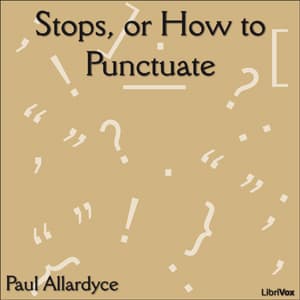
stops", or How to Punctuate: A Practical Handbook for Writers and Students
stops", or How to Punctuate: A Practical Handbook for Writers and Students
Before punctuation became automatic, writers had to understand why it mattered. Paul Allardyce's 1884 handbook makes the case that punctuation is not mere convention but a living architecture of thought. His central argument: punctuation exists to reveal how ideas group together, to show readers which words belong in intimate conversation and which stand apart. A misplaced comma isn't just a technical error; it's a misstatement of meaning. What elevates this Victorian manual beyond a dry rulebook is Allardyce's wit and philosophical restlessness. He argues that good punctuation is invisible precisely because it does its job so well, guiding readers through a text without calling attention to itself. The book systematically examines each mark (the full stop, comma, semicolon, colon, and their lesser kin) not as isolated tools but as a unified system for representing thought's natural rhythms. Examples range from the pedantic to the deliberately absurd, demonstrating how the same words can say radically different things depending on where the marks fall. For writers who sense that something is wrong with their prose but cannot name it, Allardyce remains remarkably useful. He offers not just rules but a way of thinking about clarity that precedes modern style guides. The book endures because it treats punctuation as logic made visible.
Editions
Link to this book
Add a free, dofollow link to Lex on your blog, forum, syllabus, or reading list.

<a href="https://lex-books.com/book/stops-or-how-to-punctuate-a-practical-handbook-for-writers-and-students-0db83e80-8006-4272-a584-67d94f0e50e5"><img src="https://lex-books.com/badges/read-on-lex.svg" alt="Read stops", or How to Punctuate: A Practical Handbook for Writers and Students by Paul Allardyce free on Lex" width="160" height="40"></a>[](https://lex-books.com/book/stops-or-how-to-punctuate-a-practical-handbook-for-writers-and-students-0db83e80-8006-4272-a584-67d94f0e50e5)[url=https://lex-books.com/book/stops-or-how-to-punctuate-a-practical-handbook-for-writers-and-students-0db83e80-8006-4272-a584-67d94f0e50e5][img]https://lex-books.com/badges/read-on-lex.svg[/img][/url]Read stops", or How to Punctuate: A Practical Handbook for Writers and Students by Paul Allardyce free on Lex: https://lex-books.com/book/stops-or-how-to-punctuate-a-practical-handbook-for-writers-and-students-0db83e80-8006-4272-a584-67d94f0e50e5Cite this book
Reading this edition for a paper or guide? Copy a citation.
Allardyce, Paul. stops", or How to Punctuate: A Practical Handbook for Writers and Students. Lex, lex-books.com/book/stops-or-how-to-punctuate-a-practical-handbook-for-writers-and-students-0db83e80-8006-4272-a584-67d94f0e50e5.Allardyce, P. (n.d.). stops", or How to Punctuate: A Practical Handbook for Writers and Students. Lex. https://lex-books.com/book/stops-or-how-to-punctuate-a-practical-handbook-for-writers-and-students-0db83e80-8006-4272-a584-67d94f0e50e5Allardyce, Paul. stops", or How to Punctuate: A Practical Handbook for Writers and Students. Lex. https://lex-books.com/book/stops-or-how-to-punctuate-a-practical-handbook-for-writers-and-students-0db83e80-8006-4272-a584-67d94f0e50e5.