Self-Control, Its Kingship and Majesty
1907
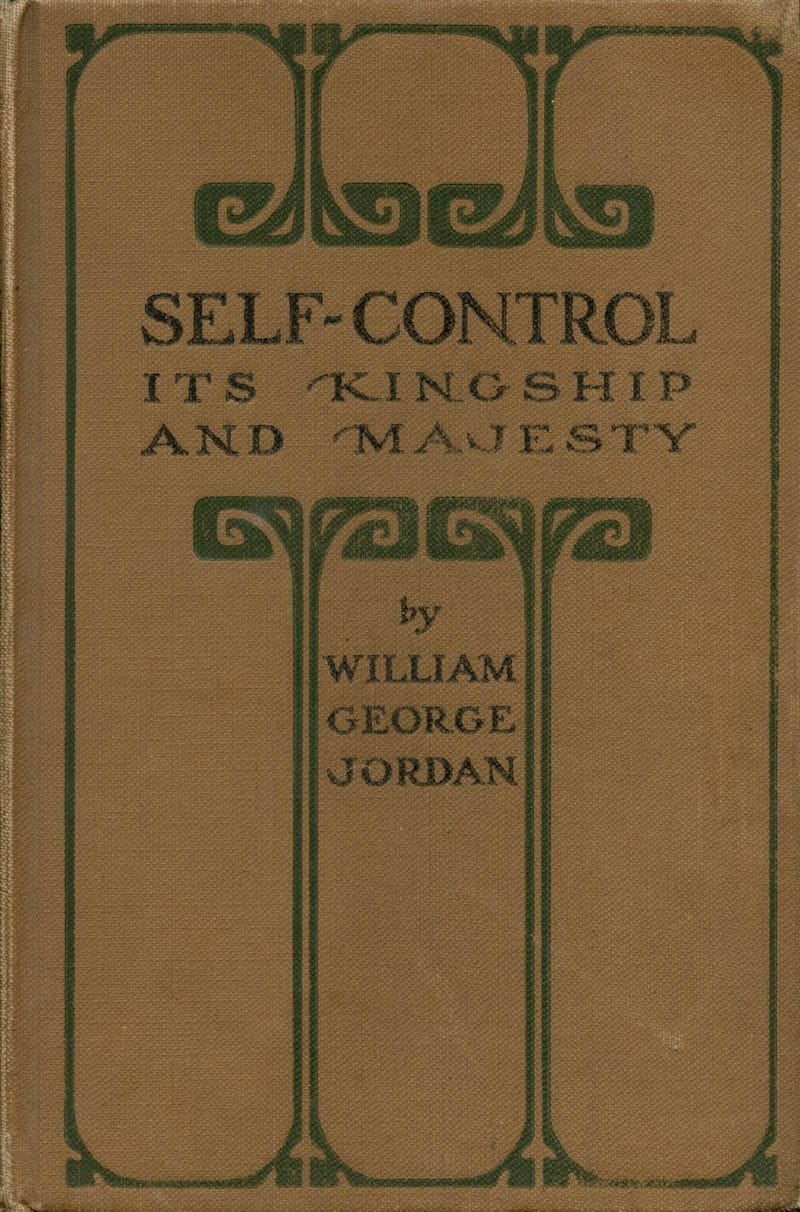
In an age of distraction and instant gratification, William George Jordan offers something radical: the ancient idea that we are both the servants and the sovereigns of our own lives. Written in 1907, this philosophical treatise argues that true freedom does not come from casting off restraint, but from mastering it. Jordan contends that humans possess a dual nature - we are products of circumstance, yes, but we are also self-creators, capable of shaping our destinies through the cultivation of self-control. He uses the striking metaphor of kingship: surrender to one's weaknesses creates a slave to circumstances, while mastery of oneself transforms an ordinary person into the ruler of their own fate. The prose carries the rhetorical elegance of turn-of-the-century moral philosophy, yet feels startlingly modern in its insistence on personal agency. This is not a quick fix or a productivity hack - it is a serious meditation on the nature of the self and the responsibility we bear for our own becoming. For readers tired of shallow self-help and seeking something with philosophical weight, Jordan's quiet, commanding voice offers a path to genuine inner sovereignty.
Editions
X-Ray
“Everything that is great in life is the product of slow growth; the newer, and greater, and higher, and nobler the work, the slower is its growth, the surer is its lasting success. Mushrooms attain their full power in a night; oaks require decades. A fad lives its life in a few weeks; a philosophy lives through generations and centuries. If you are sure you are right, do not let the voice of the world, or of friends, or of family swerve you for a moment from your purpose.””
— William George Jordan
“All the athletic exercises in the world are no power to the individual unless he compel those bars and dumbbells to yield to him and strengthen muscle; the power for which he himself pays in effort.””
— William George Jordan
Link to this book
Add a free, dofollow link to Lex on your blog, forum, syllabus, or reading list.

<a href="https://lex-books.com/book/self-control-its-kingship-and-majesty-6b7490fc-8d70-4881-a28d-013ed1e129bd"><img src="https://lex-books.com/badges/read-on-lex.svg" alt="Read Self-Control, Its Kingship and Majesty by William George Jordan free on Lex" width="160" height="40"></a>[](https://lex-books.com/book/self-control-its-kingship-and-majesty-6b7490fc-8d70-4881-a28d-013ed1e129bd)[url=https://lex-books.com/book/self-control-its-kingship-and-majesty-6b7490fc-8d70-4881-a28d-013ed1e129bd][img]https://lex-books.com/badges/read-on-lex.svg[/img][/url]Read Self-Control, Its Kingship and Majesty by William George Jordan free on Lex: https://lex-books.com/book/self-control-its-kingship-and-majesty-6b7490fc-8d70-4881-a28d-013ed1e129bdCite this book
Reading this edition for a paper or guide? Copy a citation.
Jordan, William George. Self-Control, Its Kingship and Majesty. Lex, lex-books.com/book/self-control-its-kingship-and-majesty-6b7490fc-8d70-4881-a28d-013ed1e129bd.Jordan, W. G. (1907). Self-Control, Its Kingship and Majesty. Lex. https://lex-books.com/book/self-control-its-kingship-and-majesty-6b7490fc-8d70-4881-a28d-013ed1e129bdJordan, William George. Self-Control, Its Kingship and Majesty. Lex. https://lex-books.com/book/self-control-its-kingship-and-majesty-6b7490fc-8d70-4881-a28d-013ed1e129bd.