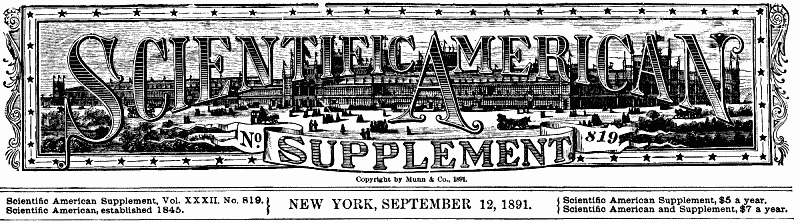
Scientific American Supplement No. 819, September 12, 1891
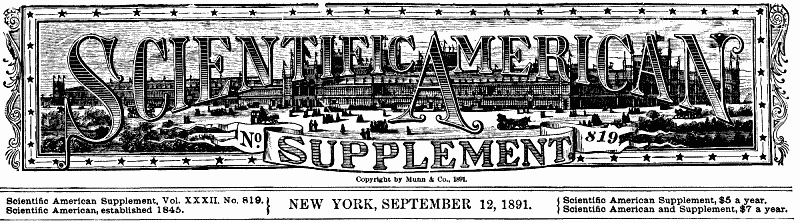
Scientific American Supplement No. 819, September 12, 1891
This is a dispatch from the edge of the known world, September 1891. The Scientific American Supplement gathers the finest scientific minds of the era to report on discoveries that would reshape the century: hydrogen and oxygen produced through the electrolysis of water, unlocking industrial possibilities that would transform manufacturing and medicine. But the pages also venture into meteorology, naval engineering, veterinary science, military tactics, and metallurgy, a portrait of an age when one publication could contain the totality of human knowledge on such subjects. What makes this supplement compelling isn't just what it gets right, but what it doesn't yet know. The reader witnesses science at an inflection point, between the discoveries that would become Einstein's relativity and the quantum world, and an earlier age of mechanical wonder. The articles on gas production and electrolysis read like the birth certificates of technologies we now take for granted. For historians of science, Victorian enthusiasts, or anyone curious about how our ancestors understood their world, this supplement offers an unfiltered window into late 19th-century thought.
Editions

X-Ray
Link to this book
Add a free, dofollow link to Lex on your blog, forum, syllabus, or reading list.

<a href="https://lex-books.com/book/scientific-american-supplement-no-819-september-12-1891-196ff09f-b358-463a-9f9e-8fcba95da6d0"><img src="https://lex-books.com/badges/read-on-lex.svg" alt="Read Scientific American Supplement No. 819, September 12, 1891 by Various free on Lex" width="160" height="40"></a>[](https://lex-books.com/book/scientific-american-supplement-no-819-september-12-1891-196ff09f-b358-463a-9f9e-8fcba95da6d0)[url=https://lex-books.com/book/scientific-american-supplement-no-819-september-12-1891-196ff09f-b358-463a-9f9e-8fcba95da6d0][img]https://lex-books.com/badges/read-on-lex.svg[/img][/url]Read Scientific American Supplement No. 819, September 12, 1891 by Various free on Lex: https://lex-books.com/book/scientific-american-supplement-no-819-september-12-1891-196ff09f-b358-463a-9f9e-8fcba95da6d0Cite this book
Reading this edition for a paper or guide? Copy a citation.
Various. Scientific American Supplement No. 819, September 12, 1891. Lex, lex-books.com/book/scientific-american-supplement-no-819-september-12-1891-196ff09f-b358-463a-9f9e-8fcba95da6d0.Various (n.d.). Scientific American Supplement No. 819, September 12, 1891. Lex. https://lex-books.com/book/scientific-american-supplement-no-819-september-12-1891-196ff09f-b358-463a-9f9e-8fcba95da6d0Various. Scientific American Supplement No. 819, September 12, 1891. Lex. https://lex-books.com/book/scientific-american-supplement-no-819-september-12-1891-196ff09f-b358-463a-9f9e-8fcba95da6d0.