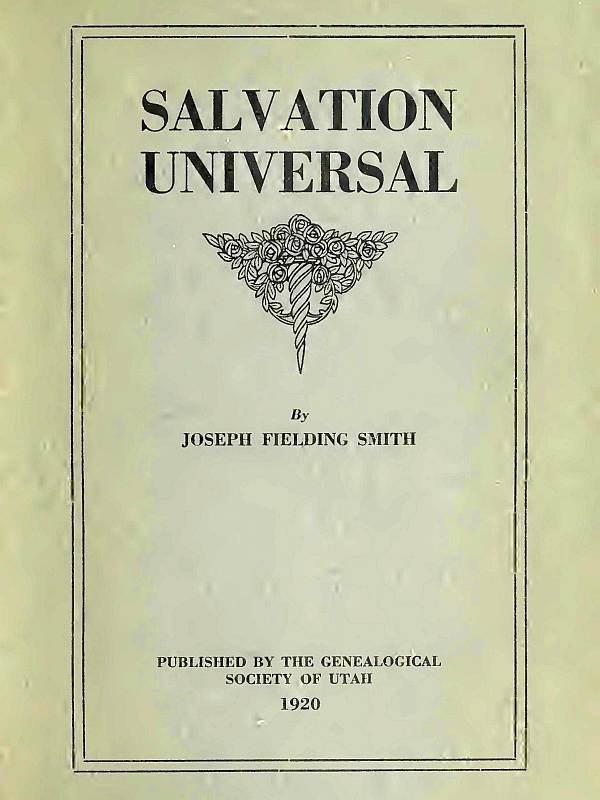
Salvation Universal
1920
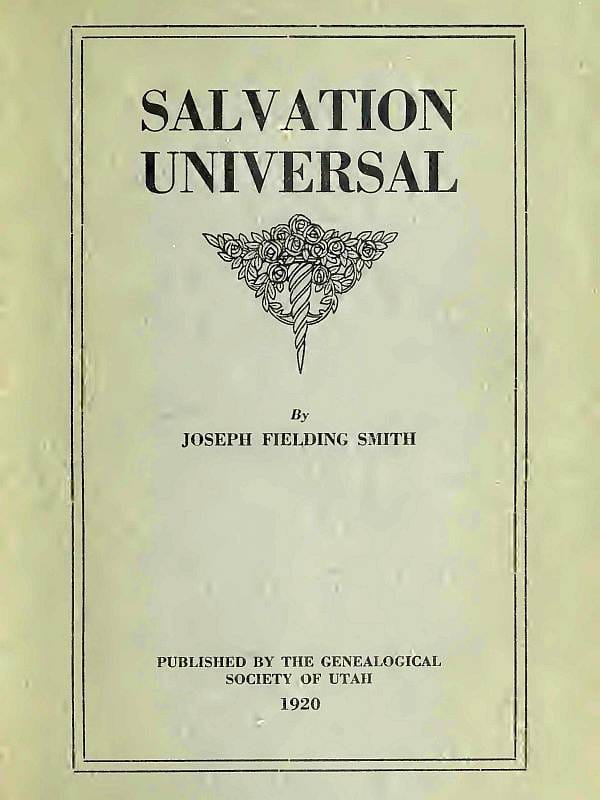
A foundational text of Latter-day Saint theology, written in 1920 by Joseph Fielding Smith, who would later become president of the Church of Jesus Christ of Latter-day Saints. Smith argues that God's salvation extends beyond the mortal life of the individual, encompassing both the living and those who died without opportunity to receive the gospel. The book's central contention is that vicarious temple work, baptism, confirmation, and other ordinances performed by the living on behalf of the dead, creates a binding link between generations, allowing deceased ancestors to receive redemption through the atonement of Jesus Christ. Smith frames this as a family enterprise: humanity's choices in mortality carry eternal weight, but divine mercy reaches across the veil to offer redemption to all who could not choose in life. The text articulates a distinctive doctrine of universal salvation within Mormonism: not automatic forgiveness, but a comprehensive plan in which the living bear sacred responsibility for their dead. For readers interested in American religious thought, the development of Mormon doctrine, or questions of grace, death, and family bonds that transcend mortality.
Editions
Link to this book
Add a free, dofollow link to Lex on your blog, forum, syllabus, or reading list.

<a href="https://lex-books.com/book/salvation-universal-0cf3cfd8-3d8b-4e9a-b3fc-dac452e77515"><img src="https://lex-books.com/badges/read-on-lex.svg" alt="Read Salvation Universal by Joseph Fielding Smith free on Lex" width="160" height="40"></a>[](https://lex-books.com/book/salvation-universal-0cf3cfd8-3d8b-4e9a-b3fc-dac452e77515)[url=https://lex-books.com/book/salvation-universal-0cf3cfd8-3d8b-4e9a-b3fc-dac452e77515][img]https://lex-books.com/badges/read-on-lex.svg[/img][/url]Read Salvation Universal by Joseph Fielding Smith free on Lex: https://lex-books.com/book/salvation-universal-0cf3cfd8-3d8b-4e9a-b3fc-dac452e77515Cite this book
Reading this edition for a paper or guide? Copy a citation.
Smith, Joseph Fielding. Salvation Universal. Lex, lex-books.com/book/salvation-universal-0cf3cfd8-3d8b-4e9a-b3fc-dac452e77515.Smith, J. F. (1920). Salvation Universal. Lex. https://lex-books.com/book/salvation-universal-0cf3cfd8-3d8b-4e9a-b3fc-dac452e77515Smith, Joseph Fielding. Salvation Universal. Lex. https://lex-books.com/book/salvation-universal-0cf3cfd8-3d8b-4e9a-b3fc-dac452e77515.