Russia
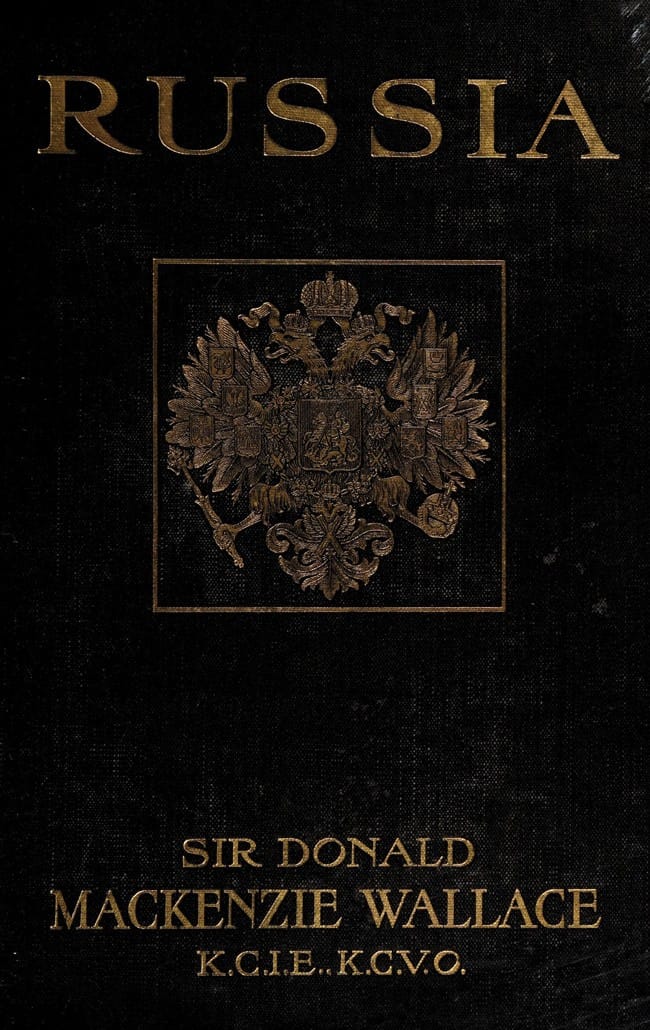
Russia
In the 1870s, a young Scottish journalist named Donald Mackenzie Wallace arrived in Russia with questions that would consume six years of his life. What he found was a realm of staggering contradictions: a vast empire hurtling toward modernization yet rooted in structures that felt medieval, railways linking imperial capitals to villages where serfdom had only recently died, and a people whose warmth and chaos defied every orderly expectation. Wallace doesn't merely observe from the outside. He learns the language, befriends peasants and princes alike, endures the infamous Russian mud, and sits in cramped railway compartments watching an empire scroll past his window. His account is the rare travel book that combines anthropological curiosity with genuine humor, whether he's describing the peculiarities of Russian hotels or the labyrinthine frustrations of bureaucratic paperwork. Here is Russia before the revolutions, before the ideologues, captured in all its beautiful disorder. For readers who want to understand how the West once saw Russia, and for anyone fascinated by the gap between imperial myth and provincial reality, Wallace remains an indispensable guide.
Editions

X-Ray
“As a whole, a village fete in Russia is a saddening spectacle. It affords a new proof”
— Donald Mackenzie Wallace
“Every married peasant strives to have a house of his own, and many of them, in order to defray the necessary expenses, have been obliged to contract debts. This is a very serious matter. Even if the peasants could obtain money at five or six per cent., the position of the debtors would be bad enough, but it is in reality much worse, for the village usurers consider twenty or twenty-five per cent. a by no means exorbitant rate of interest. A laudable attempt has been made to remedy this state of things by village banks, but these have proved successful only in certain exceptional localities. As a rule the peasant who contracts debts has a hard struggle to pay the interest in ordinary times, and when some misfortune overtakes him”
— Donald Mackenzie Wallace
“In judging of the Russian priesthood of the present time, we must call to mind this severe school through which it has passed, and we must also take into consideration the spirit which has been for centuries predominant in the Eastern Church”
— Donald Mackenzie Wallace
“It is commonly supposed that Russians have been endowed by Nature with a peculiar linguistic talent. Their own language, it is said, is so difficult that they have no difficulty in acquiring others. This common belief requires, as it seems to me, some explanation. That highly educated Russians are better linguists than the educated classes of Western Europe there can be no possible doubt, for they almost always speak French, and often English and German also. The question, however, is whether this is the result of a psychological peculiarity, or of other causes. Now, without venturing to deny the existence of a natural faculty, I should say that the other causes have at least exercised a powerful influence. Any Russian who wishes to be regarded as civilise must possess at least one foreign language; and, as a consequence of this, the children of the upper classes are always taught at least French in their infancy. Many households comprise a German nurse, a French tutor, and an English governess; and the children thus become accustomed from their earliest years to the use of these three languages. Besides this, Russian is phonetically very rich and contains nearly all the sounds which are to be found in West-European tongues. Perhaps on the whole it would be well to apply here the Darwinian theory, and suppose that the Russian Noblesse, having been obliged for several generations to acquire foreign languages, have gradually developed a hereditary polyglot talent.””
— Donald Mackenzie Wallace
“Besides this, the grammatical forms and constructions in Russian are very peculiar, and present a great many strange irregularities. As an illustration of this we may take the future tense. The Russian verb has commonly a simple and a frequentative future. The latter is always regularly formed by means of an auxiliary with the infinitive, as in English, but the former is constructed in a variety of ways, for which no rule can be given, so that the simple future of each individual verb must be learned by a pure effort of memory. In many verbs it is formed by prefixing a preposition, but it is impossible to determine by rule which preposition should be used. Thus idu (I go) becomes poidu; pishu (I write) becomes napishu; pyu (I drink) becomes vuipyu, and so on.””
— Donald Mackenzie Wallace
“Even for one who possesses a natural facility for acquiring foreign tongues, the learning of Russian is by no means an easy task. Though it is essentially an Aryan language like our own, and contains only a slight intermixture of Tartar words,”
— Donald Mackenzie Wallace
“So long as you are in Russia, you had much better let yourself be quietly robbed than use any violence against the robber. It is less trouble, and it is cheaper in the long run. If you do not, you may unexpectedly find yourself some fine morning in prison! You must know that many of the young justices belong to the new school of morals." "What is that? I have not heard of any new discoveries lately in the sphere of speculative ethics." "Well, to tell you the truth, I am not one of the initiated, and I can only tell you what I hear. So far as I have noticed, the representatives of the new doctrine talk chiefly about Gumannost' and Tchelovetcheskoe dostoinstvo. You know what these words mean?" "Humanity, or rather humanitarianism and human dignity," I replied, not sorry to give a proof that I was advancing in my studies. "There, again, you allow your dictionary and your priest to mislead you. These terms, when used by a Russian, cover much more than we understand by them, and those who use them most frequently have generally a special tenderness for all kinds of malefactors. In the old times, malefactors were popularly believed to be bad, dangerous people; but it has been lately discovered that this is a delusion. A young proprietor who lives not far off assures me that they are the true Protestants, and the most powerful social reformers! They protest practically against those imperfections of social organisation of which they are the involuntary victims. The feeble, characterless man quietly submits to his chains; the bold, generous, strong man breaks his fetters, and helps others to do the same. A very ingenious defence of all kinds of rascality, isn't it?””
— Donald Mackenzie Wallace
“Another half hour passes, and one of the justices drives up in his tarantass. Perhaps he is a glib-tongued gentleman, and assures me that the proceedings will commence at once: 'Sei tchas! sei tchas!' Don't believe what the priest or the dictionary tells you about the meaning of that expression. The dictionary will tell you that it means 'immediately,' but that's all nonsense. In the mouth of a Russian it means 'in an hour,' 'next week,' 'in a year or two,' 'never'”
— Donald Mackenzie Wallace
“Thus arose that silent conflict and that smouldering mutual enmity which almost always result from the contact of the Teuton with the Slav. The serfs instinctively regretted the good old times, when they lived under the rough-and-ready patriarchal rule of their masters, assisted by a native "burmister," or overseer, who was one of themselves. The burmister had not always been honest in his dealings with them, and the master had often, when in anger, ordered severe punishments to be inflicted; but the burmister had not attempted to make them change their old habits, and had shut his eyes to many little sins of emission and commission, whilst the master was always ready to assist them in difficulties, and commonly treated them in a kindly, familiar way. As the old Russian proverb has it, "Where danger is, there too is kindly forgiveness." Karl Karl'itch, on the contrary, was the personification of uncompassionate, inflexible law. Blind rage and compassionate kindliness were alike foreign to his system of government. If he had any feeling towards the serfs, it was one of chronic contempt. The word durak (blockhead) was constantly on his lips, and when any bit of work was well done, he took it as a matter of course, and never thought of giving a word of approval or encouragement.””
— Donald Mackenzie Wallace
Link to this book
Add a free, dofollow link to Lex on your blog, forum, syllabus, or reading list.

<a href="https://lex-books.com/book/russia-7d357ad4-e32c-4f98-af6d-431f1ab460ce"><img src="https://lex-books.com/badges/read-on-lex.svg" alt="Read Russia by Donald Mackenzie Wallace free on Lex" width="160" height="40"></a>[](https://lex-books.com/book/russia-7d357ad4-e32c-4f98-af6d-431f1ab460ce)[url=https://lex-books.com/book/russia-7d357ad4-e32c-4f98-af6d-431f1ab460ce][img]https://lex-books.com/badges/read-on-lex.svg[/img][/url]Read Russia by Donald Mackenzie Wallace free on Lex: https://lex-books.com/book/russia-7d357ad4-e32c-4f98-af6d-431f1ab460ceCite this book
Reading this edition for a paper or guide? Copy a citation.
Wallace, Donald Mackenzie. Russia. Lex, lex-books.com/book/russia-7d357ad4-e32c-4f98-af6d-431f1ab460ce.Wallace, D. M. (n.d.). Russia. Lex. https://lex-books.com/book/russia-7d357ad4-e32c-4f98-af6d-431f1ab460ceWallace, Donald Mackenzie. Russia. Lex. https://lex-books.com/book/russia-7d357ad4-e32c-4f98-af6d-431f1ab460ce.