Quand La Terre Trembla
1921
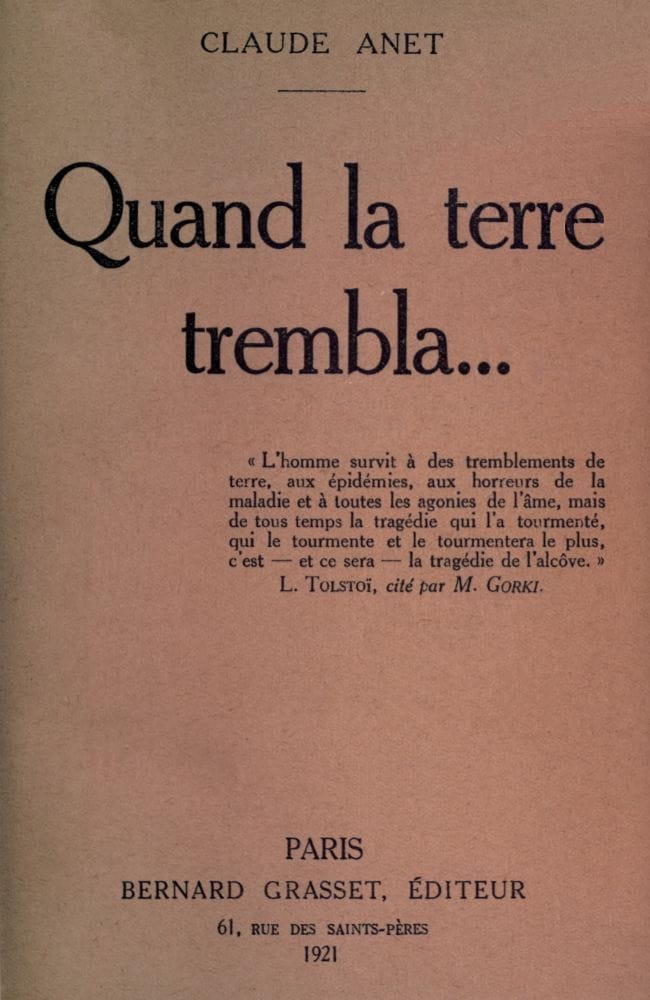
Claude Anet witnessed the Russian Revolution firsthand, and in this haunting 1921 novel, he transcribes its chaos through the body of one young woman. Lydia, daughter of a prince, wanders snowy Petersburg on March 10, 1917, caught between the crack of military boots and the roar of crowds demanding bread. She has read about the French Revolution in books, imagined it as glory. Now history arrives at her doorstep, and she must decide what she believes. Anet renders revolution not as ideology but as sensation: the push of bodies, the roar that drowns thought, the strange safety a stranger's gaze can offer in a dissolving world. Lydia's sheltered world the operas, the society dinners, her father's protected world crumbles with each passing hour. She is drawn to the fervor yet frightened by it, wanting to understand yet uncertain what understanding costs. A mysterious man in the crowd becomes her anchor, her only fixed point in a city tearing itself apart. This is a novel about the moment privilege meets history and cannot look away. For readers who crave historical fiction that prioritizes atmosphere over action, that understands revolution as personal earthquake.
Editions

Link to this book
Add a free, dofollow link to Lex on your blog, forum, syllabus, or reading list.

<a href="https://lex-books.com/book/quand-la-terre-trembla-48c5b69c-5ede-4a3c-b0a8-c9f4bc2de1f5"><img src="https://lex-books.com/badges/read-on-lex.svg" alt="Read Quand La Terre Trembla by Claude Anet free on Lex" width="160" height="40"></a>[](https://lex-books.com/book/quand-la-terre-trembla-48c5b69c-5ede-4a3c-b0a8-c9f4bc2de1f5)[url=https://lex-books.com/book/quand-la-terre-trembla-48c5b69c-5ede-4a3c-b0a8-c9f4bc2de1f5][img]https://lex-books.com/badges/read-on-lex.svg[/img][/url]Read Quand La Terre Trembla by Claude Anet free on Lex: https://lex-books.com/book/quand-la-terre-trembla-48c5b69c-5ede-4a3c-b0a8-c9f4bc2de1f5Cite this book
Reading this edition for a paper or guide? Copy a citation.
Anet, Claude. Quand La Terre Trembla. Lex, lex-books.com/book/quand-la-terre-trembla-48c5b69c-5ede-4a3c-b0a8-c9f4bc2de1f5.Anet, C. (1921). Quand La Terre Trembla. Lex. https://lex-books.com/book/quand-la-terre-trembla-48c5b69c-5ede-4a3c-b0a8-c9f4bc2de1f5Anet, Claude. Quand La Terre Trembla. Lex. https://lex-books.com/book/quand-la-terre-trembla-48c5b69c-5ede-4a3c-b0a8-c9f4bc2de1f5.