Preliminary Discourse on the Study of Natural Philosophy
1830
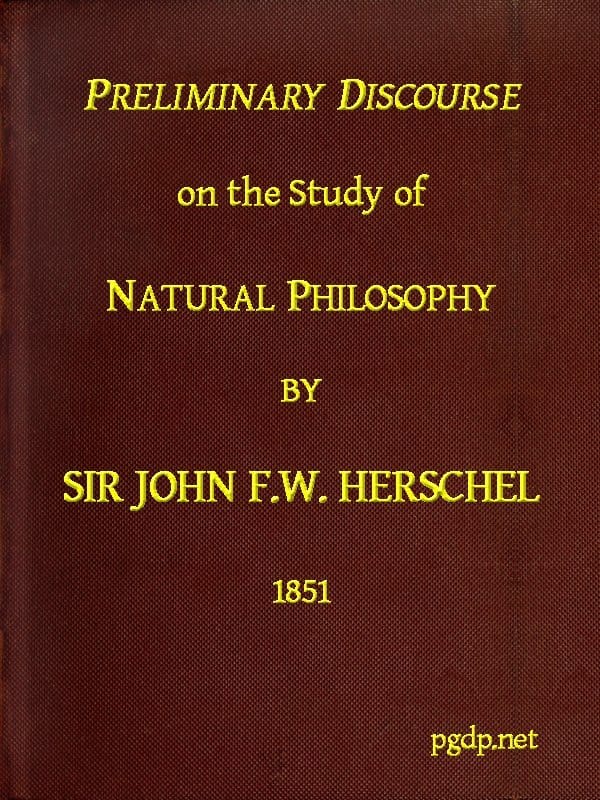
Preliminary Discourse on the Study of Natural Philosophy
1830
This 1830 masterwork essentially invented the modern concept of scientific methodology decades before the term "scientist" even entered English. John Herschel, the leading British scientist of his age, distills the philosophy of empirical inquiry into a rigorous intellectual framework: observation, experimentation, hypothesis, and verification as a unified way of understanding nature. The book reads less like a dry treatise and more like a passionate argument for systematic curiosity as humanity's highest calling. Herschel's prose sparkles with conviction, arguing that careful reasoning about the physical world doesn't diminish wonder but multiplies it. This is the book that shaped Darwin's intellectual formation, that helped establish science as a profession, that captures the moment when modern empiricism came into its own. For anyone curious about where our scientific worldview actually came from, this is a direct window into the mind of the Victorian age's greatest scientific philosopher.
Editions
X-Ray
“Science is the knowledge of many, orderly and methodically digested and arranged, so as to become attainable by one.””
— John F. W. Herschel
“To the natural philosopher there is no natural object unimportant or trifling. From the least of nature's works he may learn the greatest lessons.””
— John F. W. Herschel
Link to this book
Add a free, dofollow link to Lex on your blog, forum, syllabus, or reading list.

<a href="https://lex-books.com/book/preliminary-discourse-on-the-study-of-natural-philosophy-5240beb8-e74c-431b-a6b5-c160e21c4211"><img src="https://lex-books.com/badges/read-on-lex.svg" alt="Read Preliminary Discourse on the Study of Natural Philosophy by John F. W. Herschel free on Lex" width="160" height="40"></a>[](https://lex-books.com/book/preliminary-discourse-on-the-study-of-natural-philosophy-5240beb8-e74c-431b-a6b5-c160e21c4211)[url=https://lex-books.com/book/preliminary-discourse-on-the-study-of-natural-philosophy-5240beb8-e74c-431b-a6b5-c160e21c4211][img]https://lex-books.com/badges/read-on-lex.svg[/img][/url]Read Preliminary Discourse on the Study of Natural Philosophy by John F. W. Herschel free on Lex: https://lex-books.com/book/preliminary-discourse-on-the-study-of-natural-philosophy-5240beb8-e74c-431b-a6b5-c160e21c4211Cite this book
Reading this edition for a paper or guide? Copy a citation.
Herschel, John F. W.. Preliminary Discourse on the Study of Natural Philosophy. Lex, lex-books.com/book/preliminary-discourse-on-the-study-of-natural-philosophy-5240beb8-e74c-431b-a6b5-c160e21c4211.Herschel, J. F. W. (1830). Preliminary Discourse on the Study of Natural Philosophy. Lex. https://lex-books.com/book/preliminary-discourse-on-the-study-of-natural-philosophy-5240beb8-e74c-431b-a6b5-c160e21c4211Herschel, John F. W.. Preliminary Discourse on the Study of Natural Philosophy. Lex. https://lex-books.com/book/preliminary-discourse-on-the-study-of-natural-philosophy-5240beb8-e74c-431b-a6b5-c160e21c4211.