Pan Tadeusz
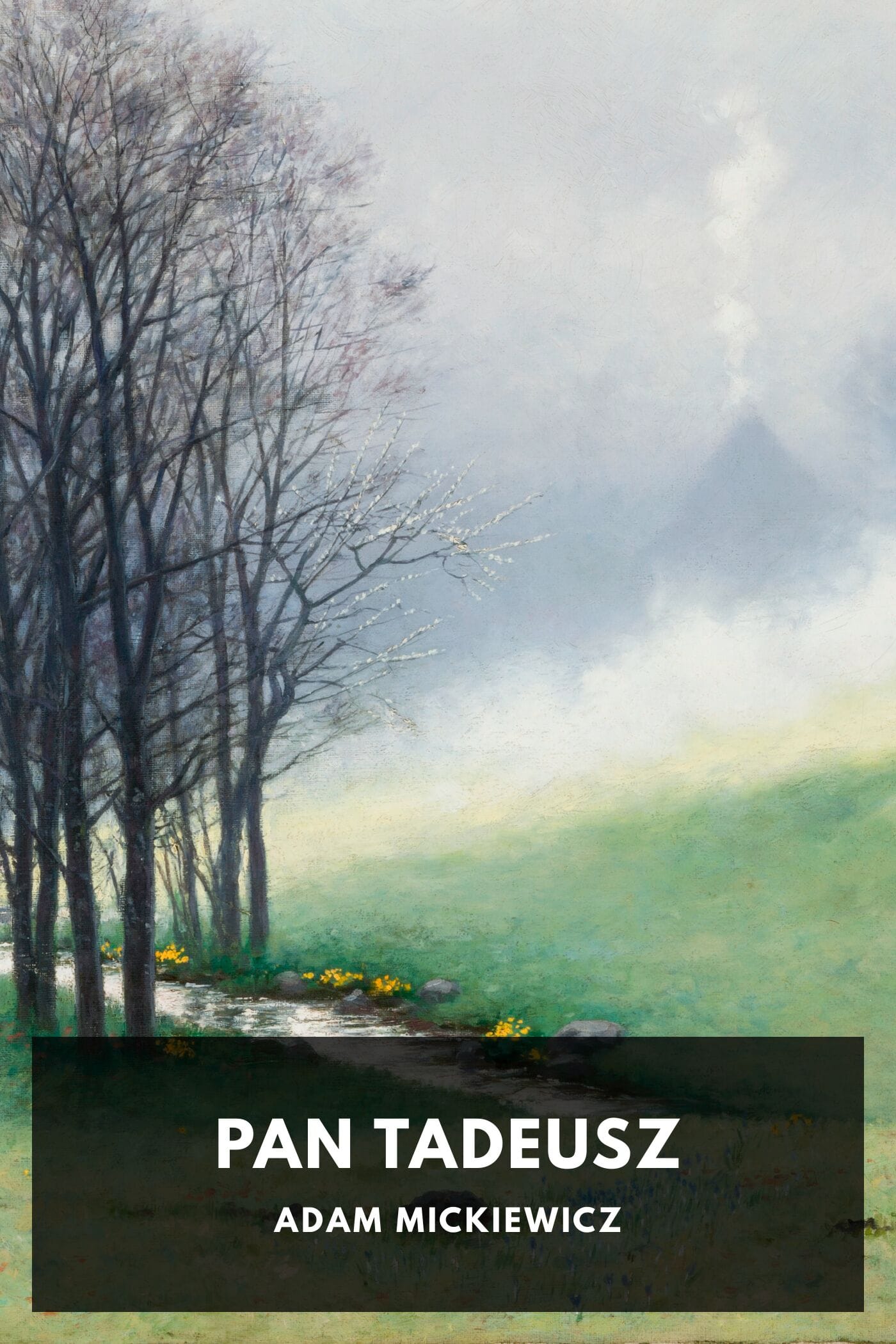
Adam Mickiewicz's national epic plunges into the twilight years of the Polish-Lithuanian Commonwealth, just before Napoleon's invasion. We follow young Tadeusz Soplica, returning from his studies to the ancestral manor, where old feuds simmer between noble families—the Soplicas and the Horeszkos—even as a new generation, embodied by Tadeusz and the enchanting Zosia, attempts to bridge the divide. Against a backdrop of bucolic Lithuanian landscapes and vibrant gentry life, Mickiewicz masterfully weaves together romance, political intrigue, and the ever-present shadow of Russian occupation, painting an intricate fresco of a nation on the brink of profound change. More than a mere tale of star-crossed lovers and squabbling nobles, *Pan Tadeusz* is a symphonic celebration of Polish identity, a lyrical lament for a lost golden age, and a defiant act of cultural preservation. Mickiewicz, writing in exile, conjured a homeland so vividly—its customs, its landscapes, its very soul—that the poem became a spiritual anchor for a nation without a state. Its enduring legacy lies not just in its poetic brilliance and narrative sweep, but in its power to forge and sustain a collective memory, making it an indispensable cornerstone of European literature.
Editions

X-Ray
Young nobleman returning from education in the city to his uncle's estate. Falls in love with both Telimena and later Sophia, experiencing the confusion of first love.
Thaddeus's uncle, a respected landowner who maintains traditional Polish customs. Hosts guests and becomes involved in the political awakening.
Sophisticated woman from Petersburg, Sophia's guardian. Experienced in worldly matters and becomes romantically involved with Thaddeus.
Young aristocrat with romantic notions, heir to the Horeszko family. Becomes involved in legal disputes and eventually leads a foray against the Soplicas.
About Pan Tadeusz
Chapter Summaries
- I
- Thaddeus returns from education to his uncle's estate and meets the mysterious Telimena. The famous opening invocation to Lithuania establishes the exile's longing for homeland.
- II
- A hunt is organized and Thaddeus encounters a mysterious girl in the garden. The Count appears and learns the tragic history of the Horeszko castle from Gervasy.
- III
- The Count pursues the garden nymph while Thaddeus and Telimena have romantic encounters. Mushroom gathering provides opportunities for courtship and intrigue.
Key Themes
- Nostalgia and Lost Paradise
- The poem opens with the famous invocation to Lithuania as a lost homeland, establishing the central theme of exile's longing for an idealized past that can never be recovered.
- Tradition vs. Modernity
- The conflict between old Polish customs and new foreign influences permeates the work, from hunting traditions to social manners to political systems.
- Love and Coming of Age
- Thaddeus's romantic awakening serves as both personal growth and metaphor for Poland's national awakening, with love triangles reflecting larger social tensions.
Characters
- Thaddeus Soplica(protagonist)
- Young nobleman returning from education in the city to his uncle's estate. Falls in love with both Telimena and later Sophia, experiencing the confusion of first love.
- Judge Soplica(major)
- Thaddeus's uncle, a respected landowner who maintains traditional Polish customs. Hosts guests and becomes involved in the political awakening.
- Telimena(major)
- Sophisticated woman from Petersburg, Sophia's guardian. Experienced in worldly matters and becomes romantically involved with Thaddeus.
- The Count(major)
- Young aristocrat with romantic notions, heir to the Horeszko family. Becomes involved in legal disputes and eventually leads a foray against the Soplicas.
- Sophia (Zosia)(major)
- Young ward of Telimena, daughter of the last Horeszko. Beautiful and innocent, she is Thaddeus's destined bride.
- Gervasy (The Klucznik)(major)
- Last faithful servant of the Horeszko family, keeper of the castle keys. Seeks revenge against the Soplicas for his master's death.
Link to this book
Add a free, dofollow link to Lex on your blog, forum, syllabus, or reading list.

<a href="https://lex-books.com/book/pan-tadeusz-1fde7883-df96-48bd-b6e3-8d1c9f44306c"><img src="https://lex-books.com/badges/read-on-lex.svg" alt="Read Pan Tadeusz by Adam Mickiewicz free on Lex" width="160" height="40"></a>[](https://lex-books.com/book/pan-tadeusz-1fde7883-df96-48bd-b6e3-8d1c9f44306c)[url=https://lex-books.com/book/pan-tadeusz-1fde7883-df96-48bd-b6e3-8d1c9f44306c][img]https://lex-books.com/badges/read-on-lex.svg[/img][/url]Read Pan Tadeusz by Adam Mickiewicz free on Lex: https://lex-books.com/book/pan-tadeusz-1fde7883-df96-48bd-b6e3-8d1c9f44306cCite this book
Reading this edition for a paper or guide? Copy a citation.
Mickiewicz, Adam. Pan Tadeusz. Lex, lex-books.com/book/pan-tadeusz-1fde7883-df96-48bd-b6e3-8d1c9f44306c.Mickiewicz, A. (n.d.). Pan Tadeusz. Lex. https://lex-books.com/book/pan-tadeusz-1fde7883-df96-48bd-b6e3-8d1c9f44306cMickiewicz, Adam. Pan Tadeusz. Lex. https://lex-books.com/book/pan-tadeusz-1fde7883-df96-48bd-b6e3-8d1c9f44306c.








![Birds and Nature, Vol. 12 No. 1 [June 1902]illustrated by Color Photography](/_next/image?url=https%3A%2F%2Fd3b2n8gj62qnwr.cloudfront.net%2FCOVERS%2Fgutenberg_covers75k%2Febook-47881.png&w=3840&q=75)