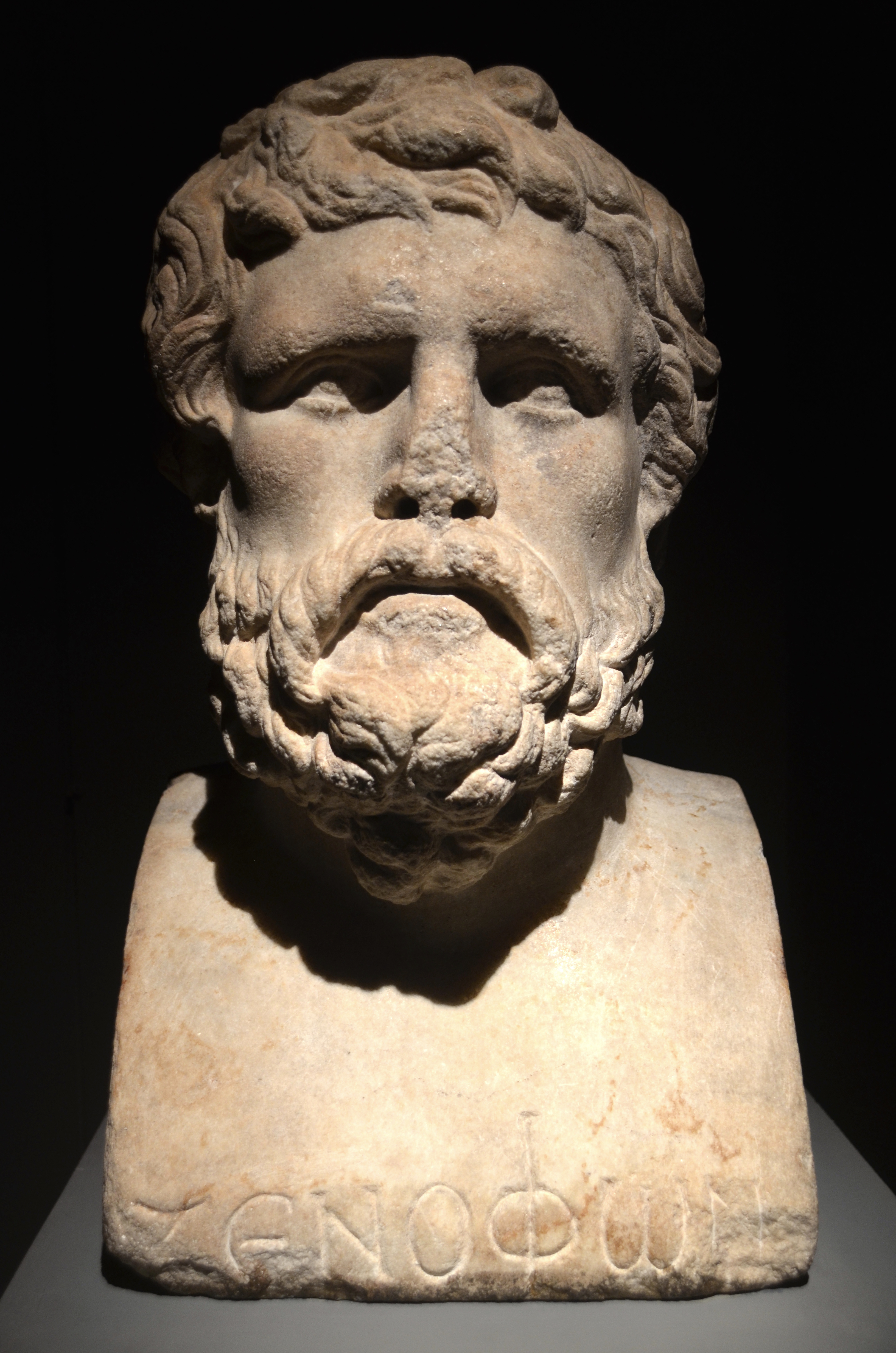
On Revenues
On Revenues is a 4th-century BC treatise by Xenophon that analyzes economic strategies to alleviate poverty and enhance financial stability in Athens. The work discusses various revenue sources, including agriculture, mining, and trade, and proposes policies to optimize these sectors. Notably, Xenophon emphasizes the importance of utilizing Attica's natural resources, particularly silver mines, and advocates for state-operated ventures to ensure a steady labor supply. His recommendations aim to create a prosperous, self-sufficient Athens, improving citizens' lives and fostering better relations with allies.
Editions
X-Ray
“But if you are agreed to carry out this plan, there is one further counsel which I would urge upon you. Send to Dodona and to Delphi, I would beg you, and consult the will of Heaven whether such a provision and such a policy on our part be truly to the interest of Athens both for the present and for the time to come. If the consent of Heaven be thus obtained, we ought then, I say, to put a further question: whose special favour among the gods shall we seek to secure with a view to the happier execution of these measures?And in accordance with that answer, let us offer a sacrifice of happy omen to the deities so named, and commence the work; since if these transactions be so carried out with the will of God, have we not the right to prognosticate some further advance in the path of political progress for this whole state?””
— Xenophon
“Again, if there is an apprehension on the part of any that the whole scheme will crumble into nothing on the first outbreak of war, I would only beg these alarmists to note that, under the condition of things which we propose to bring about, war will have more terrors for the attacking party than for this state. Since what possession I should like to know can be more serviceable for war than that of men? Think of the many ships which they will be capable of manning on public service. Think of the number who will serve on land as infantry (in the public service) and will bear hard upon the enemy. Only we must treat them with courtesy. For myself, my calculation is, that even in the event of war we shall be quite able to keep a firm hold of the silver mines.””
— Xenophon
“With regard to the price then of the men themselves, it is obvious that the public treasury is in a better position to provide funds than any private individuals. What can be easier than for the Council to invite by public proclamation all whom it may concern to bring their slaves, and to buy up those produced? Assuming the purchase to be effected, is it credible that people will hesitate to hire from the state rather than from the private owner, and actually on the same terms? People have at all events no hesitation at present in hiring consecrated grounds, sacred victims, houses, etc., or in purchasing the right of farming taxes from the state. To ensure the preservation of the purchased property, the treasury can take the same securities precisely from the lessee as it does from those who purchase the right of farming its taxes. Indeed, fraudulent dealing is easier on the part of the man who has purchased such a right than of the man who hires slaves. Since it is not easy to see how the exportation of public money is to be detected, when it differs in no way from private money. Whereas it will take a clever thief to make off with these slaves, marked as they will be with the public stamp, and in face of a heavy penalty attached at once to the sale and exportation of them. Up to this point then it would appear feasible enough for the state to acquire property in men and to keep a safe watch over them.””
— Xenophon
“And given that my proposal were carried into effect, the only novelty in it is that, just as the individual in acquiring the ownership of a gang of slaves finds himself at once provided with a permanent source of income, so the state, in like fashion, should possess herself of a body of public slaves, to the number, say, of three for every Athenian citizen.””
— Xenophon
“Or again, in a plethoric condition of the corn and wine market these fruits of the soil will be so depreciated in value that the particular husbandries cease to be remunerative, and many a farmer will give up his tillage of the soil and betake himself to the business of a merchant, or of a shopkeeper, to banking or money-lending. But the converse is the case in the working of silver; there the larger the quantity of ore discovered and the greater the amount of silver extracted, the greater the number of persons ready to engage in the operation.””
— Xenophon
“I am of opinion that if the names of contributors were to be inscribed as benefactors for all time, many foreigners would be induced to contribute, and possibly not a few states, in their desire to obtain the right of inscription; indeed I anticipate that some kings, tyrants, and satraps will display a keen desire to share in such a favour.[...] Were such a capital once furnished, it would be a magnificent plan to build lodging-houses for the benefit of shipmasters in the neighbourhood of the harbours, in addition to those which exist; and again, on the same principle, suitable places of meeting for merchants, for the purposes of buying and selling; and thirdly, public lodging-houses for persons visiting the city. Again, supposing dwelling-houses and stores for vending goods were fitted up for retail dealers in Piraeus and the city, they would at once be an ornament to the state and a fertile source of revenue. Also it seems to me it would be a good thing to try and see if, on the principle on which at present the state possesses public warships, it would not be possible to secure public merchant vessels, to be let out on the security of guarantors just like any other public property. If the plan were found feasible this public merchant navy would be a large source of extra revenue.””
— Xenophon
“Or again, supposing prizes were offered to the magistrates in charge of the market for equitable and speedy settlements of points in dispute to enable any one so wishing to proceed on his voyage without hindrance, the result would be that far more traders would trade with us and with greater satisfaction.It would indeed be a good and noble institution to pay special marks of honour, such as the privilege of the front seat, to merchants and shipowners, and on occasion to invite to hospitable entertainment those who, through something notable in the quality of ship or merchandise, may claim to have done the state a service. The recipients of these honours will rush into our arms as friends, not only under the incentive of gain, but of distinction also.Now the greater the number of people attracted to Athens either as visitors or as residents, clearly the greater the development of imports and exports. More goods will be sent out of the country, there will be more buying and selling, with a consequent influx of money in the shape of rents to individuals and dues and customs to the state exchequer. And to secure this augmentation of the revenues, mind you, not the outlay of one single penny; nothing needed beyond one or two philanthropic measures and certain details of supervision.””
— Xenophon
“[I]n most states the trader is under the necessity of lading his vessel with some merchandise or other in exchange for his cargo, since the current coin has no circulation beyond the frontier. But at Athens he has a choice: he can either in return for his wares export a variety of goods, such as human beings seek after, or, if he does not desire to take goods in exchange for goods, he has simply to export silver, and he cannot have a more excellent freight to export, since wherever he likes to sell it he may look to realise a large percentage on his capital.””
— Xenophon
“And I would further relieve them from the obligation of serving as hoplites side by side with the citizen proper; since, beside the personal risk, which is great, the trouble of quitting trades and homesteads is no trifle. Incidentally the state itself would benefit by this exemption, if the citizens were more in the habit of campaigning with one another, rather than shoulder to shoulder with Lydians, Phrygians, Syrians, and barbarians from all quarters of the world, who form the staple of our resident alien class.””
— Xenophon
Link to this book
Add a free, dofollow link to Lex on your blog, forum, syllabus, or reading list.

<a href="https://lex-books.com/book/on-revenues-e2ebf47e-70da-4a17-b842-c3ff69266a67"><img src="https://lex-books.com/badges/read-on-lex.svg" alt="Read On Revenues by Xenophon free on Lex" width="160" height="40"></a>[](https://lex-books.com/book/on-revenues-e2ebf47e-70da-4a17-b842-c3ff69266a67)[url=https://lex-books.com/book/on-revenues-e2ebf47e-70da-4a17-b842-c3ff69266a67][img]https://lex-books.com/badges/read-on-lex.svg[/img][/url]Read On Revenues by Xenophon free on Lex: https://lex-books.com/book/on-revenues-e2ebf47e-70da-4a17-b842-c3ff69266a67Cite this book
Reading this edition for a paper or guide? Copy a citation.
Xenophon. On Revenues. Lex, lex-books.com/book/on-revenues-e2ebf47e-70da-4a17-b842-c3ff69266a67.Xenophon (n.d.). On Revenues. Lex. https://lex-books.com/book/on-revenues-e2ebf47e-70da-4a17-b842-c3ff69266a67Xenophon. On Revenues. Lex. https://lex-books.com/book/on-revenues-e2ebf47e-70da-4a17-b842-c3ff69266a67.