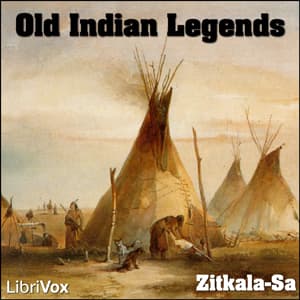
Old Indian Legends
1901
In 1901, a young Dakota woman named Zitkala-Sa gathered the stories of her people at a moment when those stories were under siege. Boarding schools were forcing Native children to forget their languages, their names, their ways of knowing. She wrote these legends down not as artifacts but as living things, hoping they might survive what was coming. The result is a collection of Sioux folklore that pulses with old magic. The centerpiece is Iktomi, a spider trickster whose exploits open the book. In "Iktomi and the Ducks," he persuades a flock to dance until they're too exhausted to fly, then helps himself to an easy meal. In other tales, he loses his blanket, outwits a muskrat, and generally proves that cunning rarely solves what greed creates. These are not moral fables exactly. They're sharper than that: stories that laugh at cleverness while admitting its fascination, that show how quickly a trickster can become the tricked. The writing has a peculiar beauty. Zitkala-Sa was bicultural in a way that shaped her prose, and the stories read as if told aloud, with repetition and rhythm and a kind of earned directness. This is essential reading for anyone who wants to encounter Native American storytelling on its own terms, unfiltered through later interpretations.
Editions
X-Ray
“run up there and take it back!" said he, pointing his long chin toward the large gray stone. Iktomi, in the warm sunshine, had no need of his blanket, and it had been very easy to part with a thing which he could not miss. But the chilly night wind quite froze his ardent thank-offering. Thus running up the hillside, his teeth chattering all the way, he drew near to Inyan, the sacred symbol. Seizing one corner of the half-worn blanket, Iktomi pulled it off with a jerk. "Give my blanket back, old grandfather! You do not need it. I do!" This was very wrong, yet Iktomi did it, for his wit was not wisdom. Drawing the blanket tight over his””
— Zitkala-Sa
Link to this book
Add a free, dofollow link to Lex on your blog, forum, syllabus, or reading list.

<a href="https://lex-books.com/book/old-indian-legends-2f32a33d-8820-48d2-a725-066c36daf176"><img src="https://lex-books.com/badges/read-on-lex.svg" alt="Read Old Indian Legends by Zitkala-Sa free on Lex" width="160" height="40"></a>[](https://lex-books.com/book/old-indian-legends-2f32a33d-8820-48d2-a725-066c36daf176)[url=https://lex-books.com/book/old-indian-legends-2f32a33d-8820-48d2-a725-066c36daf176][img]https://lex-books.com/badges/read-on-lex.svg[/img][/url]Read Old Indian Legends by Zitkala-Sa free on Lex: https://lex-books.com/book/old-indian-legends-2f32a33d-8820-48d2-a725-066c36daf176Cite this book
Reading this edition for a paper or guide? Copy a citation.
Zitkala-Sa. Old Indian Legends. Lex, lex-books.com/book/old-indian-legends-2f32a33d-8820-48d2-a725-066c36daf176.Zitkala-Sa (1901). Old Indian Legends. Lex. https://lex-books.com/book/old-indian-legends-2f32a33d-8820-48d2-a725-066c36daf176Zitkala-Sa. Old Indian Legends. Lex. https://lex-books.com/book/old-indian-legends-2f32a33d-8820-48d2-a725-066c36daf176.

![Night Watches [complete]](/_next/image?url=https%3A%2F%2Fd3b2n8gj62qnwr.cloudfront.net%2FCOVERS%2Fgutenberg_covers75k%2Febook-12161.png&w=3840&q=75)