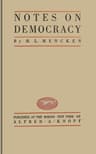
Notes on Democracy
1926
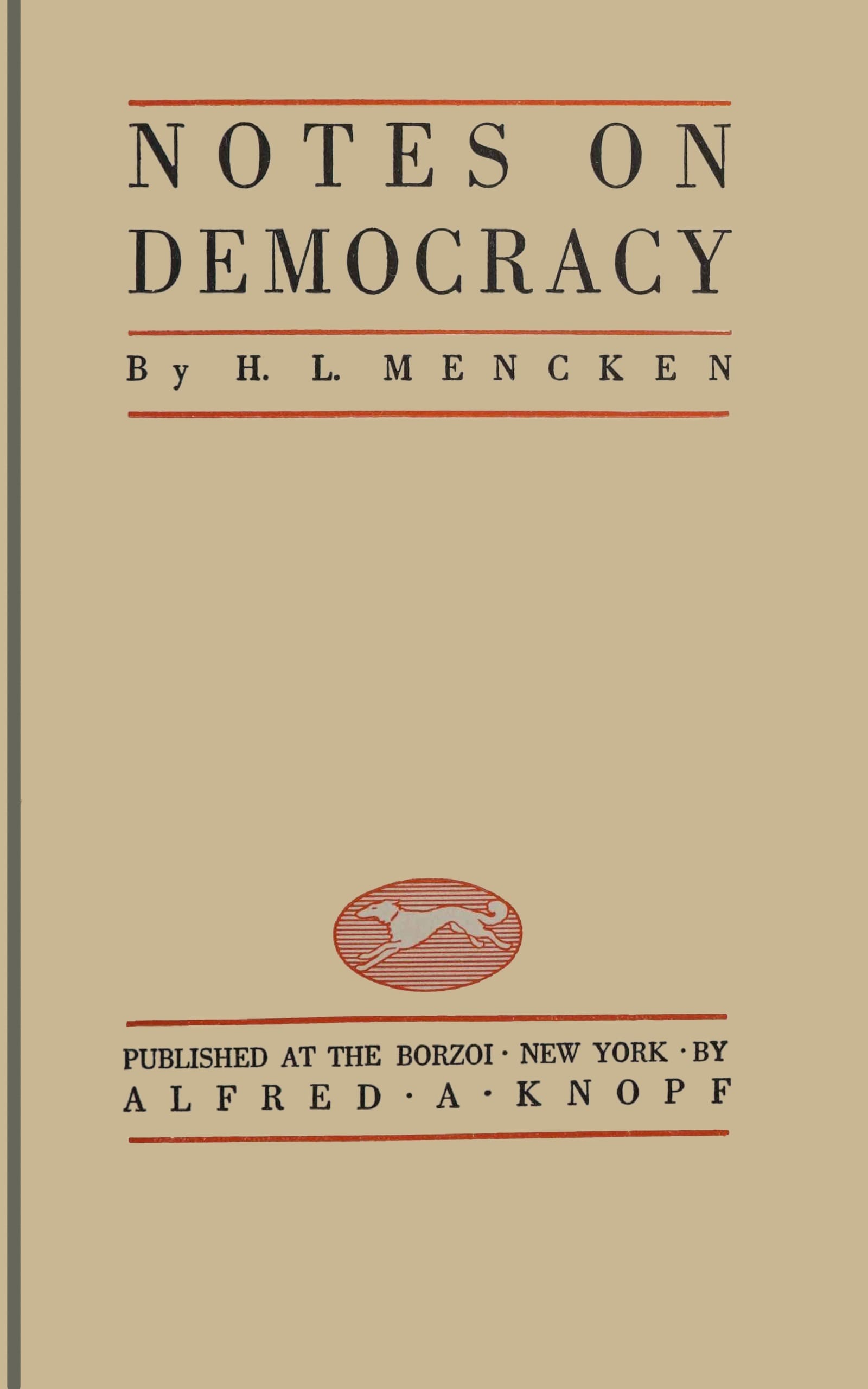
Notes on Democracy, published in 1926 by H. L. Mencken, is a critical essay that examines the principles and implications of democracy. Mencken critiques the concept of 'democratic man,' arguing that the romanticized view of the masses is based on sentimental ideology rather than rational truth. He highlights the psychological underpinnings of democratic processes and the complexities that arise when uninformed individuals wield power. This work remains relevant as it reflects on the challenges of democratic governance in both Mencken's time and today.
Editions
X-Ray
“Democracy is a pathetic belief in the collective wisdom of individual ignorance. No one in this world, so far as I know”
— H. L. Mencken
“Public opinion, in its raw state, gushes out in the immemorial form of the mob's fear. It is piped into central factories, and there it is flavored and colored, and put into cans.””
— H. L. Mencken
“It was of the essence of the courtier's art and mystery that he flattered his employer in order to victimize him, yielded to him in order to rule him. The politician under democracy does precisely the same thing. His business is never what it pretends to be. Ostensibly he is anal truist devoted whole-heartedly to the service of his fellow-men, and so abjectly public-spirited that his private interest is nothing to him. Actually he is a sturdy rogue whose principal, and often sole aim in life is to butter his parsnips.””
— H. L. Mencken
“It is a tragic but inescapable fact that most of the finest fruits of human progress, like all of the nobler virtues of man, are the exclusive possession of small minorities, chiefly unpopular and disreputable.””
— H. L. Mencken
“Liberty means self-reliance, it means resolution, it means enterprise, it means the capacity for doing without.””
— H. L. Mencken
“that the earliest and most profound of human emotions is fear. Man comes into the world weak and naked, and almost as devoid of intelligence as an oyster, but he brings with him a highly complex and sensitive susceptibility to fear.””
— H. L. Mencken
“Under the pressure of fanaticism, and with the mob complacently applauding the show,democratic law tends more and more to be grounded upon the maxim that every citizen is,by nature, a traitor, a libertine, and a scoundrel.In order to dissuade him from his evil-doing the police power is extended until it surpasses anything ever heard of in the oriental monarchies of antiquity.””
— H. L. Mencken
“. . .under democracy” he writes “. . .Two branches reveal themselves. There is the art of the demagogue, and there is the art of what may be called…the demaslave. . .The demagogue is one who preaches doctrines he knows to be untrue to men he knows to be idiots. The demaslave is one who listens to what these idiots have to say and then pretends that he believes it himself. Every man who seeks elective office under democracy has to be either the one thing or the other, and most men have to be both . . .No educated man, stating plainly the elementary notions that every educated man holds about the matters that principally concern government, could be elected to office in a democratic state, save perhaps by a miracle.””
— H. L. Mencken
“An intelligent man is one who is capable of taking in knowledge until the natural limits of the species are reached.. A stupid man is one whose progress is arrested at some specific time and place before then. There thus appears in psychology - and the next instant in politics - the concept of the unteachable. Some men can learn almost indefinitely; their capacity goes on increasing until their bodies begin to wear out. Others stop in childhood, even in infancy. They reach, say , the mental age of ten or twelve, and then they develop no more. Physically, they become men, and sprout beards, political delusions, and the desire to propagate their kind. But mentally they remain on the level of schoolboys.””
— H. L. Mencken
Link to this book
Add a free, dofollow link to Lex on your blog, forum, syllabus, or reading list.

<a href="https://lex-books.com/book/notes-on-democracy-a5483da9-b33e-4e3f-bf02-e191156575b1"><img src="https://lex-books.com/badges/read-on-lex.svg" alt="Read Notes on Democracy by H. L. Mencken free on Lex" width="160" height="40"></a>[](https://lex-books.com/book/notes-on-democracy-a5483da9-b33e-4e3f-bf02-e191156575b1)[url=https://lex-books.com/book/notes-on-democracy-a5483da9-b33e-4e3f-bf02-e191156575b1][img]https://lex-books.com/badges/read-on-lex.svg[/img][/url]Read Notes on Democracy by H. L. Mencken free on Lex: https://lex-books.com/book/notes-on-democracy-a5483da9-b33e-4e3f-bf02-e191156575b1Cite this book
Reading this edition for a paper or guide? Copy a citation.
Mencken, H. L.. Notes on Democracy. Lex, lex-books.com/book/notes-on-democracy-a5483da9-b33e-4e3f-bf02-e191156575b1.Mencken, H. L. (1926). Notes on Democracy. Lex. https://lex-books.com/book/notes-on-democracy-a5483da9-b33e-4e3f-bf02-e191156575b1Mencken, H. L.. Notes on Democracy. Lex. https://lex-books.com/book/notes-on-democracy-a5483da9-b33e-4e3f-bf02-e191156575b1.