Mine Pumping in Agricola's Time and Later
1959
Mine Pumping in Agricola's Time and Later
1959
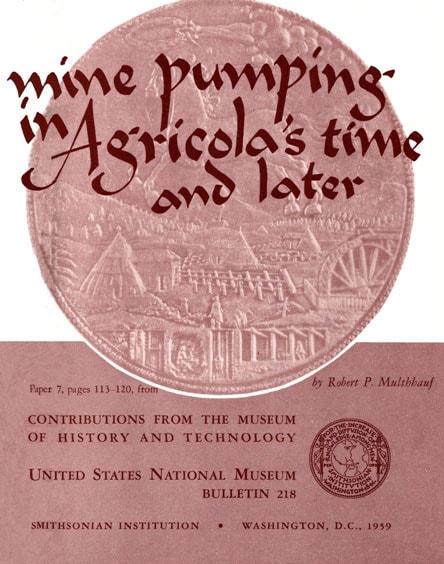
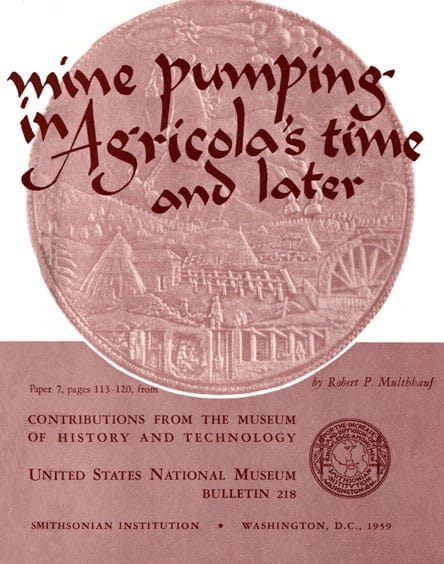
The myth that mining technology stagnated after Georgius Agricola published De re metallica in 1556 has gone unquestioned for centuries. Multhauf dismantles this assumption in this rigorous 1959 study, revealing a vibrant world of pumping innovations that evolved alongside broader developments in mechanical engineering. The book centers on devices like the Stangenkunst, the crank-driven piston pump that became the backbone of European deep mining, showing how financial pressures, deepening water tables, and industrial ambition drove technological solutions to mining's oldest enemy: water. What emerges is not decay but quiet, practical genius applied under extraordinary conditions. Multhauf also introduces an unexpected witness to this history: coins. Sixteenth-century mining landscape coins preserve surprisingly detailed images of pumping machinery, providing visual evidence that complements written records. These metallic documents, rarely examined by historians of technology, anchor the narrative in material culture. The result is a specialized but compelling work that proves how deeply mining machinery shaped early modern European industry and identity.
Editions
Link to this book
Add a free, dofollow link to Lex on your blog, forum, syllabus, or reading list.

<a href="https://lex-books.com/book/mine-pumping-in-agricola-s-time-and-later-0fbd34ed-6457-4f0e-bbd7-652170daf02d"><img src="https://lex-books.com/badges/read-on-lex.svg" alt="Read Mine Pumping in Agricola's Time and Later by Robert P. Multhauf free on Lex" width="160" height="40"></a>[](https://lex-books.com/book/mine-pumping-in-agricola-s-time-and-later-0fbd34ed-6457-4f0e-bbd7-652170daf02d)[url=https://lex-books.com/book/mine-pumping-in-agricola-s-time-and-later-0fbd34ed-6457-4f0e-bbd7-652170daf02d][img]https://lex-books.com/badges/read-on-lex.svg[/img][/url]Read Mine Pumping in Agricola's Time and Later by Robert P. Multhauf free on Lex: https://lex-books.com/book/mine-pumping-in-agricola-s-time-and-later-0fbd34ed-6457-4f0e-bbd7-652170daf02dCite this book
Reading this edition for a paper or guide? Copy a citation.
Multhauf, Robert P.. Mine Pumping in Agricola's Time and Later. Lex, lex-books.com/book/mine-pumping-in-agricola-s-time-and-later-0fbd34ed-6457-4f0e-bbd7-652170daf02d.Multhauf, R. P. (1959). Mine Pumping in Agricola's Time and Later. Lex. https://lex-books.com/book/mine-pumping-in-agricola-s-time-and-later-0fbd34ed-6457-4f0e-bbd7-652170daf02dMulthauf, Robert P.. Mine Pumping in Agricola's Time and Later. Lex. https://lex-books.com/book/mine-pumping-in-agricola-s-time-and-later-0fbd34ed-6457-4f0e-bbd7-652170daf02d.