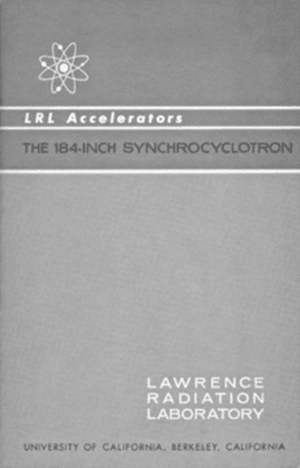
LRL Accelerators, the 184-Inch Synchrocyclotron
LRL Accelerators, the 184-Inch Synchrocyclotron
This is a firsthand account from the scientists who built one of the most powerful particle accelerators of the mid-20th century. The 184-inch synchrocyclotron at Berkeley's Lawrence Radiation Laboratory represented a monumental engineering achievement: a machine capable of accelerating particles to energies previously thought impossible, crammed into a magnet weighing thousands of tons. The book walks through every component of this remarkable apparatus - the magnet that shaped the particle paths, the vacuum system that created the pristine environment necessary for subatomic work, the ion source that injected particles into the accelerator, and the radiofrequency systems that gave those particles their accelerating kicks. But this isn't merely an engineering manual. It explains the revolutionary principle of phase stability that made higher energies achievable, and it chronicles the experiments that followed - inquiries into nuclear structure, investigations into the behavior of atomic particles, even early forays into biophysics and nuclear chemistry. Written by the researchers who actually operated the machine, this document captures a moment when physicists were just beginning to split the atom and glimpse the fundamental building blocks of matter.
Editions
Link to this book
Add a free, dofollow link to Lex on your blog, forum, syllabus, or reading list.

<a href="https://lex-books.com/book/lrl-accelerators-the-184-inch-synchrocyclotron-64ce92d5-d17e-4d74-aff4-a3a10b1f067a"><img src="https://lex-books.com/badges/read-on-lex.svg" alt="Read LRL Accelerators, the 184-Inch Synchrocyclotron by Lawrence Radiation Laboratory free on Lex" width="160" height="40"></a>[](https://lex-books.com/book/lrl-accelerators-the-184-inch-synchrocyclotron-64ce92d5-d17e-4d74-aff4-a3a10b1f067a)[url=https://lex-books.com/book/lrl-accelerators-the-184-inch-synchrocyclotron-64ce92d5-d17e-4d74-aff4-a3a10b1f067a][img]https://lex-books.com/badges/read-on-lex.svg[/img][/url]Read LRL Accelerators, the 184-Inch Synchrocyclotron by Lawrence Radiation Laboratory free on Lex: https://lex-books.com/book/lrl-accelerators-the-184-inch-synchrocyclotron-64ce92d5-d17e-4d74-aff4-a3a10b1f067aCite this book
Reading this edition for a paper or guide? Copy a citation.
Laboratory, Lawrence Radiation. LRL Accelerators, the 184-Inch Synchrocyclotron. Lex, lex-books.com/book/lrl-accelerators-the-184-inch-synchrocyclotron-64ce92d5-d17e-4d74-aff4-a3a10b1f067a.Laboratory, L. R. (n.d.). LRL Accelerators, the 184-Inch Synchrocyclotron. Lex. https://lex-books.com/book/lrl-accelerators-the-184-inch-synchrocyclotron-64ce92d5-d17e-4d74-aff4-a3a10b1f067aLaboratory, Lawrence Radiation. LRL Accelerators, the 184-Inch Synchrocyclotron. Lex. https://lex-books.com/book/lrl-accelerators-the-184-inch-synchrocyclotron-64ce92d5-d17e-4d74-aff4-a3a10b1f067a.