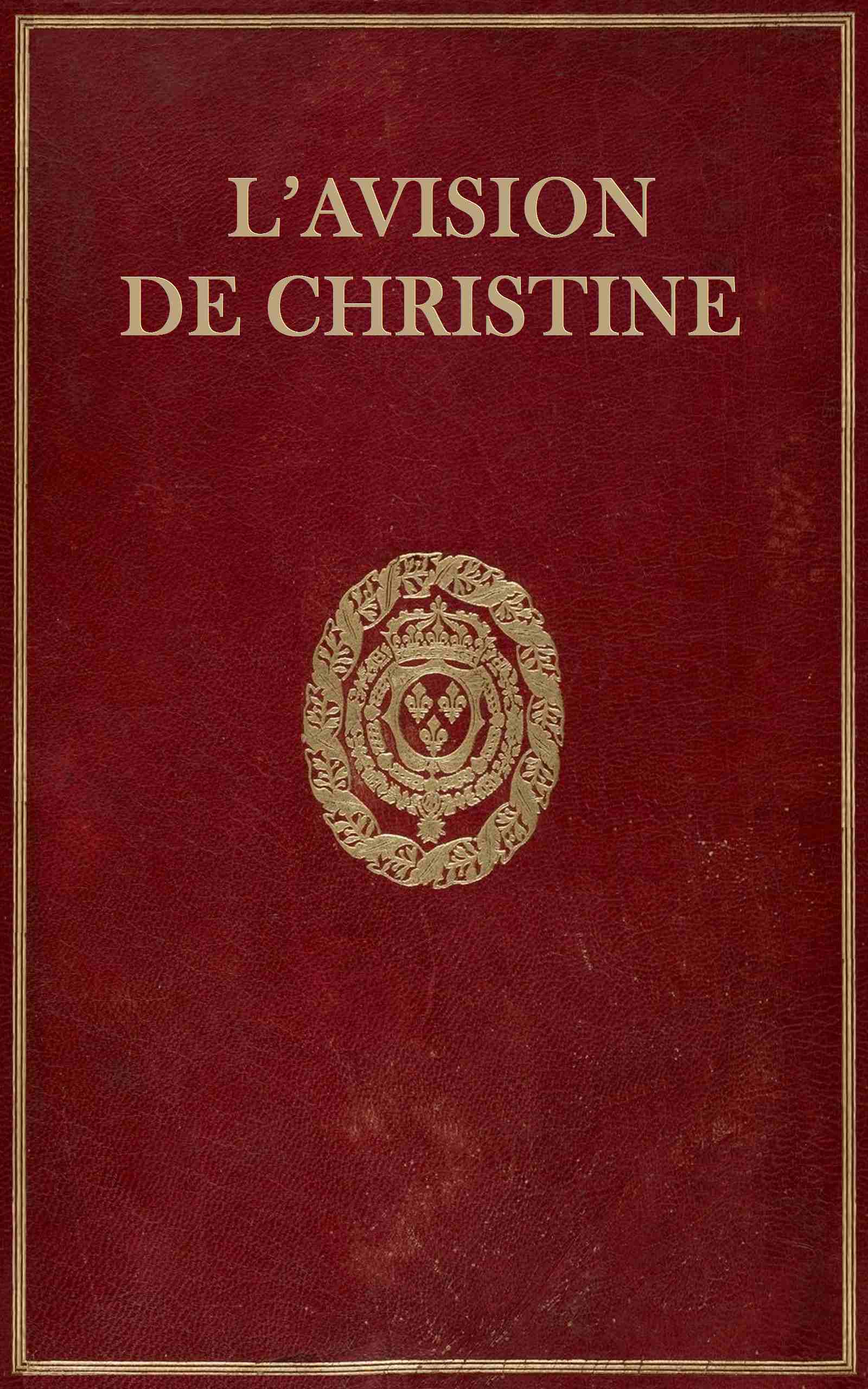
L'avision De Christine
1405
L'avision De Christine
1405
A poetic allegory written in the late 14th century. The text revolves around the author, who explores her visions, which touch on various philosophical and societal themes, highlighting a woman's perspective within medieval society. The work combines personal reflection with broader themes of wisdom, governance, and the nature of reality, emphasizing the importance of virtue and moral integrity. At the start of this narrative, Christine describes a spiritual journey during which she becomes tired and seeks rest during a pilgrimage. This leads her to experience a vision where her spirit is lifted to a dark realm, where she encounters a large image personifying a significant entity. This image is accompanied by a crowned shadow resembling a powerful queen, who acts as a caretaker for the image's nourishment, symbolizing the relationship between power and sustenance. The vivid descriptions and allegorical elements set the tone for a deep exploration of philosophical ideas and virtues, which unfold through Christine's subsequent encounters and reflections within the text.
Editions
X-Ray
The narrator and dreamer, a widowed writer who experiences a mystical vision. She is portrayed as a learned woman seeking wisdom and understanding through her encounters with allegorical figures.
An allegorical figure representing France, appearing as a crowned princess who recounts her history and current sufferings. She embodies the realm's glory and tribulations.
A shadowy allegorical figure who appears as countless colored forms. She represents human opinion and the source of all human endeavors, both good and evil.
The supreme allegorical figure of wisdom, appearing in brilliant light with nine attendant ladies. She offers consolation and represents the highest form of knowledge.
About L'avision De Christine
Chapter Summaries
- Prologue
- Christine introduces her vision divided into three parts: the image of the world, Dame Opinion and her shadow, and the comfort of Philosophy. She describes how her spirit was transported to witness these marvels.
- Part I
- Christine encounters a giant figure (Chaos) whose head touches the clouds and feet walk the abyss. A crowned shadow nourishes him by creating small human forms in molds, including Christine herself who is reborn within the giant.
- Part I Continued
- Christine meets Dame Libera (France), who recounts her ancient origins from Troy, her various rulers throughout history, and her current sufferings from civil war, corruption, and the imprisonment of virtues.
Key Themes
- The Nature of Knowledge and Opinion
- The work explores how human understanding is shaped by opinion rather than absolute truth, and how this affects all human endeavors and philosophical inquiry.
- Fortune and Adversity
- Christine's personal sufferings and the tribulations of France are presented as examples of Fortune's fickleness, leading to a search for higher consolation in Philosophy.
- Women's Intellectual Capacity
- The text defends women's ability to engage in scholarly pursuits and philosophical discourse, challenging contemporary gender assumptions about learning.
Characters
- Christine de Pizan(protagonist)
- The narrator and dreamer, a widowed writer who experiences a mystical vision. She is portrayed as a learned woman seeking wisdom and understanding through her encounters with allegorical figures.
- Dame Libera (The Crowned Lady)(major)
- An allegorical figure representing France, appearing as a crowned princess who recounts her history and current sufferings. She embodies the realm's glory and tribulations.
- Dame Opinion(major)
- A shadowy allegorical figure who appears as countless colored forms. She represents human opinion and the source of all human endeavors, both good and evil.
- Dame Philosophy(major)
- The supreme allegorical figure of wisdom, appearing in brilliant light with nine attendant ladies. She offers consolation and represents the highest form of knowledge.
- The Giant Image (Chaos)(major)
- A colossal figure whose head pierces the clouds and feet walk the abyss, representing the world or universe. He is nourished by a crowned shadow who creates small human forms.
- The Crowned Shadow(major)
- A feminine shadow who serves as administrator of nourishment to the Giant Image, creating small human forms in molds and feeding them to the giant.
Link to this book
Add a free, dofollow link to Lex on your blog, forum, syllabus, or reading list.

<a href="https://lex-books.com/book/l-avision-de-christine-f9f89842-f71c-4e72-8c1c-40b82a3cd69c"><img src="https://lex-books.com/badges/read-on-lex.svg" alt="Read L'avision De Christine by de Pisan Christine free on Lex" width="160" height="40"></a>[](https://lex-books.com/book/l-avision-de-christine-f9f89842-f71c-4e72-8c1c-40b82a3cd69c)[url=https://lex-books.com/book/l-avision-de-christine-f9f89842-f71c-4e72-8c1c-40b82a3cd69c][img]https://lex-books.com/badges/read-on-lex.svg[/img][/url]Read L'avision De Christine by de Pisan Christine free on Lex: https://lex-books.com/book/l-avision-de-christine-f9f89842-f71c-4e72-8c1c-40b82a3cd69cCite this book
Reading this edition for a paper or guide? Copy a citation.
Christine, de Pisan. L'avision De Christine. Lex, lex-books.com/book/l-avision-de-christine-f9f89842-f71c-4e72-8c1c-40b82a3cd69c.Christine, D. P. (1405). L'avision De Christine. Lex. https://lex-books.com/book/l-avision-de-christine-f9f89842-f71c-4e72-8c1c-40b82a3cd69cChristine, de Pisan. L'avision De Christine. Lex. https://lex-books.com/book/l-avision-de-christine-f9f89842-f71c-4e72-8c1c-40b82a3cd69c.