Introduction to the Study of the History of Language
1903
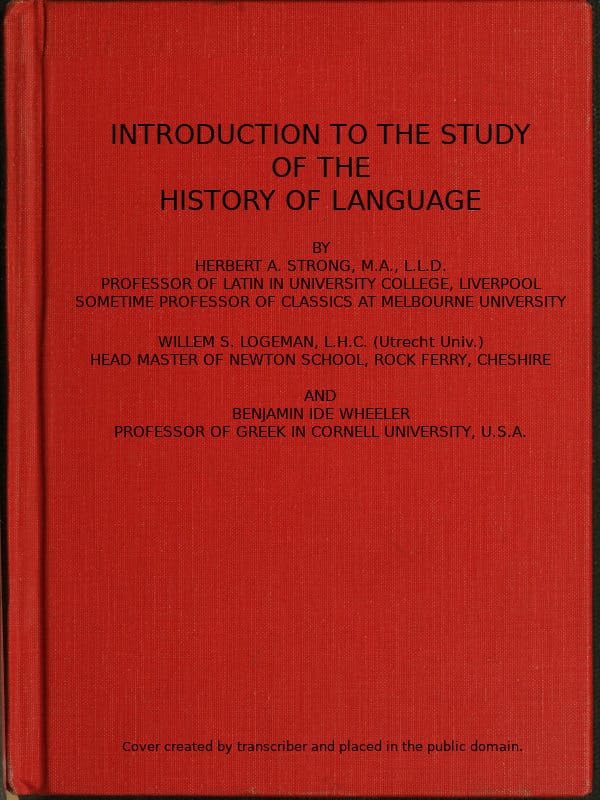
Written in 1903, this pioneering work treats language change as a subject worthy of rigorous scientific inquiry. Long before linguistics became a formal discipline, Herbert A. Strong and his collaborators set out to understand not just that languages evolve, but how and why they do. The book examines the mechanics of sound shifts, how pronunciation drifts across generations, and semantic changes, tracing how words acquire new meanings or lose old ones. But what elevates this work beyond a mere catalogue of changes is its attention to the psychological dimensions of linguistic evolution: the role of individual speakers in shaping speech, the tension between conscious invention and unconscious drift, and the complex interplay of social forces that bend languages over time. Strong distinguishes between historical grammar, which traces changes across centuries, and descriptive grammar, which captures a language at a single moment. The result is a book that treats language as a living thing, dynamic and mutable, yet governed by discernible patterns. For anyone curious about why English 'wife' once meant any woman, or how the sounds of Latin transformed into the sounds of French, this early study offers both answers and a framework for asking better questions.
Editions
Link to this book
Add a free, dofollow link to Lex on your blog, forum, syllabus, or reading list.

<a href="https://lex-books.com/book/introduction-to-the-study-of-the-history-of-language-1bd3b01f-d0ae-426e-9de2-08fafcc0417b"><img src="https://lex-books.com/badges/read-on-lex.svg" alt="Read Introduction to the Study of the History of Language by Herbert A. Strong free on Lex" width="160" height="40"></a>[](https://lex-books.com/book/introduction-to-the-study-of-the-history-of-language-1bd3b01f-d0ae-426e-9de2-08fafcc0417b)[url=https://lex-books.com/book/introduction-to-the-study-of-the-history-of-language-1bd3b01f-d0ae-426e-9de2-08fafcc0417b][img]https://lex-books.com/badges/read-on-lex.svg[/img][/url]Read Introduction to the Study of the History of Language by Herbert A. Strong free on Lex: https://lex-books.com/book/introduction-to-the-study-of-the-history-of-language-1bd3b01f-d0ae-426e-9de2-08fafcc0417bCite this book
Reading this edition for a paper or guide? Copy a citation.
Strong, Herbert A.. Introduction to the Study of the History of Language. Lex, lex-books.com/book/introduction-to-the-study-of-the-history-of-language-1bd3b01f-d0ae-426e-9de2-08fafcc0417b.Strong, H. A. (1903). Introduction to the Study of the History of Language. Lex. https://lex-books.com/book/introduction-to-the-study-of-the-history-of-language-1bd3b01f-d0ae-426e-9de2-08fafcc0417bStrong, Herbert A.. Introduction to the Study of the History of Language. Lex. https://lex-books.com/book/introduction-to-the-study-of-the-history-of-language-1bd3b01f-d0ae-426e-9de2-08fafcc0417b.