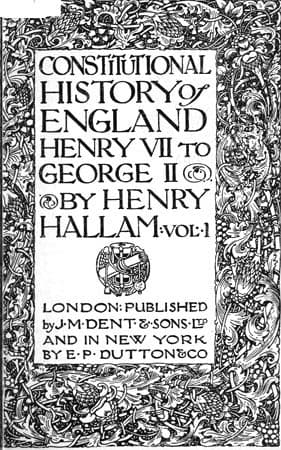
Introduction to the Literature of Europe in the Fifteenth, Sixteenth, and Seventeenth Centuries, Vol. 1
1581
Introduction to the Literature of Europe in the Fifteenth, Sixteenth, and Seventeenth Centuries, Vol. 1
1581
Henry Hallam's monumental intellectual project attempts something audacious: to trace the arc of European literature from the twilight of the Middle Ages through the revolutionary ferment of the Renaissance and Reformation. Written in the early nineteenth century when the discipline of literary history barely existed, this work established the very framework through which generations would understand the transition from medieval Latin scholarship to the vernacular literatures that would produce Dante, Cervantes, Shakespeare, and Milton. Hallam reconstructs the long recovery of learning after the collapse of Rome, showing how religious institutions preserved textual culture through the Dark Ages, how the rise of universities created new audiences for literature, and how the gradual emergence of national languages paved the way for a literary golden age. His method anticipates modern cultural history: he insists that literature cannot be understood in isolation from philosophy, science, and the shifting political structures that shaped who could speak and to whom. This is not a catalog of names and dates but an argument about civilization's slow awakening. For anyone seeking to understand how Europe learned to tell its own stories in its own voices, Hallam remains an indispensable guide.
Editions
X-Ray
The author and narrator of this comprehensive literary history. A distinguished English historian examining the development of European literature from the 15th-17th centuries.
Roman philosopher and writer of 'Consolation of Philosophy,' representing the last of classical antiquity. His work bridges the classical period and Middle Ages.
Italian poet and scholar, first true restorer of classical learning. His influence on taste and literature was transformative for his age.
Italian poet, author of the Divine Comedy. One of the morning stars of modern literature, though less influential on contemporary taste than Petrarch.
About Introduction to the Literature of Europe in the Fifteenth, Sixteenth, and Seventeenth Centuries, Vol. 1
Chapter Summaries
- 1
- Hallam surveys the decline of learning after the fall of Rome, beginning with Boethius as the last classical writer. He traces the gradual revival through Charlemagne's schools, the rise of universities and scholastic philosophy, the development of vernacular languages and literature, and early attempts at recovering classical texts, culminating in Petrarch's pioneering work.
- 2
- The chapter focuses on the early 15th century revival of classical learning in Italy, led by scholars like Poggio Bracciolini and Gasparin of Barziza. Hallam describes the arrival of Greek learning through Emanuel Chrysoloras and his disciples, the patronage of figures like Cosmo de' Medici, and the contrast with the still-backward state of learning in France, England, and Germany.
Key Themes
- Revival of Classical Learning
- The central theme examining how Greek and Latin literature was lost during the Dark Ages and gradually recovered, particularly in Italy during the 14th-15th centuries. Hallam traces the efforts of scholars like Petrarch and the Greek refugees who brought ancient texts back to Western Europe.
- The Role of Patronage in Literature
- The importance of wealthy patrons like Cosmo de' Medici, Alphonso of Naples, and various princes in supporting scholars and preserving manuscripts. Without such patronage, the revival of learning would have been impossible.
- Institutional Influence on Learning
- How universities, monasteries, and schools shaped the development of knowledge. Hallam examines both positive influences (like Charlemagne's schools) and negative ones (like the dominance of scholastic disputation).
Characters
- Henry Hallam(protagonist)
- The author and narrator of this comprehensive literary history. A distinguished English historian examining the development of European literature from the 15th-17th centuries.
- Boethius(major)
- Roman philosopher and writer of 'Consolation of Philosophy,' representing the last of classical antiquity. His work bridges the classical period and Middle Ages.
- Petrarch(major)
- Italian poet and scholar, first true restorer of classical learning. His influence on taste and literature was transformative for his age.
- Dante(major)
- Italian poet, author of the Divine Comedy. One of the morning stars of modern literature, though less influential on contemporary taste than Petrarch.
- Charlemagne(major)
- Frankish emperor who established schools and promoted learning. His efforts laid foundations for the revival of education in his dominions.
- Alcuin(major)
- English scholar who assisted Charlemagne in educational reforms. Came from the school of York and helped establish learning in France.
Link to this book
Add a free, dofollow link to Lex on your blog, forum, syllabus, or reading list.

<a href="https://lex-books.com/book/introduction-to-the-literature-of-europe-in-the-fifteenth-sixteenth-and-seventee-300f1eb8-9621-454a-996e-343f4dfe913a"><img src="https://lex-books.com/badges/read-on-lex.svg" alt="Read Introduction to the Literature of Europe in the Fifteenth, Sixteenth, and Seventeenth Centuries, Vol. 1 by Henry Hallam free on Lex" width="160" height="40"></a>[](https://lex-books.com/book/introduction-to-the-literature-of-europe-in-the-fifteenth-sixteenth-and-seventee-300f1eb8-9621-454a-996e-343f4dfe913a)[url=https://lex-books.com/book/introduction-to-the-literature-of-europe-in-the-fifteenth-sixteenth-and-seventee-300f1eb8-9621-454a-996e-343f4dfe913a][img]https://lex-books.com/badges/read-on-lex.svg[/img][/url]Read Introduction to the Literature of Europe in the Fifteenth, Sixteenth, and Seventeenth Centuries, Vol. 1 by Henry Hallam free on Lex: https://lex-books.com/book/introduction-to-the-literature-of-europe-in-the-fifteenth-sixteenth-and-seventee-300f1eb8-9621-454a-996e-343f4dfe913aCite this book
Reading this edition for a paper or guide? Copy a citation.
Hallam, Henry. Introduction to the Literature of Europe in the Fifteenth, Sixteenth, and Seventeenth Centuries, Vol. 1. Lex, lex-books.com/book/introduction-to-the-literature-of-europe-in-the-fifteenth-sixteenth-and-seventee-300f1eb8-9621-454a-996e-343f4dfe913a.Hallam, H. (1581). Introduction to the Literature of Europe in the Fifteenth, Sixteenth, and Seventeenth Centuries, Vol. 1. Lex. https://lex-books.com/book/introduction-to-the-literature-of-europe-in-the-fifteenth-sixteenth-and-seventee-300f1eb8-9621-454a-996e-343f4dfe913aHallam, Henry. Introduction to the Literature of Europe in the Fifteenth, Sixteenth, and Seventeenth Centuries, Vol. 1. Lex. https://lex-books.com/book/introduction-to-the-literature-of-europe-in-the-fifteenth-sixteenth-and-seventee-300f1eb8-9621-454a-996e-343f4dfe913a.