Insurgent Mexico
1914
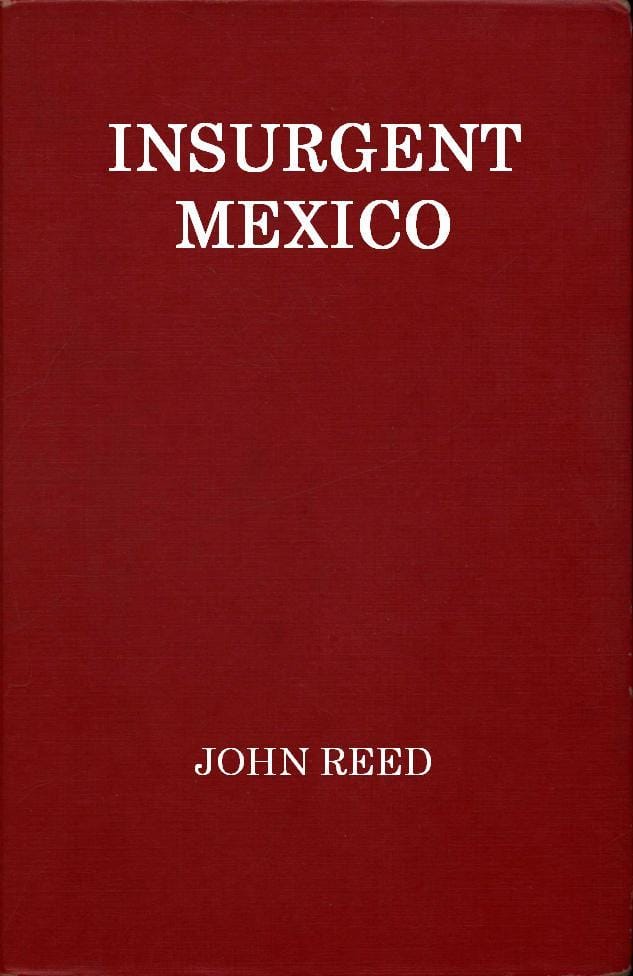
In the winter of 1914, American journalist John Reed crossed into Mexico at the height of its revolution, and what he found there rewrote the rules of journalism. This is not a distant historical account but a frontline dispatch from a country tearing itself apart. Reed walks among fleeing refugees, interviews exhausted soldiers from both sides, and sits with the women and children caught between warring factions. He witnesses a society in complete disintegration: towns burned, families scattered, ideology colliding with desperate survival. The border becomes a threshold between two worlds, where American observers watch the carnage unfold like a distant spectacle. Reed captures the revolution's brutal human texture, its mixture of idealism and atrocity, the way ordinary people become revolutionaries or victims depending on which army passes through their village. This isGonzo journalism before the term existed, a writer plunging into chaos and returning with dispatches that read like war poetry. A century later, Reed's account remains essential for understanding not just Mexico's founding violence, but the revolutionary impulse itself.
Editions

X-Ray
“The growing policy-reform movement is a broad church. It includes everyone from ganja-smoking Rastafarians to free-market fundamentalists and all in between. There are socialists who think the drug war hurts the poor, capitalists who see a business opportunity, liberals who defend the right to choose, and fiscal conservatives who complain America is spending $40 billion a year on the War on Drugs rather than making a few billion taxing it. The movement can’t agree on much other than that the present policy doesn’t work. People disagree on whether legalized drugs should be controlled by the state, by corporations, by small businessmen, or by grow-your-own farmers, and on whether they should be advertised, taxed, or just handed out free in white boxes to addicts.””
— Unknown
“But the ugly truth is that a huge number of weapons made or sold in the United States go to Mexican cartels. This is an irrefutable fact. Mexico itself has almost no gun stores and weapons factories and gives away few licenses. Almost all weapons in the hands of cartel armies are illegal. In 2008, Mexico submitted the serial numbers from close to six thousand guns they had seized from gangsters to the U.S. Bureau of Alcohol, Tobacco, and Firearms. About 90 percent, or 5,114 of the weapons, were traced to American gun sellers. The ATF and Obama administration acknowledged America’s responsibility in this tragedy. But the gun lobby still refused to concede the point. What about tens of thousands of other seized weapons in Mexico that hadn’t been traced? gun activists said. The Mexican government, they alleged, was only tracing guns that looked as if they had come from America to sway the debate. So to make it easier to trace weapons seized in Mexico, the ATF introduced a new computer system. Between 2009 and April 2010, this traced another 63,700 firearms to U.S. gun stores.18 And those are only the ones they have captured. People can argue endlessly about the exact percentages, but the underlying fact is that tens of thousands of guns go from American stores to Mexican gangsters.””
— Unknown
“He understood that alienated youth can be won by little more than a decent salary and a sense of purpose.””
— Unknown
“Violence was no longer a way of control but a basic language of communication.””
— Unknown
“On December 1, 2006, federal deputies were brawling in Mexico’s Congress hours before Felipe Calderón was due to enter the chamber to be sworn in as president. It was a fight for space. The leftist deputies claimed their candidate, Andrés Manuel López Obrador, had really won the election but been robbed of his rightful victory. They were trying to gain control of the podium to stop Calderón from taking the oath and assuming office. The conservative deputies were defending the podium to allow the presidential accession. The conservatives won the scrap. There were more of them, and they seemed to be better fed. Among those attending the ceremony were former U.S. president George Bush (Bush the First) and California governor Arnold Schwarzenegger. I was covering the Congress door, snatching interviews as guests went in. The elderly Bush hobbled past with six bodyguards with bald heads and microphones at their mouths. I asked him what he thought about the ruckus in the chamber. “Well, I hope that Mexicans can resolve their differences,” he replied diplomatically. Schwarzenegger strolled past with no bodyguards at all. I asked what he thought about the fisticuffs. The Terminator turned round, stared intensely, and uttered three words: “It’s good action!” I phoned the quote back to headquarters and it went out on a wire story. Suddenly, Schwarznegger’s statement was being bounced around California TV stations. Then the BBC led their newscast with it: “It takes a lot to impress Arnold Schwarznegger but today when he was in Mexico …” I got frantic phone calls from the governor’s office in Los Angeles. Was his quote perhaps being used out of context? Well, I replied, I asked him straight and he told me straight.””
— Unknown
“But the dynamics of Mexican cartels have also developed in distinct ways from Colombia. Mexico has seven major cartels”
— Unknown
“When you go back to Pablo Ecobar, this guy blew up a passenger plane, police headquarters, funded guerrillas to kill Supreme Court justices, and had the number one Colombian presidential candidate assassinated. Now there is no organization in Colombia that can go toe-to-toe with the government, that can threaten the national security of Colombia. In each successive generation of traffickers there has been a dilution of their power.“Pablo Escobar lasted fifteen years. The average kingpin here now lasts fifteen months. If you are named as a kingpin here, you are gone. The government of Colombia and the government of the United States will not allow a trafficker to exist long enough to become a viable threat.”In this analysis, drug enforcement can be seen as a giant hammer that keeps on falling. Any gangster that gets too big gets smashed by the hammer. This is known as cartel decapitation, taking out the heads of the gang. The villains are kept in check. But the drug trade does go on, and so does the war.””
— Unknown
“Evidence of police working for the insurgent Zetas was startling, but would soon become depressingly typical in Mexico. Time and time again, federal troops rolled into cities and accused local police of being deeply entwined with gangsters. Officers no longer just turned a blind eye on smuggling, but worked as kidnappers and assassins in their own right, a grave fragmentation of the state. To aggravate this problem, many federal officers were also found working for gangsters, normally different factions of the Sinaloa Cartel. So as federal troops rounded up Zetas, observers asked whom they were serving: the public or Sinaloan capos?These revelations underline a central problem in the Mexican Drug War. The PRI years featured a delicate dance of corruption; in the democratic years, it turned to a corrupt dance of death. In the old days, police officers were rotten, but at least they worked together. In democracy, police work for competing mafias and actively fight each other. Gangsters target both good police who get in their way and bad police who work for their rivals. For policy makers it becomes a Gordian knot.Added to this thorny issue of corruption is a more fundamental problem of drug-law enforcement. Every time you arrest one trafficker, you are helping his rival. In this way, when the federal police stormed Zetas safe houses, they were scoring victories for Sinaloans, whether they liked it or not. Arrests did not subdue violence, but only inflamed it.””
— Unknown
“As G. Gordon Liddy described the visit in his memoir, “The Mexicans, using diplomatic language of course, told us to go piss up a rope.””
— Unknown
Link to this book
Add a free, dofollow link to Lex on your blog, forum, syllabus, or reading list.

<a href="https://lex-books.com/book/insurgent-mexico-3a233b30-4a64-4f3b-9e8a-9d78039d4d7c"><img src="https://lex-books.com/badges/read-on-lex.svg" alt="Read Insurgent Mexico by Unknown free on Lex" width="160" height="40"></a>[](https://lex-books.com/book/insurgent-mexico-3a233b30-4a64-4f3b-9e8a-9d78039d4d7c)[url=https://lex-books.com/book/insurgent-mexico-3a233b30-4a64-4f3b-9e8a-9d78039d4d7c][img]https://lex-books.com/badges/read-on-lex.svg[/img][/url]Read Insurgent Mexico by Unknown free on Lex: https://lex-books.com/book/insurgent-mexico-3a233b30-4a64-4f3b-9e8a-9d78039d4d7cCite this book
Reading this edition for a paper or guide? Copy a citation.
Unknown. Insurgent Mexico. Lex, lex-books.com/book/insurgent-mexico-3a233b30-4a64-4f3b-9e8a-9d78039d4d7c.Unknown (1914). Insurgent Mexico. Lex. https://lex-books.com/book/insurgent-mexico-3a233b30-4a64-4f3b-9e8a-9d78039d4d7cUnknown. Insurgent Mexico. Lex. https://lex-books.com/book/insurgent-mexico-3a233b30-4a64-4f3b-9e8a-9d78039d4d7c.