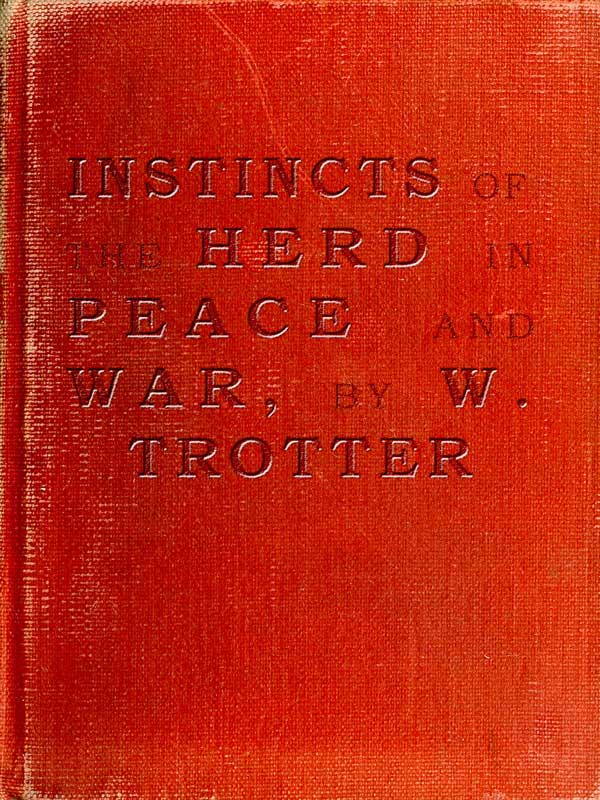
Instincts of the Herd in Peace and War
1916
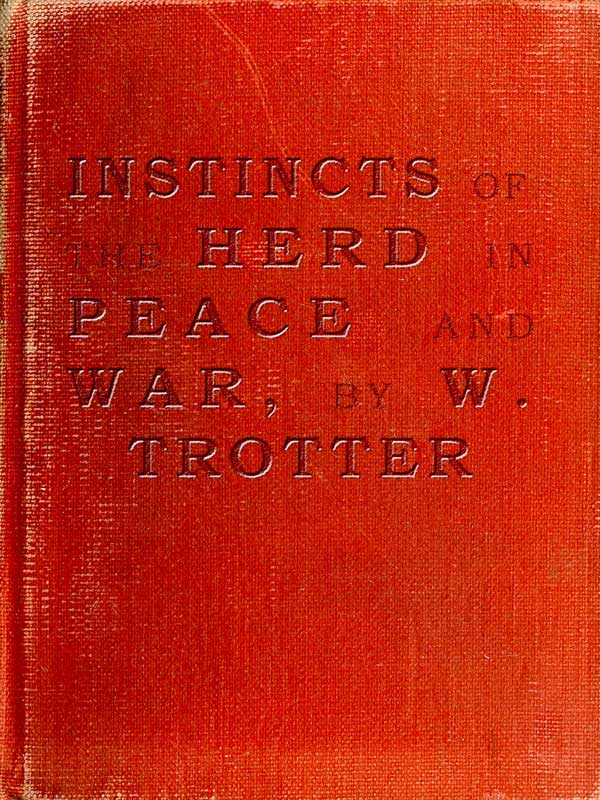
Before Trump, before Brexit, before algorithms learned to feed our tribal instincts, a British surgeon named Wilfred Trotter mapped the psychology of the crowd. Written in the trenches of 1916, this slim, ferocious book asks a question we still haven't answered: why do human beings surrender their individuality to the group, and what happens when that instinct is weaponized? Trotter builds on Gustave Le Bon to argue that gregariousness - the deep biological pull toward belonging - shapes our decisions far more than reason. In wartime, national morale becomes a matter of life and death; in peace, it determines whether societies flourish or fracture. The book offers a systematic, even clinical, examination of how social habits and collective sentiment drive behavior. One hundred years later, it reads less like a historical artifact and more like a manual for understanding our current moment. Essential for anyone trying to make sense of propaganda, polarization, and the ancient, dangerous pull of us-versus-them.
Editions
X-Ray
“It is clear at the outset that these beliefs are invariably regarded as rational and defend as such, while the position of one who hold contrary views is held to be obviously unreasonable. The religious man accuses the atheist of being shallow and irrational, and is met by a similar reply. To the Conservative the amazing thing about the Liberal is his incapacity to see reason and accept the only possible solution of public problems. Examination reveals the fact that the differences are not due to the commission of the mere mechanical fallacies of logic, since these are easily avoided, even by the politician, and since there is no reason to believe that one party in such controversies is less logical than the other. The difference is due rather to the fundamental assumptions of the antagonists being hostile, and these assumptions are derived from herd-suggestions; to the Liberal certain basal conceptions have acquired the quality of instinctive truth, have become a priori syntheses, because of the accumulated suggestions towhich he has been exposed; and a similar explanation applies the atheist, the Christian, and the Conservative. Each, it is important to remember, finds in consequence the rationality of his position flawless and is quite incapable of detecting in it the fallacies which are obvious to his opponent, to whom that particular series of assumptions has not been rendered acceptable by herd suggestion.””
— W. Trotter
“It should be observed that the mind rarely leaves uncriticized the assumptions which are forced on it by herd suggestion, the tendency being for it to find more or less elaborately rationalized justifications of them. This is in accordance with the enormously exaggerated weight which is always ascribed to reason in the formation of opinion and conduct, as is very well seen, for example, in the explanation of the existence of altruism as being due to man seeing that it "pays".””
— W. Trotter
Link to this book
Add a free, dofollow link to Lex on your blog, forum, syllabus, or reading list.

<a href="https://lex-books.com/book/instincts-of-the-herd-in-peace-and-war-6486f469-9031-48f2-a52f-5b7e34c5d805"><img src="https://lex-books.com/badges/read-on-lex.svg" alt="Read Instincts of the Herd in Peace and War by W. Trotter free on Lex" width="160" height="40"></a>[](https://lex-books.com/book/instincts-of-the-herd-in-peace-and-war-6486f469-9031-48f2-a52f-5b7e34c5d805)[url=https://lex-books.com/book/instincts-of-the-herd-in-peace-and-war-6486f469-9031-48f2-a52f-5b7e34c5d805][img]https://lex-books.com/badges/read-on-lex.svg[/img][/url]Read Instincts of the Herd in Peace and War by W. Trotter free on Lex: https://lex-books.com/book/instincts-of-the-herd-in-peace-and-war-6486f469-9031-48f2-a52f-5b7e34c5d805Cite this book
Reading this edition for a paper or guide? Copy a citation.
Trotter, W.. Instincts of the Herd in Peace and War. Lex, lex-books.com/book/instincts-of-the-herd-in-peace-and-war-6486f469-9031-48f2-a52f-5b7e34c5d805.Trotter, W. (1916). Instincts of the Herd in Peace and War. Lex. https://lex-books.com/book/instincts-of-the-herd-in-peace-and-war-6486f469-9031-48f2-a52f-5b7e34c5d805Trotter, W.. Instincts of the Herd in Peace and War. Lex. https://lex-books.com/book/instincts-of-the-herd-in-peace-and-war-6486f469-9031-48f2-a52f-5b7e34c5d805.