Feudal England: Historical Studies on the Eleventh and Twelfth Centuries
1895
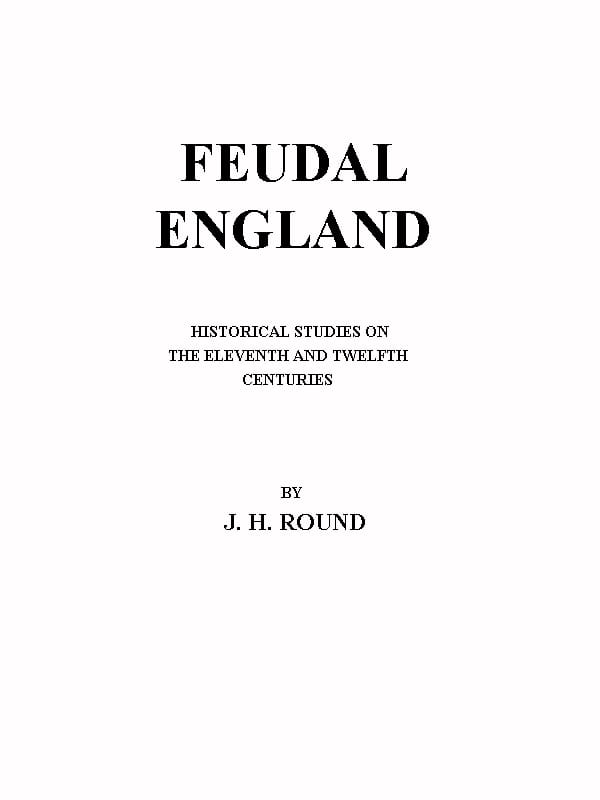
Feudal England: Historical Studies on the Eleventh and Twelfth Centuries
1895
John Horace Round was a scholar who understood that the story of Norman England had been told wrong for centuries. In these meticulous studies, first published in 1895, he returns to the original documents the chroniclers ignored: charters, Pipe Rolls, and most explosively, Domesday Book. What emerges is not the comfortable narrative of kings and battles, but a granular reconstruction of how feudalism actually worked on the ground, who held the land, and how the Norman Conquest reshaped English society at its deepest levels. Round's forensic readings of records expose errors in received wisdom that had gone unchallenged for generations. His debate with Freeman over the Battle of Hastings and the character of William the Conqueror alone makes this essential reading. For anyone who wants to move beyond the storytelling of popular medieval history to the documentary reality beneath it, these studies remain startlingly relevant.
Editions
X-Ray
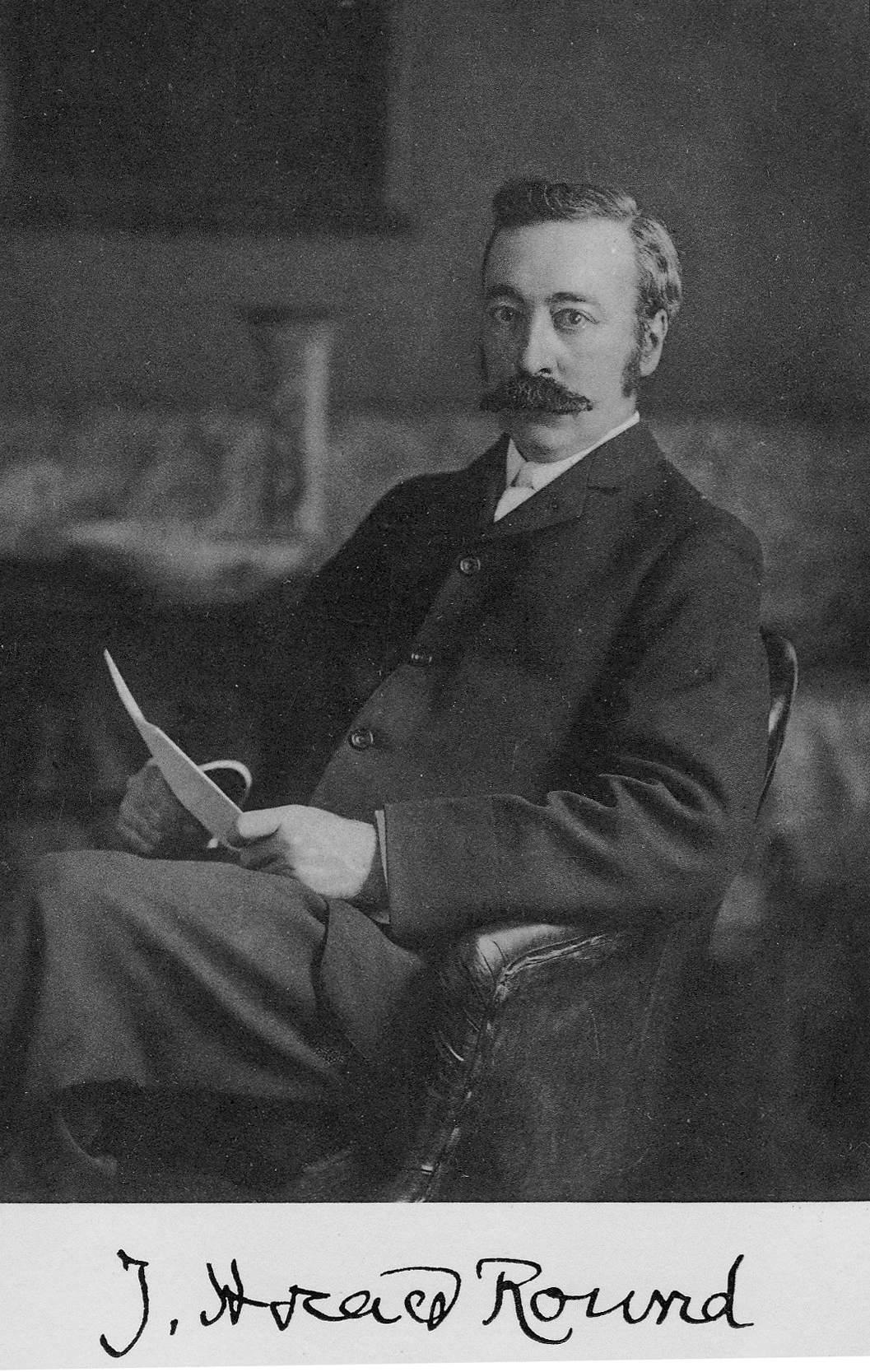
The author and historian conducting detailed analysis of medieval English records. He is methodical, critical of previous scholarship, and dedicated to establishing historical facts through careful examination of primary sources.
A prominent historian whose work Round systematically challenges for inaccuracies. Though acknowledged as having 'many and splendid gifts,' Freeman is portrayed as prone to significant errors despite his reputation for accuracy.
A distinguished legal historian studying Domesday Book. He is portrayed as generous and scholarly, offering to delay his own conclusions to avoid conflicting with Round's work.
An 18th-century antiquary who first identified the Inquisitio Comitatus Cantabrigiensis. Round champions giving Webb proper credit for this important discovery.
About Feudal England: Historical Studies on the Eleventh and Twelfth Centuries
Chapter Summaries
- Preface
- Round explains his methodology of using primary records to correct existing historical knowledge and defends his criticism of Freeman's scholarship. He outlines his discoveries about the five-hide unit system and feudal assessment methods.
- 1
- Detailed analysis of the Inquisitio Comitatus Cantabrigiensis and its relationship to Domesday Book. Round establishes the document's importance and critiques both its accuracy and that of Domesday itself.
- 2
- Round analyzes an early English financial document showing the devastating effects of the 1065 ravages in Northamptonshire and its implications for understanding Danegeld collection.
Key Themes
- Scholarly Accuracy vs. Reputation
- Round challenges the accepted authority of established historians like Freeman, arguing that reputation should not shield scholars from criticism when their work contains demonstrable errors.
- Primary Sources vs. Secondary Interpretation
- The work emphasizes the superiority of original documents and records over later interpretations, advocating for direct examination of medieval manuscripts and charters.
- Administrative Systems and Social Organization
- Round explores how Norman administrative practices transformed English society, particularly through the feudal system and land assessment methods.
Characters
- J. H. Round(protagonist)
- The author and historian conducting detailed analysis of medieval English records. He is methodical, critical of previous scholarship, and dedicated to establishing historical facts through careful examination of primary sources.
- Professor Freeman(antagonist)
- A prominent historian whose work Round systematically challenges for inaccuracies. Though acknowledged as having 'many and splendid gifts,' Freeman is portrayed as prone to significant errors despite his reputation for accuracy.
- Professor Maitland(major)
- A distinguished legal historian studying Domesday Book. He is portrayed as generous and scholarly, offering to delay his own conclusions to avoid conflicting with Round's work.
- Mr Philip Carteret Webb(major)
- An 18th-century antiquary who first identified the Inquisitio Comitatus Cantabrigiensis. Round champions giving Webb proper credit for this important discovery.
- William the Conqueror(major)
- The Norman king who ordered the Domesday Survey. He appears as the ultimate authority behind the great administrative undertaking that Round analyzes.
Link to this book
Add a free, dofollow link to Lex on your blog, forum, syllabus, or reading list.

<a href="https://lex-books.com/book/feudal-england-historical-studies-on-the-eleventh-and-twelfth-centuries-3e378437-3665-48a3-84f4-708cefa972a4"><img src="https://lex-books.com/badges/read-on-lex.svg" alt="Read Feudal England: Historical Studies on the Eleventh and Twelfth Centuries by John Horace Round free on Lex" width="160" height="40"></a>[](https://lex-books.com/book/feudal-england-historical-studies-on-the-eleventh-and-twelfth-centuries-3e378437-3665-48a3-84f4-708cefa972a4)[url=https://lex-books.com/book/feudal-england-historical-studies-on-the-eleventh-and-twelfth-centuries-3e378437-3665-48a3-84f4-708cefa972a4][img]https://lex-books.com/badges/read-on-lex.svg[/img][/url]Read Feudal England: Historical Studies on the Eleventh and Twelfth Centuries by John Horace Round free on Lex: https://lex-books.com/book/feudal-england-historical-studies-on-the-eleventh-and-twelfth-centuries-3e378437-3665-48a3-84f4-708cefa972a4Cite this book
Reading this edition for a paper or guide? Copy a citation.
Round, John Horace. Feudal England: Historical Studies on the Eleventh and Twelfth Centuries. Lex, lex-books.com/book/feudal-england-historical-studies-on-the-eleventh-and-twelfth-centuries-3e378437-3665-48a3-84f4-708cefa972a4.Round, J. H. (1895). Feudal England: Historical Studies on the Eleventh and Twelfth Centuries. Lex. https://lex-books.com/book/feudal-england-historical-studies-on-the-eleventh-and-twelfth-centuries-3e378437-3665-48a3-84f4-708cefa972a4Round, John Horace. Feudal England: Historical Studies on the Eleventh and Twelfth Centuries. Lex. https://lex-books.com/book/feudal-england-historical-studies-on-the-eleventh-and-twelfth-centuries-3e378437-3665-48a3-84f4-708cefa972a4.