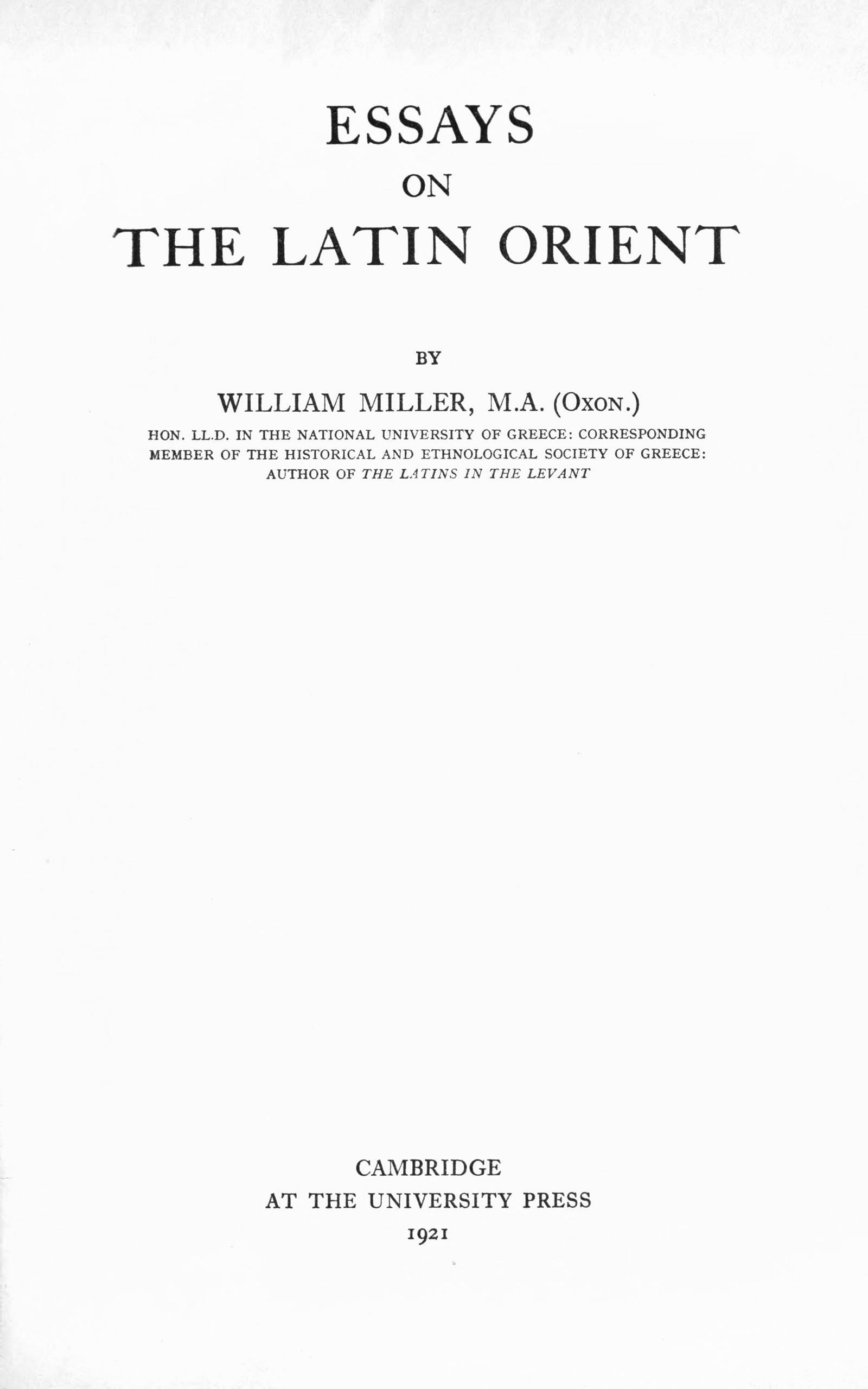
Essays on the Latin Orient
1921
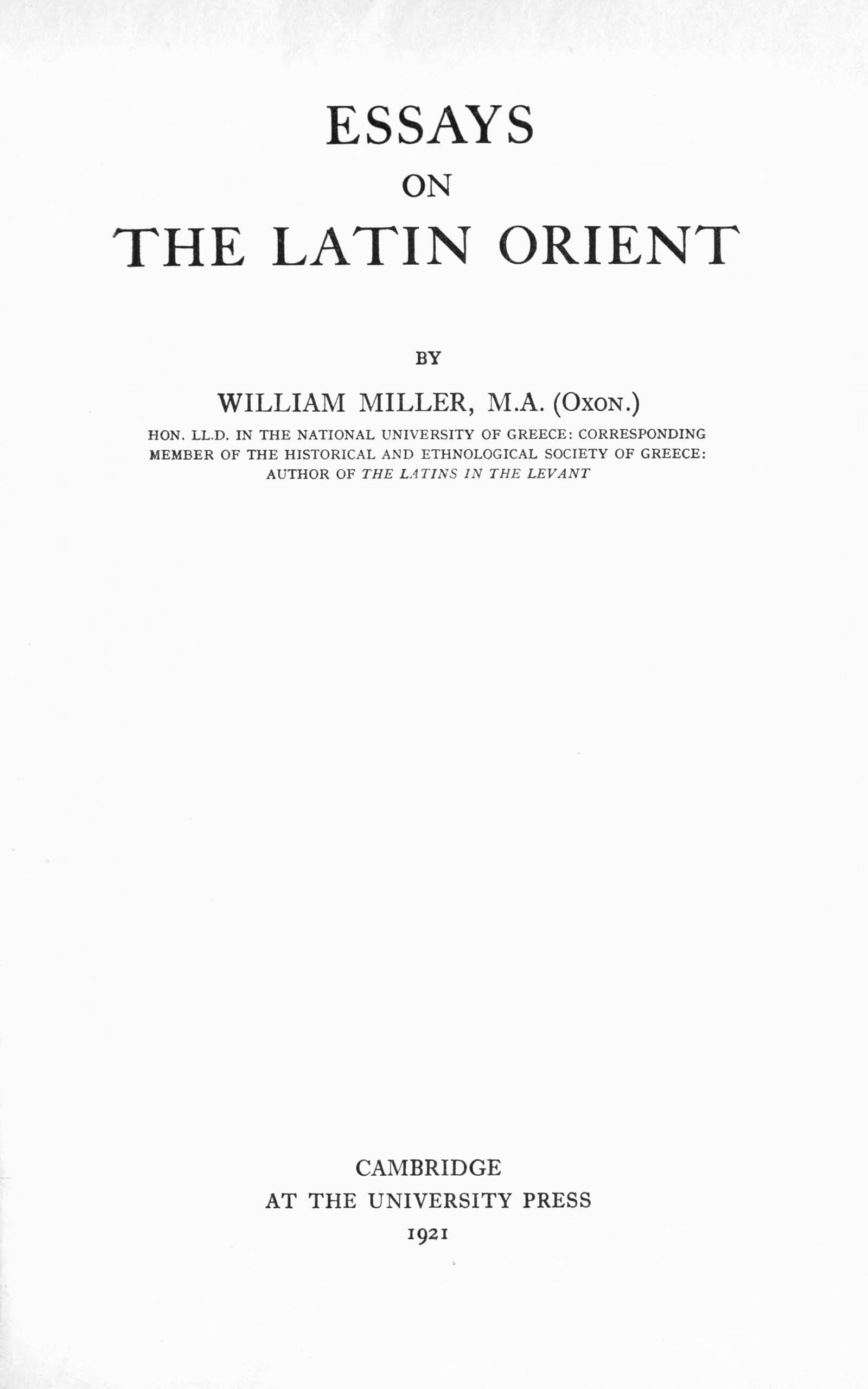
Essays on the Latin Orient
1921
The Latin Orient is a place where empires went to collide, and where Greek identity somehow survived the wreckage. William Miller's 1921 collection traces the arc of nearly two millennia: from Rome's conquest of Greece, through the centuries of Latin rule, into the shimmering Byzantine twilight and the maritime dominion of Venice. These are essays built on deep archival scholarship, rendering vivid the feuds of dukes in the Cyclades, the political intrigues of Constantinople's Purple Chamber, and the stubborn persistence of Hellenic culture under foreign heel. Miller writes with the confidence of a man who has read what few others have consulted, rescuing figures like the Mad Duke of Naxos and the formidable Anna Comnene from historical oblivion. For anyone drawn to the overlooked corridors of medieval history, those where East meets West and the result is neither, this remains an essential portal. It captures a world that shaped everything that came after, yet rarely gets told with this much particularity and verve.
Editions
X-Ray
A historian whose work 'Essays on the Latin Orient' compiles articles and monographs on the Latin Orient and Balkan history, revised and updated with recent research.
An ancient Greek historian and diplomat who successfully pleaded the cause of his countrymen at the time of the Roman conquest, known for contrasting Roman financial purity with Greek corruption.
A Roman general who besieged and took Athens in 86 B.C., destroying parts of the city and its port, Piraeus, but sparing the city's fabric for its ancient renown.
A Philhellenic Roman Emperor who visited Greece multiple times, making significant improvements to Athens, founding the Panhellenic festival, and showing great affection for Greek culture.
About Essays on the Latin Orient
Chapter Summaries
- 1
- This chapter details Greece's loss of independence after the Roman conquest in 146 B.C., covering Roman administration, the impact of civil wars (Mithridatic, Caesar vs. Pompey, Antony vs. Octavian), and early barbarian incursions. It highlights how Greece, despite suffering, retained some local liberties and continued to be a cultural center, attracting Roman students and travelers.
- 2
- This chapter covers the period from Alaric's invasion to the Latin conquest of Constantinople, focusing on the decay of classical life and the rise of new powers. It discusses Slav invasions, the controversial Fallmerayer theory of Greek depopulation, the influence of Byzantine Empresses like Eudokia and Irene, the impact of Iconoclasm, Saracen raids, and the reorganization of Greece into Themes, leading to its increasing provincialization within the Byzantine Empire.
- 3.1
- This chapter describes how the Fourth Crusade led to the partition of the Byzantine Empire and the establishment of various Latin states in Greece. It details the conquest efforts of Boniface of Montferrat, the first King of Salonika, and his companions, including Othon de la Roche and Geoffroy de Villehardouin, who carved out feudal lordships across the mainland and islands, marking the beginning of Frankish rule.
Key Themes
- Foreign Domination and Greek Resilience
- The book extensively chronicles nearly two millennia of foreign rule over Greece, from Roman conquest to the eve of modern independence. Despite successive waves of conquerors—Romans, Byzantines, Franks, Venetians, Genoese, and Turks—it highlights the enduring spirit of the Greek people, their cultural preservation, and their occasional, often desperate, acts of resistance.
- Cultural Exchange and Assimilation
- Miller explores how different ruling powers influenced Greek society, language, and customs, and conversely, how Greek culture often assimilated its conquerors. Examples include the Roman adoption of Greek letters, the Hellenization of Slavs and Venetian colonists, and the blend of Greek and Florentine elements in medieval Athens.
- Religious Conflict and Coexistence
- The narrative frequently touches upon the interplay between Orthodox Christianity, Roman Catholicism, and Islam. It details periods of persecution (e.g., Iconoclasm, Angevin intolerance), the strategic use of religious divisions by foreign powers, and instances where different faiths coexisted, sometimes uneasily, within the same communities.
Characters
- William Miller(Author)
- A historian whose work 'Essays on the Latin Orient' compiles articles and monographs on the Latin Orient and Balkan history, revised and updated with recent research.
- Polybios(Historical Figure)
- An ancient Greek historian and diplomat who successfully pleaded the cause of his countrymen at the time of the Roman conquest, known for contrasting Roman financial purity with Greek corruption.
- Sulla(Roman General)
- A Roman general who besieged and took Athens in 86 B.C., destroying parts of the city and its port, Piraeus, but sparing the city's fabric for its ancient renown.
- Hadrian(Roman Emperor)
- A Philhellenic Roman Emperor who visited Greece multiple times, making significant improvements to Athens, founding the Panhellenic festival, and showing great affection for Greek culture.
- St Paul(Apostle)
- The Apostle who visited Athens and Corinth around 54 A.D., delivering his famous speech at the Areopagus and establishing early Christian communities in Greece.
- Nero(Roman Emperor)
- A Roman Emperor who displayed his artistic talents before Greek audiences, declared Greece free from Senate jurisdiction and taxes, and initiated the digging of the Isthmus canal.
Link to this book
Add a free, dofollow link to Lex on your blog, forum, syllabus, or reading list.

<a href="https://lex-books.com/book/essays-on-the-latin-orient-b0234cc8-b50d-4918-ab6f-be343bc54fcd"><img src="https://lex-books.com/badges/read-on-lex.svg" alt="Read Essays on the Latin Orient by William Miller free on Lex" width="160" height="40"></a>[](https://lex-books.com/book/essays-on-the-latin-orient-b0234cc8-b50d-4918-ab6f-be343bc54fcd)[url=https://lex-books.com/book/essays-on-the-latin-orient-b0234cc8-b50d-4918-ab6f-be343bc54fcd][img]https://lex-books.com/badges/read-on-lex.svg[/img][/url]Read Essays on the Latin Orient by William Miller free on Lex: https://lex-books.com/book/essays-on-the-latin-orient-b0234cc8-b50d-4918-ab6f-be343bc54fcdCite this book
Reading this edition for a paper or guide? Copy a citation.
Miller, William. Essays on the Latin Orient. Lex, lex-books.com/book/essays-on-the-latin-orient-b0234cc8-b50d-4918-ab6f-be343bc54fcd.Miller, W. (1921). Essays on the Latin Orient. Lex. https://lex-books.com/book/essays-on-the-latin-orient-b0234cc8-b50d-4918-ab6f-be343bc54fcdMiller, William. Essays on the Latin Orient. Lex. https://lex-books.com/book/essays-on-the-latin-orient-b0234cc8-b50d-4918-ab6f-be343bc54fcd.