Desert, Further Studies in Natural Appearances
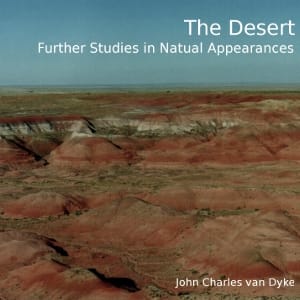
In 1901, an art historian stood in the American Southwest and saw something no one before him had seen: sublimity in what others called wasteland. John Charles van Dyke was not the first to visit the desert, but he was perhaps the first to truly look at it, to find in its lonely desolation a beauty that the previous generations had dismissed as worthless. He writes of the changing colors of sky, hills, and sand, of mirages that shimmer at the edges of perception, of cacti and greasewood and the winged life that animates these harsh plains. His conservationist argument feels distinctly modern: "The deserts should never be reclaimed. They are the breathing spaces of the west and should be preserved forever." This is not a travel guide or a naturalist's catalog. It is a philosophical meditation on looking, on learning to see what has always been there but never noticed. For readers who have ever stood in a landscape others called empty and felt, against all reason, that they were in the presence of something vast.
Editions

Link to this book
Add a free, dofollow link to Lex on your blog, forum, syllabus, or reading list.

<a href="https://lex-books.com/book/desert-further-studies-in-natural-appearances-166c65c8-2edb-4943-a926-27fee92ef00e"><img src="https://lex-books.com/badges/read-on-lex.svg" alt="Read Desert, Further Studies in Natural Appearances by John Charles van Dyke free on Lex" width="160" height="40"></a>[](https://lex-books.com/book/desert-further-studies-in-natural-appearances-166c65c8-2edb-4943-a926-27fee92ef00e)[url=https://lex-books.com/book/desert-further-studies-in-natural-appearances-166c65c8-2edb-4943-a926-27fee92ef00e][img]https://lex-books.com/badges/read-on-lex.svg[/img][/url]Read Desert, Further Studies in Natural Appearances by John Charles van Dyke free on Lex: https://lex-books.com/book/desert-further-studies-in-natural-appearances-166c65c8-2edb-4943-a926-27fee92ef00eCite this book
Reading this edition for a paper or guide? Copy a citation.
Dyke, John Charles van. Desert, Further Studies in Natural Appearances. Lex, lex-books.com/book/desert-further-studies-in-natural-appearances-166c65c8-2edb-4943-a926-27fee92ef00e.Dyke, J. C. V. (n.d.). Desert, Further Studies in Natural Appearances. Lex. https://lex-books.com/book/desert-further-studies-in-natural-appearances-166c65c8-2edb-4943-a926-27fee92ef00eDyke, John Charles van. Desert, Further Studies in Natural Appearances. Lex. https://lex-books.com/book/desert-further-studies-in-natural-appearances-166c65c8-2edb-4943-a926-27fee92ef00e.