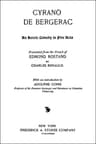
Cyrano De Bergerac
1898
Cyrano de Bergerac is a brilliant poet, fearsome swordsman, and devastating wit who believes himself unlovable because of his enormous nose. When the beautiful Roxane falls for the handsome but tongue-tied Christian, Cyrano makes an extraordinary sacrifice: he will compose the words Christian speaks to win her heart, effectively giving away the very eloquence he might use to declare his own love. What unfolds is a tragicomedy of errors, where the man with the most beautiful words in France cannot use them for himself, and a woman falls in love with a voice without knowing its true owner. Rostand's 1897 masterpiece is at once a celebration of wit and courage, a piercing examination of how we judge ourselves and others, and a devastating portrait of love too noble for its own good. The play crackles with swordfights, wordplay, and poetry, yet builds toward an ending that will break you. It endures because it captures something universal: the fear that we are unworthy of what we desire, and the terrible grace of loving someone enough to want their happiness even without us.
Editions
X-Ray
“A kiss is a secret which takes the lips for the ear.””
— Edmond Rostand
“A great nose may be an indexOf a great soul””
— Edmond Rostand
“My heart always timidly hides itself behind my mind. I set out to bring down stars from the sky, then, for fear of ridicule, I stop and pick little flowers of eloquence.””
— Edmond Rostand
“All our souls are written in our eyes.””
— Edmond Rostand
“I have a different idea of elegance. I don't dress like a fop, it's true, but my moral grooming is impeccable. I never appear in public with a soiled conscience, a tarnished honor, threadbare scruples, or an insult that I haven't washed away. I'm always immaculately clean, adorned with independence and frankness. I may not cut a stylish figure, but I hold my soul erect. I wear my deeds as ribbons, my wit is sharper then the finest mustache, and when I walk among men I make truths ring like spurs.””
— Edmond Rostand
“And what is a kiss, specifically? A pledge properly sealed, a promise seasoned to taste, a vow stamped with the immediacy of a lip, a rosy circle drawn around the verb 'to love.' A kiss is a message too intimate for the ear, infinity captured in the bee's brief visit to a flower, secular communication with an aftertaste of heaven, the pulse rising from the heart to utter its name on a lover's lip: 'Forever.””
— Edmond Rostand
“I-I am going to be a storm-a flame-I need to fight whole armies alone;I have ten hearts; I have a hundred arms;I feel too strong to war with mortals-BRING ME GIANTS!””
— Edmond Rostand
“...But...to sing,to dream, to smile, to walk, to be alone, be free,with a voice that stirs and an eye that still can see!To cock your hat to one side, when you pleaseat a yes, a no, to fight, or- make poetry!To work without a thought of fame or fortune,on that journey, that you dream of, to the moon!Never to write a line that's not your own...””
— Edmond Rostand
“My soul, be satisfied with flowers,With fruit, with weeds even; but gather themIn the one garden you may call your own.””
— Edmond Rostand
Link to this book
Add a free, dofollow link to Lex on your blog, forum, syllabus, or reading list.

<a href="https://lex-books.com/book/cyrano-de-bergerac-da4743ef-f535-48b7-9236-16adc243ed2b"><img src="https://lex-books.com/badges/read-on-lex.svg" alt="Read Cyrano De Bergerac by Edmond Rostand free on Lex" width="160" height="40"></a>[](https://lex-books.com/book/cyrano-de-bergerac-da4743ef-f535-48b7-9236-16adc243ed2b)[url=https://lex-books.com/book/cyrano-de-bergerac-da4743ef-f535-48b7-9236-16adc243ed2b][img]https://lex-books.com/badges/read-on-lex.svg[/img][/url]Read Cyrano De Bergerac by Edmond Rostand free on Lex: https://lex-books.com/book/cyrano-de-bergerac-da4743ef-f535-48b7-9236-16adc243ed2bCite this book
Reading this edition for a paper or guide? Copy a citation.
Rostand, Edmond. Cyrano De Bergerac. Lex, lex-books.com/book/cyrano-de-bergerac-da4743ef-f535-48b7-9236-16adc243ed2b.Rostand, E. (1898). Cyrano De Bergerac. Lex. https://lex-books.com/book/cyrano-de-bergerac-da4743ef-f535-48b7-9236-16adc243ed2bRostand, Edmond. Cyrano De Bergerac. Lex. https://lex-books.com/book/cyrano-de-bergerac-da4743ef-f535-48b7-9236-16adc243ed2b.