An Essay Towards a New Theory of Vision
1709
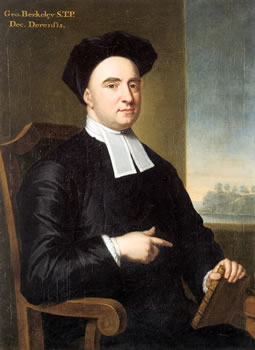
What you see is not what you get. That's the daring claim at the heart of this revolutionary treatise, written by a 23-year-old philosopher who would go on to become one of the most influential thinkers in Western philosophy. George Berkeley argues that when you look at a mountain in the distance, you don't actually perceive its distance, you infer it. Distance itself is invisible. What you see is just a faint blur, a certain quality of blueness. Your mind fills in the rest through experience. This is the inverse square law of perception: the farther something is, the smaller and blurrier the image on your retina, but we somehow translate these retinal signals into a three-dimensional world. Berkeley's radical insight is that this translation isn't automatic or mathematical, it is learned. We come to associate certain visual experiences with tangible distance through repeated interaction with the physical world. Berkeley illustrates this with a famous thought experiment: imagine someone born blind who suddenly gains sight. What would they see? Not the orderly 3D world we take for granted, but a flat, confusing blur of colors with no meaning. Only through touch and movement would they learn to interpret what their eyes reveal. This critique of the then-dominant mathematical theories of vision laid the groundwork for empirical philosophy and poses questions that still haunt contemporary debates about perception, consciousness, and the gap between what exists and what we experience.
Editions
Link to this book
Add a free, dofollow link to Lex on your blog, forum, syllabus, or reading list.

<a href="https://lex-books.com/book/an-essay-towards-a-new-theory-of-vision-1cc40fb2-1221-409e-846f-88966a2705aa"><img src="https://lex-books.com/badges/read-on-lex.svg" alt="Read An Essay Towards a New Theory of Vision by George Berkeley free on Lex" width="160" height="40"></a>[](https://lex-books.com/book/an-essay-towards-a-new-theory-of-vision-1cc40fb2-1221-409e-846f-88966a2705aa)[url=https://lex-books.com/book/an-essay-towards-a-new-theory-of-vision-1cc40fb2-1221-409e-846f-88966a2705aa][img]https://lex-books.com/badges/read-on-lex.svg[/img][/url]Read An Essay Towards a New Theory of Vision by George Berkeley free on Lex: https://lex-books.com/book/an-essay-towards-a-new-theory-of-vision-1cc40fb2-1221-409e-846f-88966a2705aaCite this book
Reading this edition for a paper or guide? Copy a citation.
Berkeley, George. An Essay Towards a New Theory of Vision. Lex, lex-books.com/book/an-essay-towards-a-new-theory-of-vision-1cc40fb2-1221-409e-846f-88966a2705aa.Berkeley, G. (1709). An Essay Towards a New Theory of Vision. Lex. https://lex-books.com/book/an-essay-towards-a-new-theory-of-vision-1cc40fb2-1221-409e-846f-88966a2705aaBerkeley, George. An Essay Towards a New Theory of Vision. Lex. https://lex-books.com/book/an-essay-towards-a-new-theory-of-vision-1cc40fb2-1221-409e-846f-88966a2705aa.