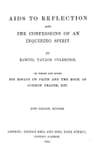
AIDS to Reflection; And, the Confessions of an Inquiring Spirit
1825
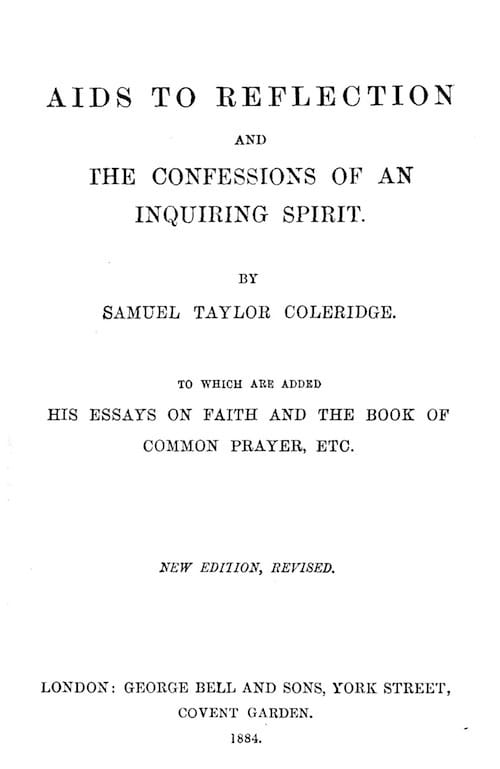
AIDS to Reflection; And, the Confessions of an Inquiring Spirit
1825
Samuel Taylor Coleridge wrote this book near the end of his life, when he had become one of the most intellectually restless minds in England. It is partly a philosophical treatise, partly a confession, and wholly an act of courage: an attempt to think honestly about faith without surrendering either the intellect or the soul. Coleridge distinguishes between reason (the faculty that grasps principles) and understanding (the faculty that manages facts), arguing that both are necessary for genuine spiritual comprehension. The "Confessions" section turns autobiographical, tracing his own tortured journey through doubt and belief, his horror at doctrinal rigidity and his equal horror at spiritual emptiness. He writes for the reader who cannot simply believe, who demands to understand why they believe, and who suspects that this very demand might itself be a form of faith. This is not comfortable devotional literature. It is a book written by a man who knew the danger of unexamined belief and the equal danger of belief unexamined. Two centuries later, Coleridge's wrestling remains startlingly contemporary.
Editions
X-Ray
“It is a dull and obtuse mind, that must divide in order to distinguish; but it is a still worse that distinguishes in order to divide.””
— Samuel Taylor Coleridge
Link to this book
Add a free, dofollow link to Lex on your blog, forum, syllabus, or reading list.

<a href="https://lex-books.com/book/aids-to-reflection-and-the-confessions-of-an-inquiring-spirit-92d6e2ef-13a0-449d-8b6f-d5ff61bd8082"><img src="https://lex-books.com/badges/read-on-lex.svg" alt="Read AIDS to Reflection; And, the Confessions of an Inquiring Spirit by Samuel Taylor Coleridge free on Lex" width="160" height="40"></a>[](https://lex-books.com/book/aids-to-reflection-and-the-confessions-of-an-inquiring-spirit-92d6e2ef-13a0-449d-8b6f-d5ff61bd8082)[url=https://lex-books.com/book/aids-to-reflection-and-the-confessions-of-an-inquiring-spirit-92d6e2ef-13a0-449d-8b6f-d5ff61bd8082][img]https://lex-books.com/badges/read-on-lex.svg[/img][/url]Read AIDS to Reflection; And, the Confessions of an Inquiring Spirit by Samuel Taylor Coleridge free on Lex: https://lex-books.com/book/aids-to-reflection-and-the-confessions-of-an-inquiring-spirit-92d6e2ef-13a0-449d-8b6f-d5ff61bd8082Cite this book
Reading this edition for a paper or guide? Copy a citation.
Coleridge, Samuel Taylor. AIDS to Reflection; And, the Confessions of an Inquiring Spirit. Lex, lex-books.com/book/aids-to-reflection-and-the-confessions-of-an-inquiring-spirit-92d6e2ef-13a0-449d-8b6f-d5ff61bd8082.Coleridge, S. T. (1825). AIDS to Reflection; And, the Confessions of an Inquiring Spirit. Lex. https://lex-books.com/book/aids-to-reflection-and-the-confessions-of-an-inquiring-spirit-92d6e2ef-13a0-449d-8b6f-d5ff61bd8082Coleridge, Samuel Taylor. AIDS to Reflection; And, the Confessions of an Inquiring Spirit. Lex. https://lex-books.com/book/aids-to-reflection-and-the-confessions-of-an-inquiring-spirit-92d6e2ef-13a0-449d-8b6f-d5ff61bd8082.