A Mechanical Account of Poisons in Several Essays
1702
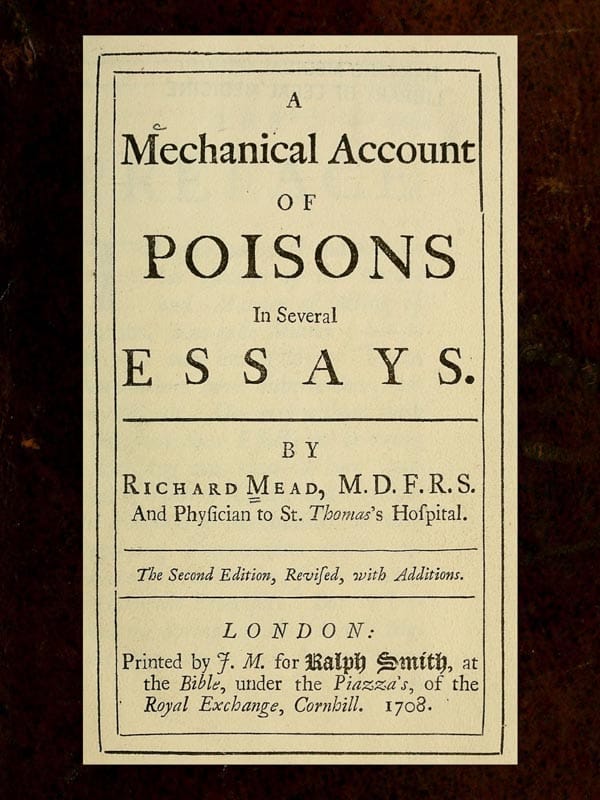
A Mechanical Account of Poisons in Several Essays
1702
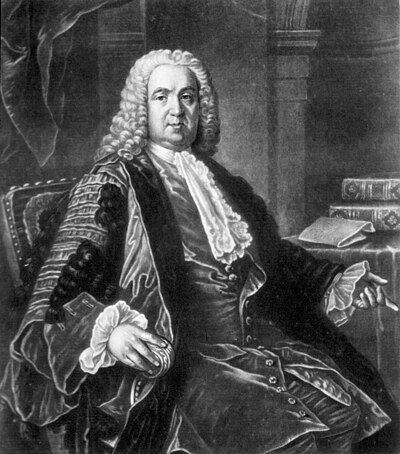
In 1702, physician Richard Mead set out to do something radical: explain poison through reason rather than superstition. This collection of essays tackles one of nature's most terrifying phenomena, examining how venoms act upon the human body through what Mead calls "mechanical" principles. The centerpiece is his exhaustive study of the viper: its deadly bite, the swift cascade of symptoms it produces, and the desperate search for antidotes. Mead dissects the creature both as a biological specimen and as a symbol that has haunted human imagination for millennia. He challenges the mystical associations surrounding serpents, arguing instead that venom serves a clear survival purpose. The text captures a pivotal moment in scientific history, when scholars were beginning to reject occult explanations in favor of observable mechanisms. This is not merely a medical curiosity but a window into how Enlightenment thinking transformed our understanding of the natural world, one venomous bite at a time.
Editions
Link to this book
Add a free, dofollow link to Lex on your blog, forum, syllabus, or reading list.

<a href="https://lex-books.com/book/a-mechanical-account-of-poisons-in-several-essays-4ed79224-f8b0-4a2b-895b-e1fc1e5d3676"><img src="https://lex-books.com/badges/read-on-lex.svg" alt="Read A Mechanical Account of Poisons in Several Essays by Richard Mead free on Lex" width="160" height="40"></a>[](https://lex-books.com/book/a-mechanical-account-of-poisons-in-several-essays-4ed79224-f8b0-4a2b-895b-e1fc1e5d3676)[url=https://lex-books.com/book/a-mechanical-account-of-poisons-in-several-essays-4ed79224-f8b0-4a2b-895b-e1fc1e5d3676][img]https://lex-books.com/badges/read-on-lex.svg[/img][/url]Read A Mechanical Account of Poisons in Several Essays by Richard Mead free on Lex: https://lex-books.com/book/a-mechanical-account-of-poisons-in-several-essays-4ed79224-f8b0-4a2b-895b-e1fc1e5d3676Cite this book
Reading this edition for a paper or guide? Copy a citation.
Mead, Richard. A Mechanical Account of Poisons in Several Essays. Lex, lex-books.com/book/a-mechanical-account-of-poisons-in-several-essays-4ed79224-f8b0-4a2b-895b-e1fc1e5d3676.Mead, R. (1702). A Mechanical Account of Poisons in Several Essays. Lex. https://lex-books.com/book/a-mechanical-account-of-poisons-in-several-essays-4ed79224-f8b0-4a2b-895b-e1fc1e5d3676Mead, Richard. A Mechanical Account of Poisons in Several Essays. Lex. https://lex-books.com/book/a-mechanical-account-of-poisons-in-several-essays-4ed79224-f8b0-4a2b-895b-e1fc1e5d3676.