
Richard Cantillon
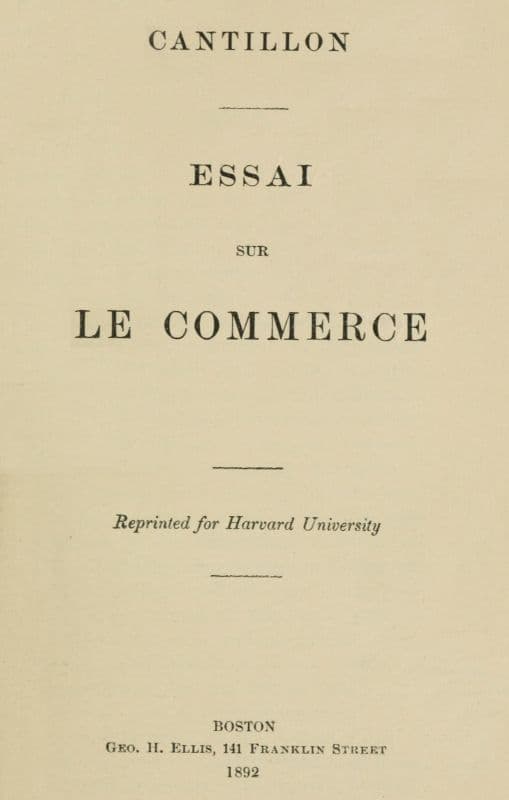
Richard Cantillon was an influential Irish-French economist and author, best known for his seminal work, 'Essai sur le commerce'. Born in the late 17th century, Cantillon's writings laid the groundwork for modern economic theory, particularly in the areas of entrepreneurship and market dynamics. His 'Essai', written in the early 18th century, presented a comprehensive analysis of economic principles, including the role of the entrepreneur in the economy and the importance of supply and demand. Cantillon's insights into the nature of wealth and the functioning of markets were groundbreaking, making him a precursor to later economists such as Adam Smith and Jean-Baptiste Say. Despite the limited recognition during his lifetime, Cantillon's ideas gained prominence posthumously, influencing the development of classical economics. His work is characterized by a systematic approach to economic phenomena, emphasizing the interconnectedness of various economic agents. Cantillon's legacy endures as a foundational figure in economic thought, whose theories continue to resonate in contemporary discussions on entrepreneurship and market behavior.
Famous Quotes
View all 7 quotes“(...) all the inhabitants of a state are dependent. They can be divided into two classes, entrepreneurs and hired workers. The entrepreneurs are on unfixed wages while the others are on fixed wages as long as there is work, although their functions and ranks may be very unequal. The general who has his pay, the courtier his pension and the domestic servant who has wages, all fall into this last class. All the others are entrepreneurs, whether they are set up with capital to conduct their enterprise, or are entrepreneurs of their own labor without capital, and they may be regarded as living under uncertainty; even the beggars and the robbers are entrepreneurs of this class. Finally all the inhabitants of a state derive their living and their advantages from the property of the landowners and are dependent.””
“If the property owners had the desire to increase the population they would encourage peasants to marry young and raise children by promising to provide them with subsistence, devoting the land entirely to that purpose, and they would doubtless increase the population up to the point that the land could support, according to the products allotted for each person, whether those of an acre and a half, or four to five acres.But if instead, the prince, or the property owners, made them use the land for other purposes than the upkeep of the people...””
“(...) if the [native] Americans, who did not make use of iron before the discovery of their continent, had found mines and had known how to use it, there is little doubt that they would have labored to produce it whatever the cost.””
Books from the author





Link to this page
Add a free, dofollow link to Lex on your blog, forum, syllabus, or reading list.

<a href="https://lex-books.com/author/richard-cantillon"><img src="https://lex-books.com/badges/read-on-lex.svg" alt="Richard Cantillon on Lex" width="160" height="40"></a>[](https://lex-books.com/author/richard-cantillon)[url=https://lex-books.com/author/richard-cantillon][img]https://lex-books.com/badges/read-on-lex.svg[/img][/url]Richard Cantillon on Lex: https://lex-books.com/author/richard-cantillon