
Bernhard Marks
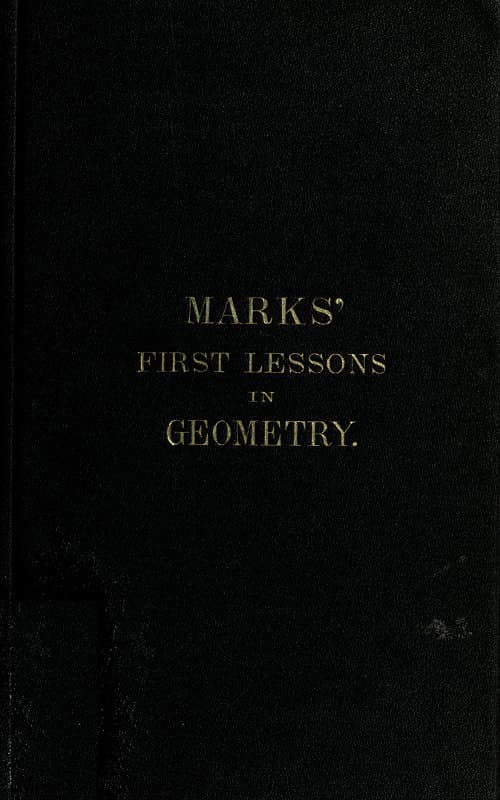
Bernhard Marks was an influential educator and author known for his contributions to mathematical pedagogy in the 19th century. His notable work, 'Marks' First Lessons in Geometry,' was designed specifically for primary classes in grammar schools and academies, reflecting his commitment to making complex subjects accessible to young learners. The book, presented in two parts, aimed to provide a clear and objective introduction to geometric concepts, emphasizing the importance of foundational knowledge in mathematics. Marks' educational philosophy was rooted in the belief that a strong grasp of geometry was essential for students' overall academic development. His works not only served as instructional materials but also contributed to the broader discourse on educational methods during a time when formal education was evolving rapidly. Through his writings, Marks played a significant role in shaping the way geometry was taught, making him a notable figure in the field of educational literature and mathematics instruction.
Famous Quotes
View all 3 quotes“I made him look at my showpiece, a straight-edged Egyptian stamp with a pyramid that was listed in the catalog for four hundred marks. He shrugged. If I cared that much about my collection, maybe I should hang on to it. Was I even allowed to be selling it? What did my parents say about it? I tried to bargain. If the stamp with the pyramid wasn’t that valuable, I would just keep it. Then he could only give me thirty marks. So the stamp with the pyramid was valuable after all? In the end I got seventy marks. I felt cheated, but I didn’t care.””
“Hanna turned around and looked at me. Her eyes found me at once, and I realized that she had known the whole time I was there. She just looked at me. Her face didn’t ask for anything, beg for anything, assure me of anything or promise anything. It simply presented itself. I saw how tense and exhausted she was. She had circles under her eyes, and on each cheek a line that ran from top to bottom that I’d never seen before, that weren’t yet deep, but already marked her like scars. When I turned red under her gaze, she turned away and back to the judges’ bench.””
“Flight is not concerned with the past, but flight is the conscious concentration on the present and the future, a concentration that is blind to the legacy of the past that leaves a mark on us and with which we have to live.””
Books from the author


Link to this page
Add a free, dofollow link to Lex on your blog, forum, syllabus, or reading list.

<a href="https://lex-books.com/author/bernhard-marks"><img src="https://lex-books.com/badges/read-on-lex.svg" alt="Bernhard Marks on Lex" width="160" height="40"></a>[](https://lex-books.com/author/bernhard-marks)[url=https://lex-books.com/author/bernhard-marks][img]https://lex-books.com/badges/read-on-lex.svg[/img][/url]Bernhard Marks on Lex: https://lex-books.com/author/bernhard-marks