“Jane Austen, who is said to be Shakespearian, never reminds us of Shakespeare, I think, in her full-dress portraits, but she does so in characters such as Miss Bates and Mrs. Allen.””
Quotes by A. C. Bradley
“I pity, approve, respect, admire her, but I neither desire her company, nor am greatly concerned about her destiny, and she makes me impatient at moments when I doubt if she was meant to.””
“His fate affects the welfare of a whole nation or empire; and when he falls suddenly from the height of earthly greatness to the dust, his fall produces a sense of contrast, of the powerlessness of man, and of the omnipotence”
“The nature of a work of art is to be not a part, nor yet a copy of the real world but a world in itself, independent, complete, autonomous; and to possess it fully you must enter that world, conform to its laws, and ignore for a time the beliefs, aims, and particular conditions which belong to you in the other world of reality.””
“In Shakespearean tragedy the main source of the convulsion which produces suffering and death is never good: good contributes to this convulsion only from its tragic implication with its opposite in one and the same character. The main source, on the contrary, is in every case evil; and, what is more (though this seems to have been little noticed), it is in almost every case evil in the fullest sense, not mere imperfection but plain moral evil. The love of Romeo and Juliet conducts them to death only because of the senseless hatred of their houses. Guilty ambition, seconded by diabolic malice and issuing in murder, opens the action in Macbeth. Iago is the main source of the convulsion in Othello; Goneril, Regan and Edmund in King Lear. Even when this plain moral evil is not the obviously prime source within the play, it lies behind it: the situation with which Hamlet has to deal has been formed by adultery and murder. Julius Caesar is the only tragedy in which one is even tempted to find an exception to this rule. And the inference is obvious. If it is chiefly evil that violently disturbs the order of the world, this order cannot be friendly to evil or indifferent between evil and good, any more than a body which is convulsed by poison is friendly to it or indifferent to the distinction between poison and food.””
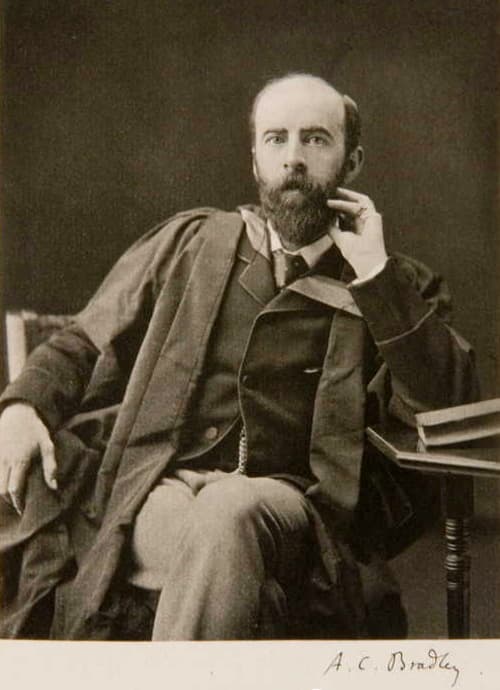 A. C. Bradley
A. C. Bradley was a prominent English literary scholar and critic, best known for his influential work on Shakespeare. Born in 1851, he was educated at Oxford, where he developed a deep appreciation f...